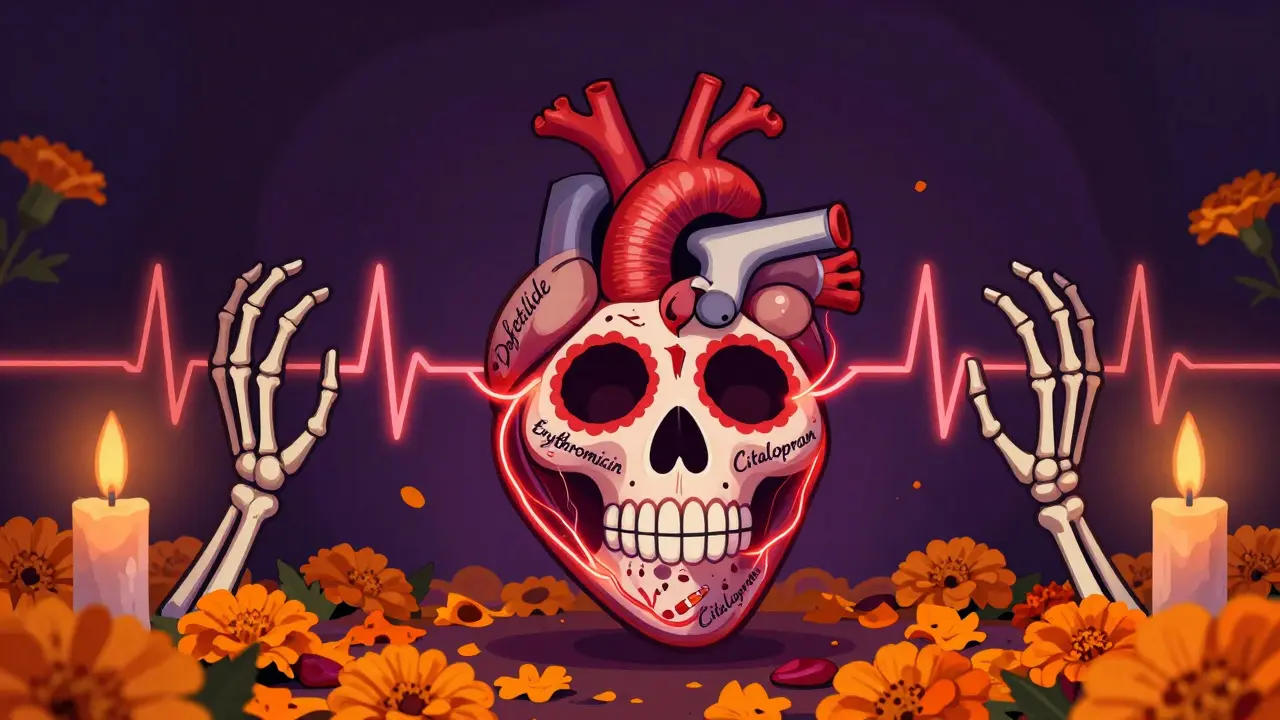
QT Prolongation Risk Assessment Tool
This tool helps you assess your risk of QT prolongation from medications based on key factors discussed in the article. Input your current information to calculate your personalized risk level.
Your Current Health Factors
Medications
Select medications you're currently taking. Some medications increase QT risk significantly.
Risk increases with dose above 40 mg/day
Dangerous in bradycardia due to reverse use dependence
Antibiotic risk increases with low potassium
Risk increases 5x with CYP3A4 inhibitors like fluconazole
Minimal risk compared to other antibiotics
Safer alternative to citalopram
When you take a new medication, you expect it to help-not to put your heart at risk. But for some drugs, even a normal dose can trigger a silent, deadly chain reaction: QT prolongation. This isn’t a rare edge case. It’s a well-documented, life-threatening side effect linked to over 100 common prescriptions. And the danger doesn’t always show up in symptoms. Sometimes, the first sign is sudden cardiac death.
What QT Prolongation Actually Means
QT prolongation is a change in your heart’s electrical timing, visible on an ECG. It’s measured from the start of the Q wave to the end of the T wave-the time it takes your ventricles to reset after each beat. When this interval gets too long, your heart’s electrical system becomes unstable. That’s when Torsades de Pointes (TdP), a dangerous type of irregular heartbeat, can kick in. TdP can spiral into ventricular fibrillation-and then, sudden death.
The numbers don’t lie. A QTc (corrected QT interval) above 450 ms in men or 470 ms in women is considered prolonged. But the real red flag? When it jumps over 500 ms, or increases by more than 60 ms from your baseline. At that point, your risk of sudden cardiac death rises sharply. According to the ARIC study, every one standard deviation increase in T-wave duration (a key part of the QT interval) raises your risk by 21%.
Which Medications Are the Biggest Culprits?
Not all QT-prolonging drugs are created equal. Some are high-risk by design, others are dangerous only under certain conditions.
Class III antiarrhythmics like dofetilide and sotalol are built to prolong repolarization-and they do it well. Dofetilide causes TdP in about 3.3% of patients at standard doses. Sotalol is worse at slow heart rates because of something called reverse use dependence: the slower your heart beats, the more it prolongs the QT interval. That’s why it’s dangerous in people with bradycardia or heart block.
Antibiotics are another hidden threat. Moxifloxacin can stretch your QTc by 6 to 15 milliseconds on average. Compare that to ciprofloxacin, which barely moves the needle-0 to 5 ms. And then there’s erythromycin. A 2006 study of 1.2 million Medicaid patients found it doubled the risk of sudden cardiac death. But when taken with a CYP3A4 inhibitor like clarithromycin or fluconazole? Risk jumps fivefold.
Antidepressants vary widely too. Citalopram at 40 mg daily adds about 8.5 ms to QTc. But escitalopram, its closer cousin, only adds 4.2 ms at the same dose. That’s why many doctors now prefer escitalopram for patients with heart risks.
It’s Not Just the Drug-It’s the Combo
Most cases of drug-induced TdP don’t happen because of one pill. They happen because of a perfect storm.
Three things stack up:
- **A QT-prolonging drug**
- **An electrolyte imbalance**-especially low potassium (hypokalemia) or low magnesium
- **A drug interaction** that slows down how your body clears the medication
For example, if you’re on citalopram and also take a common antifungal like fluconazole (which blocks CYP3A4), your citalopram levels spike. That’s when QTc can jump from 460 ms to 520 ms overnight. The University of Michigan’s QT Clinician Toolkit found that correcting low potassium (target >4.0 mEq/L) cuts risk by 62%. Avoiding CYP3A4 inhibitors? That drops risk by 78%.
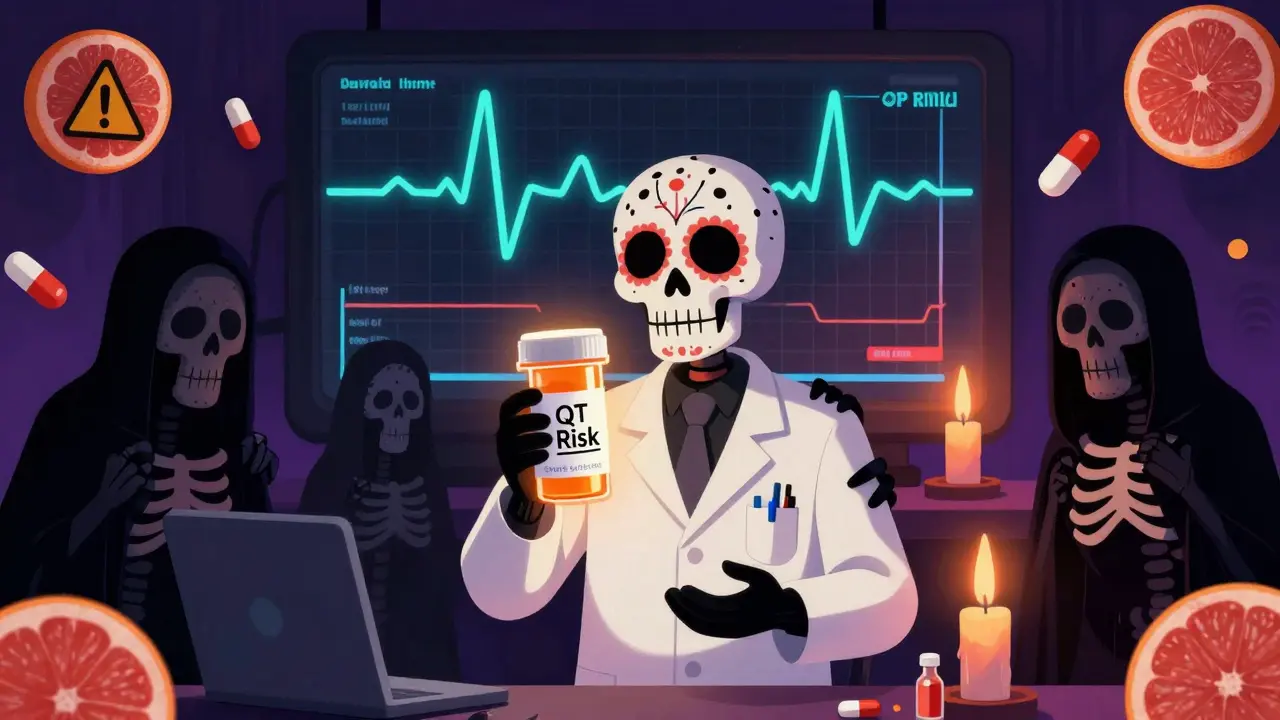
And it’s not just prescriptions. Some OTC drugs and supplements can do this too. Echinacea, for instance, can interfere with liver enzymes. Even grapefruit juice can amplify the effect of certain meds.
Who’s Most at Risk?
It’s not just the elderly. Though older adults are more vulnerable, the real danger zone is anyone with:
- Heart disease-especially heart failure or prior heart attack
- Low potassium or magnesium
- Slow heart rate (bradycardia)
- Female gender (women have longer baseline QT intervals)
- Genetic predisposition-like congenital long QT syndrome
- Multiple QT-prolonging drugs
Here’s the scary part: the American Heart Association says structural heart disease multiplies the risk of drug-induced arrhythmias by 10 to 100 times. So if you have heart failure and take a QT-prolonging antibiotic? You’re not just at risk-you’re in a high-risk category.
And it’s not just about one drug. In people over 65, the average number of prescriptions is 7.8. One in three older adults is on at least one QT-prolonging medication. That’s why polypharmacy is such a silent killer.
Why ECG Alerts Are Often Wrong (and What to Do Instead)
Many hospitals have automated ECG systems that flag high QTc values. At Mayo Clinic, this system cut dangerous prescriptions by 37%. But elsewhere? It’s chaos.
One 2022 JAMIA study found that 78% of QTc alerts in a typical hospital were false positives. Residents get so used to ignoring them that they stop paying attention. That’s alarm fatigue-and it’s deadly.
So what’s the fix? Don’t rely on alerts alone. Use a simple 3-step screening process recommended by the UK’s MHRA:
- Check your baseline QTc. If it’s already over 450 (men) or 470 (women), think twice before adding a new drug.
- Check electrolytes. Low potassium? Fix it before prescribing.
- Check for interactions. Use tools like AZCERT.org, which rates 212 medications by risk level (Known, Possible, Conditional).
And if you’re unsure? Ask for a cardiology consult. You don’t need a specialist to read every ECG-but you do need one to weigh the real risk in complex cases.
The Bigger Picture: When QT Prolongation Isn’t the Real Problem
Here’s a twist: not every sudden cardiac death linked to a QT-prolonging drug is actually caused by the arrhythmia.
The POST SCD study found that 78% of patients who died suddenly while on these drugs had no evidence of arrhythmia at autopsy. Their deaths were from heart failure, stroke, or other non-arrhythmic causes. That’s why Dr. Dan M. Roden from Vanderbilt says: “The link between QT prolongation and sudden death is more complex than we thought.”
This matters because doctors sometimes stop life-saving meds-like antidepressants or antipsychotics-just because QTc went up a little. But if the patient has severe depression or schizophrenia, stopping the drug might kill them faster than the QT prolongation would.
The European Heart Rhythm Association warns that overemphasizing QT prolongation has led to 15-20% of heart failure patients being taken off effective drugs-increasing their risk of death from their original condition.
What’s Changing Now?
The FDA and other regulators are finally catching up. The CiPA initiative, launched in 2013, replaced outdated hERG channel tests with more accurate models that simulate how drugs affect the whole heart-not just one ion channel. As of 2023, 92% of big pharma companies use it.
In 2023, the FDA approved the first AI-based QT monitoring system: QTguard by Verily. It analyzes ECG morphology, not just numbers, and reduces false alarms by 53%. The International Council for Harmonisation now requires new drugs to be tested for T-wave shape changes-not just QTc length.
And the NIH’s All of Us program is collecting genetic data from a million people to find who’s naturally more susceptible. One day, we might know before prescribing: “This drug is safe for you-but not for your cousin with the same diagnosis.”
Bottom Line: What You Should Do
If you’re prescribed a new medication, ask:
- Is this known to prolong QT?
- Am I on any other drugs that could interact with it?
- Have my potassium and magnesium been checked recently?
- Do I have heart disease or a history of fainting?
If you’re on a QT-prolonging drug and feel dizzy, have palpitations, or pass out-get an ECG. Don’t wait. Don’t assume it’s “just anxiety.”
And if you’re a clinician? Don’t let automated alerts replace your judgment. Use the tools. Know the risks. And remember: sometimes, the safest choice isn’t the one with the shortest QTc-it’s the one that keeps your patient alive.

There are 8 Comments
Andrea Di Candia
It’s wild how we treat meds like they’re harmless candy until something goes wrong. I’ve seen friends get prescribed citalopram without a single ECG or electrolyte check-just ‘take it, it’s safe.’ But the body’s not a lab model. It’s a living, breathing system that reacts to combos we don’t even think about. I wish doctors would pause before prescribing and just ask: ‘What else is this person taking?’ Not just meds-supplements, grapefruit juice, even that herbal tea they swear by.
It’s not about fear. It’s about awareness. We’ve got tools. We’ve got data. We just need to use them before someone’s gone.
bharath vinay
They’re lying to you. QT prolongation is a scam pushed by Big Pharma to sell more ECG machines and ‘risk assessment’ software. Every single one of these ‘life-threatening’ drugs was approved by the FDA after years of testing. If they were that dangerous, they’d be banned. But they’re not. Why? Because the data is manipulated. The real killer is polypharmacy-and the doctors who stack prescriptions like Jenga blocks without even looking at the patient’s history. You’re being conditioned to fear pills, not the system that prescribes them.
Dan Gaytan
This is such an important post. I work in a clinic and we just started using the AZCERT tool last month-and wow, it changed everything. We caught a combo of erythromycin + fluconazole in a 72-year-old with heart failure that would’ve been a disaster. We switched her to azithromycin and checked her K+ levels. She’s doing great now.
Also, shoutout to QTguard. We tested it against our old system and the false alarms dropped from 80% to 28%. That’s huge. We’re actually starting to trust the alerts again. We’re not just ignoring them because we’re numb. Thank you for sharing this. 🙏
Usha Sundar
My grandma died from this. No warning. Just stopped breathing at 3 a.m. They said it was ‘natural causes.’
She was on citalopram and furosemide.
claire davies
Oh my goodness, this is the kind of post I wish every GP had pinned to their fridge. I’m from the UK and we’ve got this weird cultural thing where patients are afraid to question prescriptions-‘the doctor knows best’ and all that. But honestly? The more I’ve learned about this, the more I’ve become a tiny, annoying medication detective for my mum and her friends. ‘Mum, is that amoxicillin or clarithromycin?’ ‘Why are you taking echinacea with your statin?’ ‘Have you had your potassium checked since you started that diuretic?’
It’s not nagging-it’s love. And honestly, if we all started asking these questions, we’d save lives. Not because we’re doctors, but because we’re human. And humans look out for each other. Especially when the system forgets to.
Also, the CiPA initiative? That’s the future. I’m so glad we’re moving away from hERG tests. It’s like judging a car by its tire pressure alone. The whole engine matters.
Wilton Holliday
As someone who’s been on sotalol for years, this hit home. I didn’t know about reverse use dependence until I read this. My heart rate drops at night-I’ve had episodes of dizziness since I started it. I’m scheduling an ECG next week. Also, I had no idea escitalopram was safer. My doc just gave me citalopram because it’s cheaper. Now I’m gonna push for the switch.
And yeah, electrolytes. I’ve been taking magnesium supplements since I found out. Small change. Big difference.
Thanks for writing this. It’s not fearmongering-it’s empowerment.
Abby Polhill
The CiPA paradigm shift represents a critical evolution in cardiac safety pharmacology, transitioning from single-channel hERG inhibition assays to multi-ion channel, in silico, and human stem cell-derived cardiomyocyte-based phenotypic screening. This systems pharmacology approach better captures the integrated electrophysiological consequences of drug exposure, reducing both false negatives and false positives in preclinical risk stratification. The integration of AI-driven ECG morphological analysis, as demonstrated by QTguard, further enhances specificity by accounting for T-wave morphology deviations that precede QTc prolongation-a biomarker with known limitations in sensitivity and inter-observer variability.
However, the clinical translation remains constrained by fragmented EHR integration, lack of standardized baseline QTc protocols across institutions, and insufficient provider education on risk stratification tools like AZCERT. Until these systemic gaps are addressed, pharmacovigilance will remain reactive rather than proactive.
Bret Freeman
Look, I get it. But let’s not turn every medication into a death sentence. My cousin’s on fluconazole for a yeast infection and they’re panicking because some blog says it ‘doubles your risk.’ Meanwhile, his heart’s fine. He’s 32. No heart disease. No low K+. He’s not even on anything else.
People are so scared of pills now they won’t take antibiotics when they need them. Or antidepressants. Or beta blockers. We’re trading real suffering for theoretical risk. The real problem? Doctors who don’t listen. Not the drugs.
And don’t even get me started on ‘grapefruit juice is dangerous’-I’ve been drinking it with my statin for 10 years. Still alive. Still healthy. Stop scaring people with statistics they don’t understand.
Write a comment
Your email address will not be published. Required fields are marked *