
Gastrointestinal Side Effect Management Calculator
This calculator helps you determine the safest and most effective way to adjust your dose of acarbose or miglitol based on your tolerance. Starting low and going slow is key to minimizing side effects while maintaining blood sugar control.
Your personalized recommendations will appear here.
When you’re managing type 2 diabetes, every pill you take has a price. For some, that price is constant bloating, embarrassing gas, and stomach cramps. If you’ve been prescribed acarbose or miglitol, you’re not alone-thousands of people deal with these side effects every day. These drugs work by slowing down how fast your body breaks down carbs, which helps keep your blood sugar from spiking after meals. But that same mechanism leaves undigested starches and sugars to ferment in your colon, turning your gut into a gas factory.
Why These Drugs Cause So Much Gas
Acarbose and miglitol belong to a class called alpha-glucosidase inhibitors. They block enzymes in your small intestine that normally break down complex carbs like bread, rice, and pasta into simple sugars. That’s good for blood sugar-but bad for your gut. The undigested carbs travel all the way to your colon, where bacteria feast on them. The result? Lots of hydrogen, methane, and carbon dioxide. That’s the gas you feel.
Here’s the catch: acarbose is worse than miglitol. Studies show acarbose causes about 30% more flatulence than miglitol. Why? Acarbose stays mostly in your gut-it’s barely absorbed into your bloodstream. That means it’s working hard right where your food is being digested, leaving more carbs behind. Miglitol, on the other hand, gets absorbed about half-way through the small intestine. That means it doesn’t linger as long, so less carb residue reaches the colon.
One 2010 study with 20 men found that acarbose caused flatulence scores nearly 50% higher than miglitol in the first week. Abdominal bloating was also significantly worse. And while both drugs lower HbA1c by about 0.5-1.0%, acarbose has a slight edge in long-term glucose control-but only if you can tolerate the side effects.
Most People Quit Within 12 Weeks
It’s not just discomfort-it’s quitting. Around 20-30% of people stop taking these drugs within the first three months because the gas, bloating, and cramps become unbearable. On Drugs.com, 58% of acarbose users rated it negatively, with 73% citing excessive gas as the main problem. Miglitol fares better, but still, 61% of negative reviews mention gas.
What’s worse? Many doctors don’t warn you about this upfront. Patients often start on the full dose-100mg three times a day-and are shocked when their body turns into a balloon. That’s not how it’s supposed to work.
The Right Way to Start: Slow and Low
Here’s what works: start with 25mg once a day, with your biggest meal. Wait two weeks. Then add a second dose. After another two weeks, add the third. It takes patience, but this approach cuts discontinuation rates from 30% down to 12%.
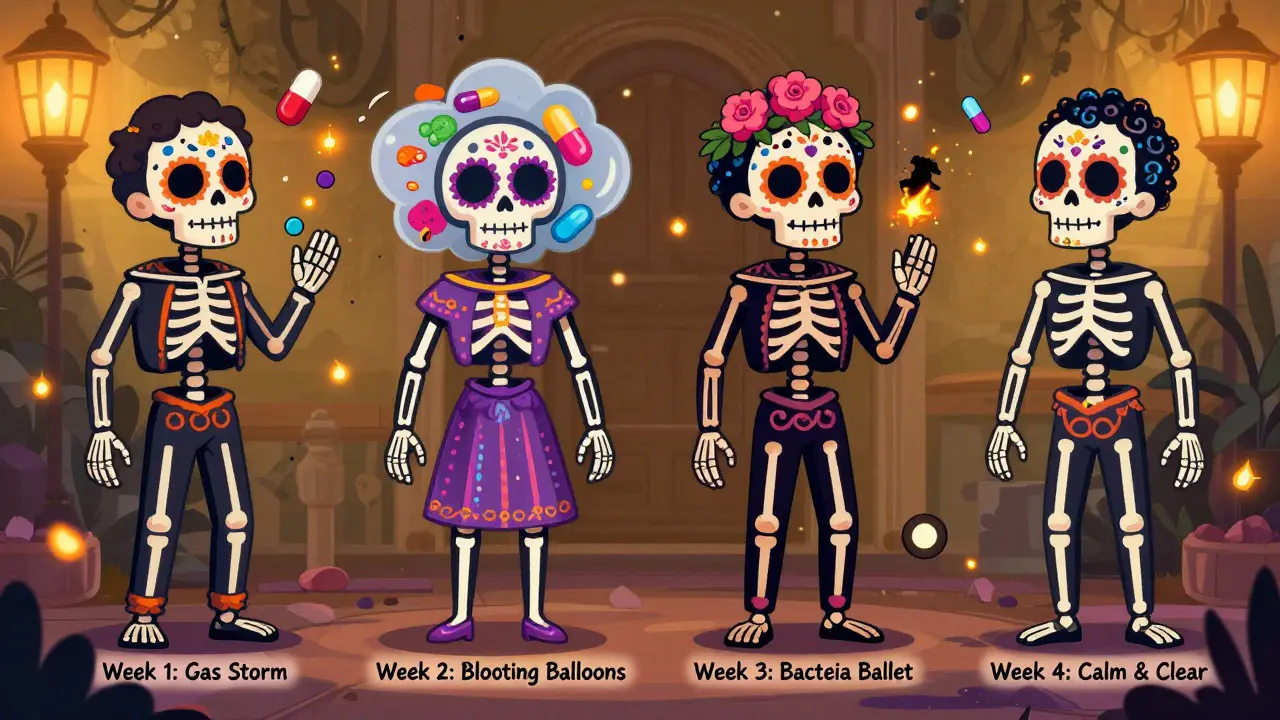
Why does this work? Your gut bacteria need time to adapt. In the first 3-7 days, gas peaks. But by week 2-4, your microbiome shifts. The bacteria that thrive on undigested carbs become more efficient, producing less gas. It’s not magic-it’s biology.
One Reddit user, u/DiabeticDave1982, started with 25mg acarbose once daily and slowly increased over six weeks. After two months, he said the gas was “barely noticeable.” That’s not luck-it’s strategy.
Diet Tweaks That Actually Help
It’s not just about the drug-it’s about what you eat with it.
- Avoid large amounts of simple sugars-candy, soda, juice. These get broken down fast and flood your colon with sugar, making gas worse.
- Don’t cut fiber entirely, but ease into it. Whole grains, beans, and veggies are fine, but introduce them slowly. A sudden jump from white bread to lentils will make things worse.
- Keep carbs consistent. Aim for 45-60g per meal. Spikes in carb intake = spikes in gas.
- Spread carbs evenly across meals. Three moderate meals are better than one big one.
One user, u/SugarFreeSue, said avoiding high-fiber foods during the first month on miglitol made all the difference. “I didn’t stop eating healthy-I just delayed the beans and broccoli until my gut caught up.”
Over-the-Counter Fixes That Work
If you’re still struggling, these aren’t just band-aids-they’re science-backed tools.
- Activated charcoal: Take 500-1000mg 30 minutes before meals. Studies show it reduces flatus volume by about 32%. It binds gases in your gut before they build up.
- Simethicone: Found in Gas-X or Mylanta. Take 120mg three times a day. It breaks up gas bubbles, making them easier to pass. One 2019 study found it reduced bloating severity by 40%.
- Probiotics: Lactobacillus GG (10 billion CFU daily) reduced flatulence frequency by 37% in a 12-week trial. Bifidobacterium longum BB536, combined with miglitol, cut gas by 42% in a 2023 trial.
Don’t expect miracles overnight. These take 2-4 weeks to show real results. But they work better than just hoping it’ll go away.
Acarbose vs. Miglitol: Which One Should You Choose?
Let’s cut through the noise.
| Feature | Acarbose | Miglitol |
|---|---|---|
| Typical Starting Dose | 25mg three times daily | 25mg three times daily |
| Systemic Absorption | <2% | 50-100% |
| Flatulence Severity | Higher | Lower |
| HbA1c Reduction (24 weeks) | 0.8% | 0.6% |
| Weight Effect | Neutral | Slight weight loss (avg. 1.2kg) |
| Cost (30-day supply, generic) | $15-25 | $20-35 |
| Best For | Patients who need max HbA1c drop and can tolerate side effects | Patients prioritizing comfort and weight loss |
If your main goal is comfort, go with miglitol. If you need the strongest blood sugar drop and can handle the gas, acarbose gives you a little more punch. But if you’re unsure, start with miglitol. It’s the better first choice for most people.

When to Talk to Your Doctor
These drugs are safe for most people-but not everyone. Watch for:
- Severe abdominal pain or swelling
- Yellowing of skin or eyes (rare liver issue with acarbose)
- Diarrhea that lasts more than a week
Also, if you’ve been on it for six weeks and still can’t function because of gas, it’s time to rethink. There are other options-GLP-1 agonists, SGLT2 inhibitors, even metformin if you can tolerate it. You don’t have to suffer.
What’s Changing in 2026
The field is moving. In 2023, the FDA approved a new combo pill-Acbeta-M-that blends acarbose with metformin in a controlled-release form. Early data shows 28% less gas than regular acarbose. That’s huge.
Research is also looking at genetic testing to predict who’s more likely to get bad side effects. Some people have natural variations in their gut enzymes that make them more sensitive. In the future, a simple DNA test might tell you whether acarbose is even worth trying.
For now, the best advice is simple: start low, go slow, tweak your diet, and use OTC tools. Most people find relief within a month. And if you stick with it, you get the benefits: better blood sugar, no weight gain, no hypoglycemia. That’s worth fighting for.
Why does acarbose cause more gas than miglitol?
Acarbose stays almost entirely in the gut and blocks carb-digesting enzymes right where food is being broken down, leaving more undigested carbs to reach the colon. Miglitol is partially absorbed in the upper intestine, so less carb residue makes it to the colon where gas-producing bacteria live. This makes miglitol gentler on the digestive system.
How long does it take for gas side effects to improve?
Gas and bloating usually peak between days 3 and 7 after starting the medication. Most people notice significant improvement by week 2-4 as gut bacteria adapt to the increased fiber load. Full adaptation can take up to 8 weeks, but symptoms rarely stay severe beyond that if you’re following a proper dosing and diet plan.
Can I take probiotics with acarbose or miglitol?
Yes, and it’s often recommended. Studies show specific strains like Lactobacillus GG and Bifidobacterium longum BB536 reduce flatulence by 37-42% when taken daily alongside these drugs. Take them at least 2 hours apart from your medication to avoid interference.
Is it safe to use activated charcoal with these drugs?
Yes, but timing matters. Take activated charcoal 30 minutes before meals to bind gases without interfering with the drug’s action in the small intestine. Avoid taking it within 2 hours of other medications, as it can reduce their absorption.
Should I stop taking acarbose or miglitol if the gas is unbearable?
Don’t quit without talking to your doctor. Many people give up too soon. Try lowering your dose, adjusting your diet, and adding simethicone or probiotics. If symptoms persist after 6-8 weeks of careful management, your doctor can switch you to another medication. There are alternatives that work just as well without the gas.
Final Thought: You’re Not Broken
This isn’t about being weak or sensitive. Your body is reacting exactly as expected to a drug designed to change how your gut works. The side effects aren’t a flaw in you-they’re a flaw in the drug’s mechanism. But that doesn’t mean you’re stuck with them. With the right approach, most people get through it. You don’t have to choose between good blood sugar and a normal life. You just need the right strategy.

There are 11 Comments
steve rumsford
Poppy Newman
LALITA KUDIYA
Anastasia Novak
Vince Nairn
Aparna karwande
Ayodeji Williams
Jonathan Larson
Anthony Capunong
Kamlesh Chauhan
Kyle King
Write a comment
Your email address will not be published. Required fields are marked *