Heat Risk Assessment Tool
Assess Your Heat Exposure Risk
Temperature in Fahrenheit (70-100)
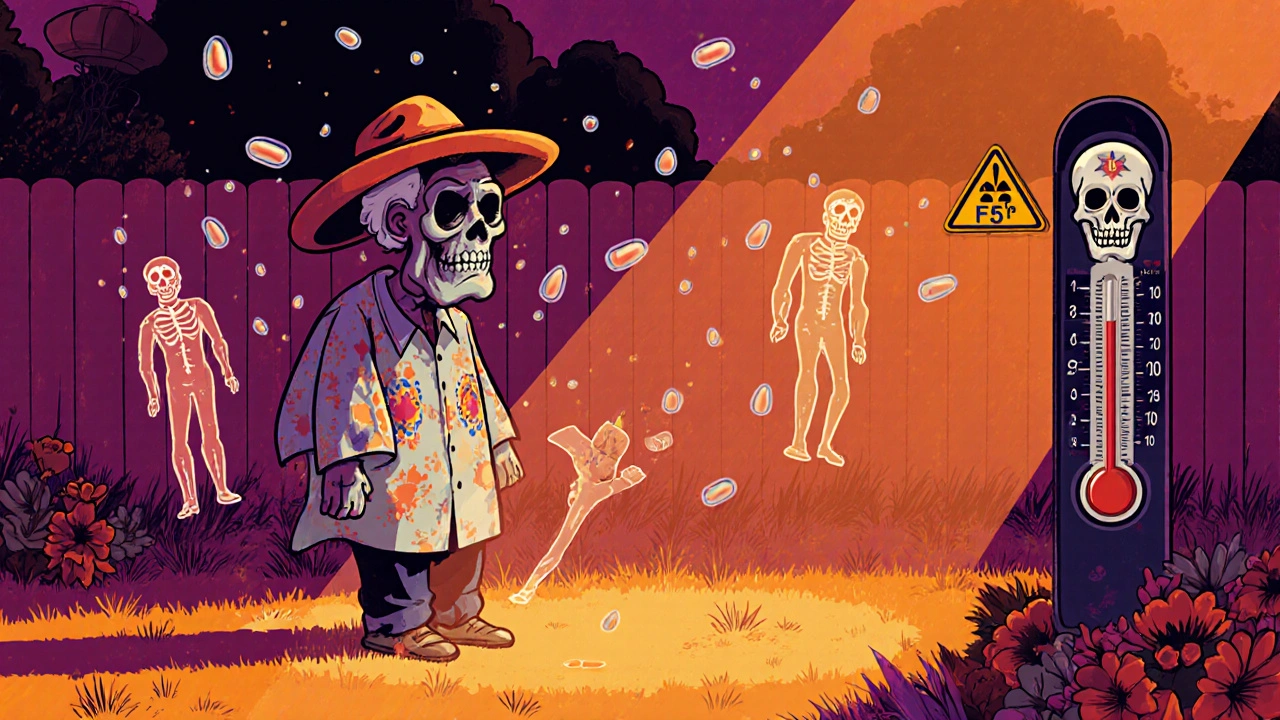
When the temperature rises, most people think about drinking more water, staying in the shade, or wearing light clothes. But for people taking diuretics or anticholinergics, heat isn’t just uncomfortable-it can be life-threatening. These medications, commonly prescribed for high blood pressure, heart failure, overactive bladder, or depression, quietly disable the body’s natural cooling system. And many patients don’t even realize they’re at risk.
How Diuretics Make Heat Dangerous
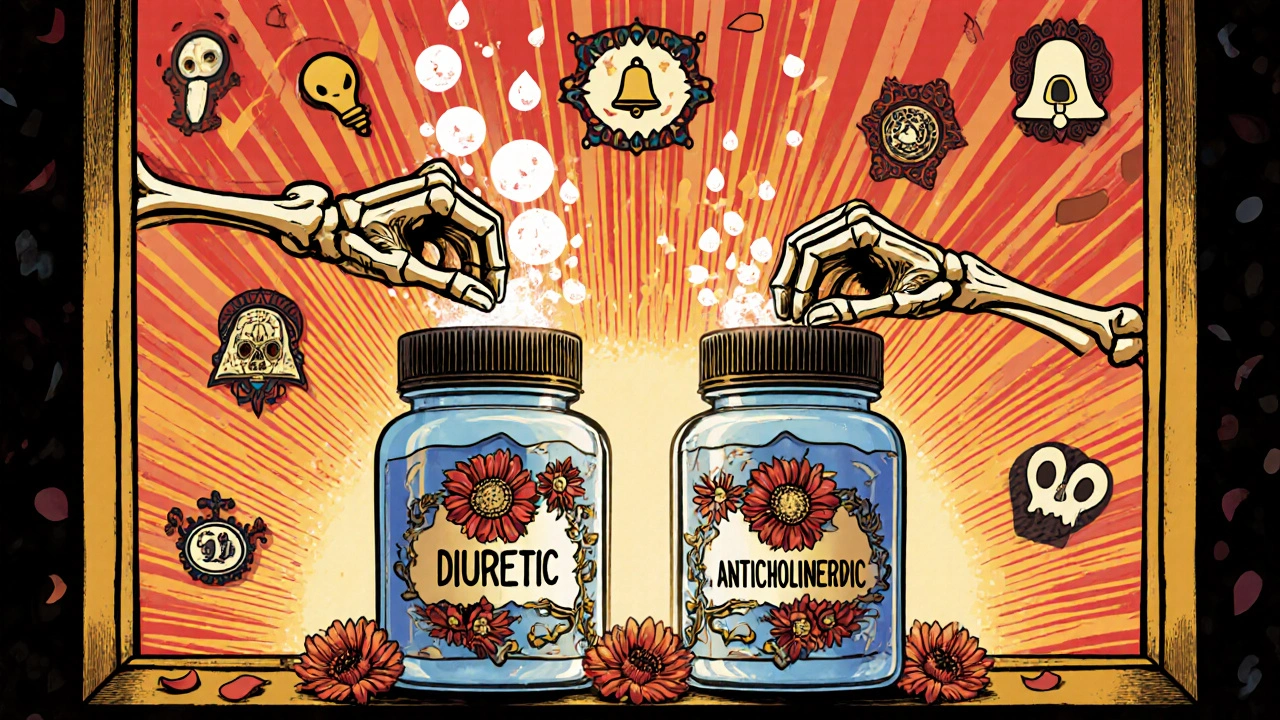
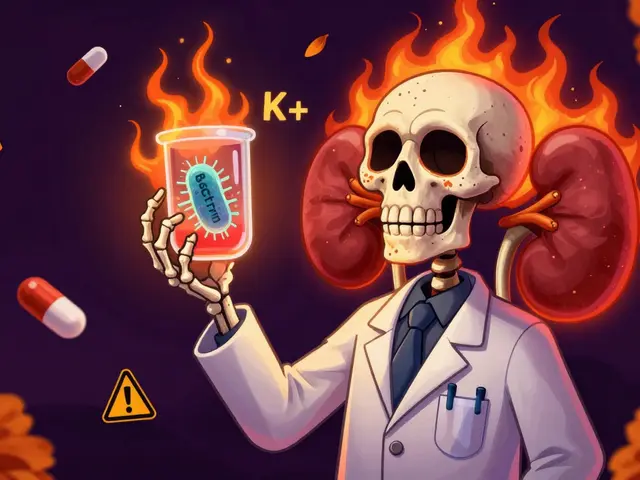
Diuretics-like furosemide (Lasix), hydrochlorothiazide, and chlorthalidone-are called "water pills" for a reason. They help your kidneys flush out extra fluid and salt. That’s great for lowering blood pressure or reducing swelling in heart failure. But when it’s hot outside, that same mechanism becomes a liability.
Your body sweats to cool down. Sweating needs fluid. Diuretics make you lose more fluid than normal, even before you start sweating. That means your blood volume drops. Lower blood volume = less blood reaching your skin to release heat. Your core temperature climbs faster. And because you’re losing sodium and potassium, your muscles and heart don’t work as well. One study of over 1.2 million Medicare patients found that those on loop diuretics had a 37% higher chance of being hospitalized for heat illness-even when temperatures were just 80°F (26.7°C), not even a "heatwave."
It’s not just about thirst. You might not feel dehydrated until it’s too late. Older adults, especially those with heart or kidney disease, often have reduced thirst signals. They don’t drink enough, and their bodies can’t hold onto what they do take in. By the time they feel dizzy or confused, their body temperature could already be dangerously high.
Anticholinergics: The Silent Saboteurs of Sweating
Anticholinergics work by blocking acetylcholine, a chemical that tells your body to sweat. Medications like oxybutynin (Ditropan), tolterodine (Detrol), and amitriptyline (Elavil) are prescribed for bladder control, Parkinson’s, or depression. But they come with a hidden cost: they turn off your sweat glands.
Studies show that drugs with a high anticholinergic burden score (ACB = 3) can reduce sweating by 30% to 50%. That’s not a small drop-it’s a shutdown. Your body can’t cool itself. Even if you’re drinking plenty of water, you’re still overheating. And because these drugs can cause drowsiness or confusion, you might not notice you’re in trouble until you’re already delirious or collapsing.
During the 2021 Pacific Northwest heat dome, 63% of the people who died from heat exposure were taking either a diuretic or an anticholinergic. Many of them were older adults living alone. Their symptoms-headache, nausea, confusion-were mistaken for dementia or a stroke. By the time someone called 911, it was too late.
Why Combining Them Is a Recipe for Disaster
The real danger isn’t just one medication-it’s the combo. Many older adults take both a diuretic and an anticholinergic. Maybe they’re on hydrochlorothiazide for blood pressure and oxybutynin for bladder leaks. That’s two ways your body loses its ability to handle heat: one stops you from keeping fluid, the other stops you from sweating it out.
This combination doesn’t just add risk-it multiplies it. A 2023 study in the Journal of Thermal Biology found that patients on multiple heat-sensitive medications had core temperatures that rose faster and stayed higher during heat exposure than those on just one. Their bodies couldn’t compensate. No sweat. No fluid reserve. No warning signs.
And here’s the scary part: many doctors don’t ask about heat exposure when prescribing these drugs. Patients aren’t warned. The CDC says this is a major gap in care. You might get instructions to take your pill with food or avoid alcohol-but rarely are you told, "When it hits 85°F, you need to rethink your day."
What You Should Do Right Now
Don’t stop your meds. That’s dangerous too. But you do need a plan.
- Check your meds. Look up your prescriptions on the Anticholinergic Cognitive Burden (ACB) scale. If any have a score of 3, you’re at high risk. Common ones: oxybutynin, tolterodine, diphenhydramine (Benadryl), amitriptyline, and some antipsychotics.
- Hydrate smart. Drink water regularly-even if you’re not thirsty. Don’t wait until you’re dry-mouthed. Sip throughout the day. Avoid alcohol and caffeine-they make you lose more fluid.
- Adjust timing. If you take a diuretic in the morning, you’ll be peeing all day. On hot days, ask your doctor if you can skip the afternoon dose. Some patients in a 2022 pilot study at Massachusetts General Hospital had fewer heat-related issues after adjusting timing.
- Wear the right clothes. Light colors, loose fit, breathable fabric. Dark, tight clothes trap heat. And yes, wear sunscreen-many anticholinergics make your skin more sensitive to UV rays.
- Know the signs. Headache, dizziness, nausea, confusion, muscle cramps, rapid heartbeat. If you have any of these and you’re on one of these meds, get to a cool place immediately. Call 911 if you feel disoriented.
Ask Your Doctor These Questions
You need to have a conversation with your provider-not just a quick refill. Here’s what to ask:
- "Is my medication on the high-risk list for heat exposure?"
- "Could my dose be adjusted during hot weather?"
- "Do I need to change how much water I drink on hot days?"
- "Are there safer alternatives that don’t affect sweating or fluid balance?"
- "Should I have a buddy check on me when it’s over 85°F?"
Some doctors will say, "It’s not that common." But the data says otherwise. The CDC and EPA now track heat-related deaths linked to medications. In 2022, 92% of heat-related deaths involved someone taking at least one medication that interferes with thermoregulation. That’s not rare. That’s epidemic.
What’s Being Done to Fix This?
Researchers are finally paying attention. The National Institute on Aging just funded $4.2 million to study how medications affect older adults in heat. Penn State is running a $2.8 million study tracking real-world heat tolerance in people over 60 on diuretics and anticholinergics. Results are expected in 2025.
The CDC’s Heat and Health Tracking System now includes medication data in 25 states. They’re building risk models that can warn people before a heatwave hits-based on their prescriptions, age, and location.
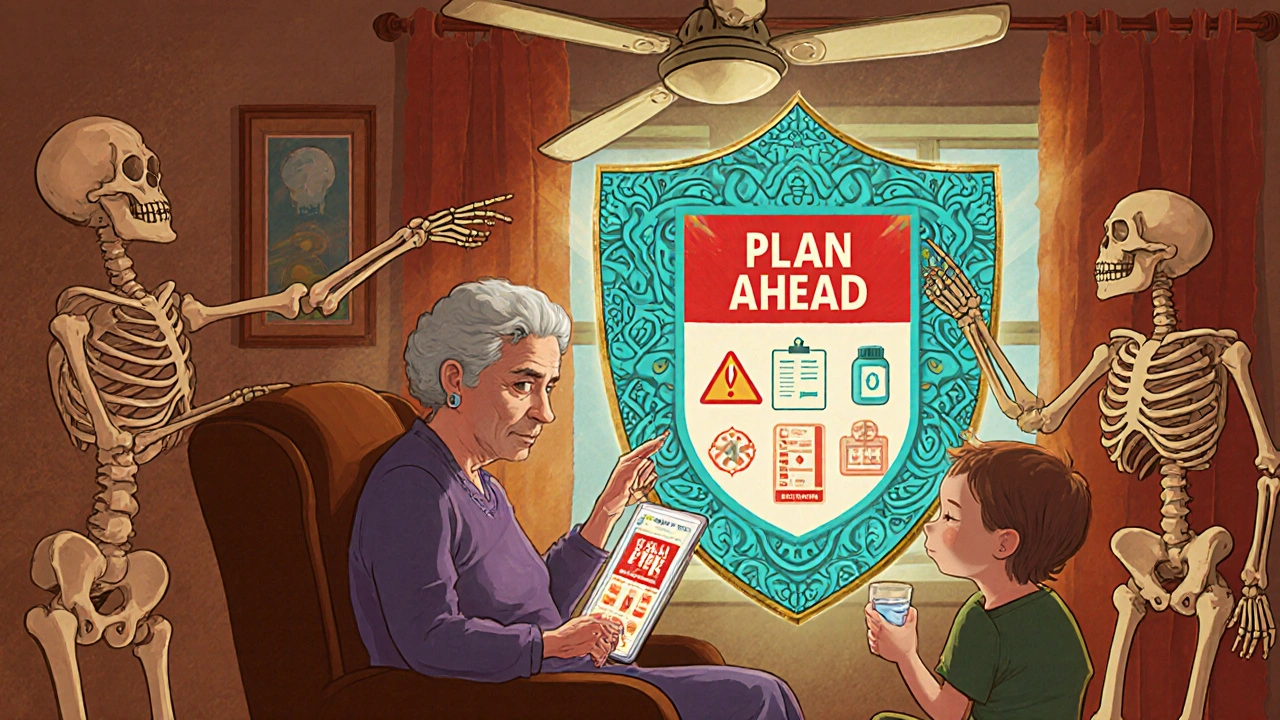
But until those systems are nationwide, the responsibility falls on you and your doctor. Don’t wait for a heat advisory to think about this. Talk to your provider now. Write down your meds. Know your risk. Plan ahead.
Final Thought: Heat Doesn’t Care About Your Prescription
Your medication helps you live longer. But heat doesn’t care if you’re on a pill for your heart or your bladder. It only knows one thing: if your body can’t sweat and can’t hold water, it will overheat. Fast.
There’s no magic fix. No supplement. No trick. Just awareness, preparation, and communication. If you or someone you love is on diuretics or anticholinergics, treat heat like a medical emergency-even when the thermometer says "only" 85°F. Because for you, it might as well be 110°F.

There are 5 Comments
Jermaine Jordan
This is one of the most critical public health blind spots I’ve ever seen. We monitor air quality, we warn about UV index, we track pollen counts-but we ignore the silent killer in your medicine cabinet. Diuretics and anticholinergics aren’t just drugs; they’re thermal disarmament devices. And yet, no pharmacy label, no prescribing checklist, no patient brochure says: "This may turn your body into a furnace with no vent." The CDC’s new tracking system is a start, but it’s like putting a bandage on a hemorrhage. We need mandatory heat-risk alerts at the point of prescription. Period.
Imagine if every time a doctor prescribed oxybutynin, the EHR popped up: "Patient at 3x higher risk of heat stroke. Advise hydration plan and avoid 85°F+ exposure." That’s not radical-it’s basic medical ethics.
I’ve seen elderly patients collapse in their own homes during heatwaves, and the coroner’s report says "natural causes." No. It was polypharmacy meets climate change. We’re killing people with kindness-prescribing for comfort while ignoring lethal side effects.
This isn’t about fearmongering. It’s about accountability. If you’re prescribing this combo, you’re responsible for the outcome. And if you’re taking it, you’re not just a patient-you’re a climate vulnerability. Wake up.
And yes, I’m sending this to my own doctor tomorrow.
-Jermaine Jordan, MD
Chetan Chauhan
uuhh i think u r overreacting… like, i take hydrochlorothiazide and benadryl and i go outside in 90f and i’m fine… maybe ur just weak? or maybe u drink too much coffee? i think this is just fear porn from med bros who wanna feel smart. also, i read somewhere that sweat is gross anyway, so why even care if u stop sweating? 🤷♂️
Phil Thornton
My grandma’s on oxybutynin and furosemide. She didn’t know any of this. Last summer she passed out on her porch. Thought it was just "getting old."
Now I print out the ACB scale. Tape it to her fridge. And I make her drink water every hour-even if she says she’s not thirsty.
She calls me her "water cop."
Worth it.
-Phil
Pranab Daulagupu
There’s a profound physiological irony here: medications designed to restore homeostasis become agents of dysregulation under environmental stress. The autonomic nervous system, finely tuned over millennia to manage thermoregulation via cholinergic signaling and fluid homeostasis, is pharmacologically neutered by compounds that suppress these very pathways.
What’s alarming is the confluence of aging physiology-reduced renal perfusion, diminished baroreceptor sensitivity, blunted thirst response-with polypharmacy. This isn’t just drug interaction; it’s a systems failure at the intersection of geriatric medicine, climate science, and public health infrastructure.
The solution isn’t just patient education-it’s algorithmic risk stratification embedded in EHRs, triggered by prescription patterns and local heat indices. We have the data. We need the integration.
Thank you for highlighting this silent epidemic. It’s time to treat heat exposure as a pharmacovigilance issue, not just a weather event.
-Pranab
Alexander Levin
92% of heat deaths involve meds? 😏
That’s because the CDC and Big Pharma are in cahoots. They want you scared so you’ll take MORE pills to "fix" the side effects of the first pills.
Also, sweat is just your body leaking toxins. Stop sweating = detox mode. 🤓
And 85°F? That’s a nice day. I’ve seen people die from AC failure. Now THAT’S the real danger.
Just say no to fear. 🌞💊
Write a comment
Your email address will not be published. Required fields are marked *