
Myasthenia gravis isn’t just muscle weakness-it’s weakness that gets worse the more you use your muscles. Imagine lifting your eyelids and feeling them droop after reading for ten minutes. Or swallowing a bite of food and suddenly choking, only to feel fine again after resting. That’s fatigable weakness: the hallmark of myasthenia gravis (MG), a rare autoimmune disorder that attacks the connection between nerves and muscles. Unlike general tiredness, this isn’t about being worn out-it’s a neurological glitch where your body’s own immune system mistakes parts of your neuromuscular junction for invaders and destroys them.
How Myasthenia Gravis Breaks the Signal Between Nerve and Muscle
Your muscles don’t move on their own. They wait for a signal from your nerves, delivered by a chemical called acetylcholine. At the neuromuscular junction, acetylcholine binds to receptors on the muscle, triggering contraction. In myasthenia gravis, antibodies block, destroy, or alter those receptors. The result? The signal gets lost. The muscle doesn’t respond. And the more you try to use it, the weaker it gets.
About 80-90% of people with generalized MG have antibodies against the acetylcholine receptor (AChR). Another 5-8% have antibodies against muscle-specific kinase (MuSK), a protein that helps organize those receptors. The rest are seronegative-no known antibodies detected, but symptoms still match. These aren’t just labels. They determine how the disease behaves and what treatments work best.
Early-onset MG (under 50) often comes with thymus gland enlargement and AChR antibodies. Late-onset MG (over 50) is more likely to involve thymoma-a tumor in the thymus-and tends to be more severe. About 15-20% of people start with only eye symptoms: drooping eyelids or double vision. But half of them will develop full-body weakness within two years.
Fatigable Weakness: The Telltale Sign
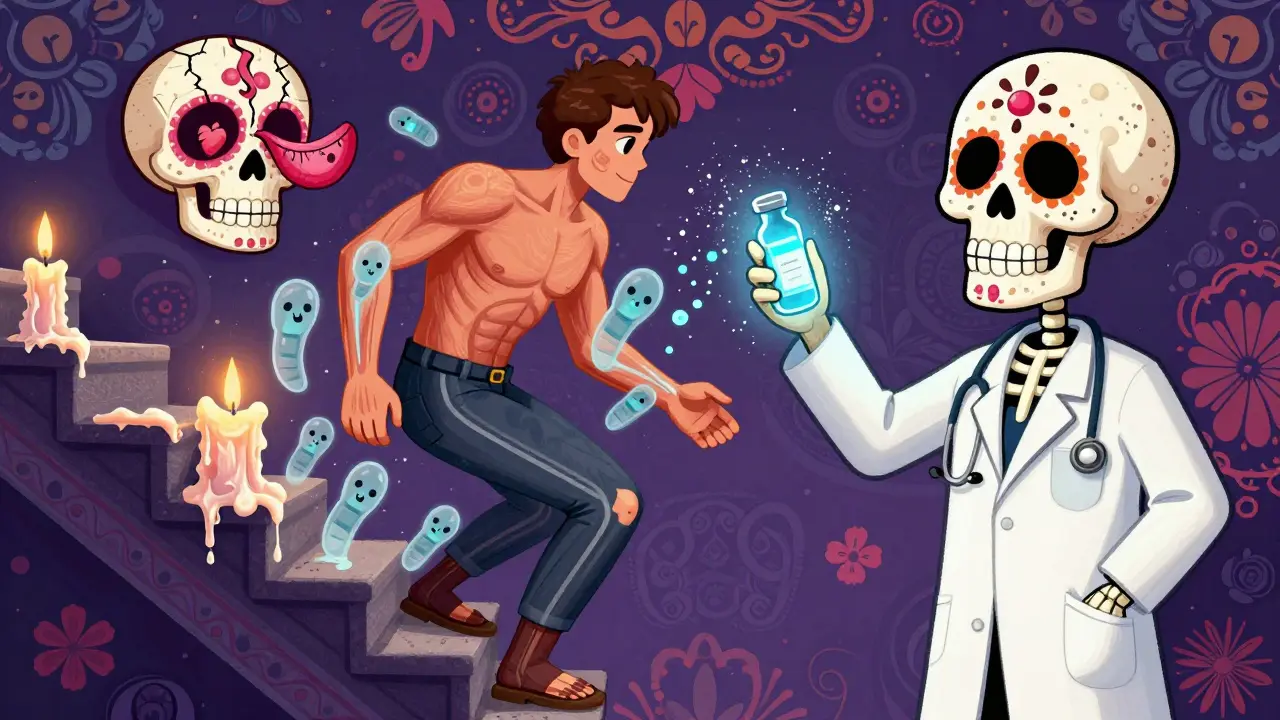
Fatigable weakness doesn’t show up on a routine physical exam. You might look perfectly normal after resting. But ask someone to hold their arms out, smile, or climb stairs-and watch what happens. Within minutes, the muscles tire. The smile becomes lopsided. The arms drop. The voice fades.
Doctors use a tool called the Quantitative Myasthenia Gravis Score (QMGS) to measure this. A score above 11 means moderate to severe disease. That’s when symptomatic treatment alone-like pyridostigmine-isn’t enough. Immunotherapy kicks in.
Why does rest help? Because the body slowly rebuilds acetylcholine receptors between uses. But every time you move, you burn through them faster than they can recover. That’s why MG patients often schedule activities around rest. A morning walk might be fine. An afternoon grocery run? Not so much.
Immunotherapy: From Steroids to Targeted Drugs
For decades, the go-to treatment was pyridostigmine-a drug that slows the breakdown of acetylcholine, giving it more time to bind to receptors. It helps, but it doesn’t fix the root problem: the immune system’s attack.
That’s where immunotherapy comes in. The goal isn’t just to manage symptoms. It’s to silence the immune system’s mistake. The first line? Corticosteroids like prednisone. About 70-80% of patients see major improvement or even full remission. But side effects are real: weight gain, bone thinning, mood swings, high blood sugar. Many can’t tolerate long-term use.
That’s why doctors add steroid-sparing agents. Azathioprine and mycophenolate mofetil are common. They take months to work-6 to 18 months-but they let doctors lower steroid doses. About 60-70% of people respond to azathioprine. Mycophenolate works for 50-60%. Both need regular blood tests to catch liver or bone marrow issues early.
But here’s the twist: MuSK-positive MG doesn’t respond well to standard immunosuppressants. For these patients, rituximab-a drug that wipes out B-cells-works far better. Studies show 71-89% reach minimal symptom status with rituximab, compared to just 40-50% in AChR-positive cases. That’s not a small difference. It’s life-changing.
Emergency Treatments: IVIG and Plasma Exchange
When MG suddenly worsens-when swallowing becomes impossible, or breathing grows shallow-doctors reach for fast-acting tools: intravenous immunoglobulin (IVIG) or plasma exchange (PLEX).
IVIG floods the bloodstream with healthy antibodies, confusing the immune system and temporarily stopping the attack. It takes 5-7 days to kick in, and the effect lasts 3-6 weeks. It’s easier on the body-no catheters needed-but expensive and in limited supply.
PLEX pulls blood, removes the bad antibodies, and returns clean plasma. It works faster-2-3 days-and is often preferred in life-threatening cases like respiratory failure or severe bulbar weakness. But it requires a central line, carries infection risks, and isn’t available everywhere.
Experts agree: both are equally effective in emergencies. The choice comes down to access, speed, and patient condition.
The New Wave: nFcR Antagonists and Beyond
In 2021, the FDA approved efgartigimod-the first drug in a new class called neonatal Fc receptor (nFcR) antagonists. It doesn’t suppress the immune system. Instead, it tricks the body into breaking down its own antibodies faster. Within a week, IgG levels drop by 60-75%. In clinical trials, 68% of patients reached minimal manifestation status.
It’s given as a weekly infusion for four weeks, then as needed. No hospital stay. No central line. Fewer side effects than steroids or immunosuppressants. It’s not a cure-but for many, it’s a game-changer.
Ravulizumab, approved in late 2023, blocks a different part of the immune cascade: the complement system. It’s the first complement inhibitor for MG. Both drugs represent a shift: from broad immune suppression to precise antibody targeting.
Other drugs are coming. Rozanolixizumab and inebilizumab are in late-stage trials. Subcutaneous versions of nFcR blockers are being tested for home use. The goal? Long-term control without daily pills or lifelong side effects.
Thymectomy: Removing the Source
For early-onset, AChR-positive MG patients between 18 and 65, removing the thymus gland (thymectomy) is now standard. The MGTX trial showed that after three years, patients who had surgery reached symptom control faster and more often than those on medication alone. Five years later, 35-45% were in complete remission-no drugs needed.
It’s not a magic fix. But for the right person, it can mean freedom from medication. Surgeons now use minimally invasive techniques. Recovery is faster. Risks are lower.

When Treatment Backfires: Immune Checkpoint Inhibitors
There’s a dark side to modern cancer care. Immune checkpoint inhibitors-drugs that help the immune system fight tumors-can accidentally trigger or worsen MG. In one study, 60% of patients who developed immune-related MG also had heart inflammation (myocarditis). Eighty-three percent ended up in intensive care. Some didn’t survive.
Doctors now screen cancer patients for MG symptoms before starting these drugs. If MG develops, treatment stops. Steroids and IVIG are used urgently. But prevention matters more than cure here.
Living With Myasthenia Gravis
Most people with MG need long-term treatment. About 85-90% stay on immunosuppressants. But remission is possible. Younger patients, especially after thymectomy, have the best shot. One in three can stop all drugs and stay symptom-free.
Challenges remain. Infections are 2-3 times more common on immunosuppressants. Weight gain from steroids is widespread. Liver damage from azathioprine happens in 15-20%. And if you taper too fast, relapse hits in 40-50% of cases.
Doctors now wait at least two years of stable, minimal symptoms before even thinking about reducing meds. And even then, it’s slow. One pill less every few months. Close monitoring. No rushing.
What’s Next?
The 2023 Myasthenia Gravis Foundation Research Roadmap puts one goal at the top: disease modification without lifelong immunosuppression. Fifteen clinical trials are underway-targeting B-cells, cytokines, complement proteins. The dream? A cure that doesn’t come with a long list of side effects.
For now, MG is manageable. Not curable. But better than ever. With the right mix of drugs, surgery, and monitoring, most people live full lives. They work. They travel. They raise families. The weakness doesn’t disappear-but with modern tools, it no longer defines them.
What causes myasthenia gravis?
Myasthenia gravis is caused by the immune system producing antibodies that attack the neuromuscular junction-specifically, the receptors for acetylcholine, the chemical that tells muscles to contract. In 80-90% of cases, these are anti-AChR antibodies. In 5-8%, they’re anti-MuSK antibodies. The thymus gland often plays a role, especially in early-onset cases, where it may be enlarged or contain a tumor.
Is myasthenia gravis curable?
There is no cure yet, but many people achieve long-term remission. About 35-45% of early-onset, AChR-positive patients who have a thymectomy go into complete remission within five years-meaning no symptoms and no medication. Others manage symptoms effectively with immunotherapy. The goal is minimal manifestation status: almost no symptoms, even if some treatment continues.
Can you die from myasthenia gravis?
Yes, but it’s rare with modern care. The biggest risk is a myasthenic crisis-when breathing muscles fail. This requires emergency intubation and ventilation. Before the 1950s, mortality was high. Today, with access to IVIG, plasma exchange, and ICU care, survival rates exceed 95%. Prompt treatment and avoiding triggers like infections or certain medications reduce risk significantly.
What’s the difference between IVIG and plasma exchange?
Both treat acute MG flare-ups by removing harmful antibodies. IVIG works by flooding the body with healthy antibodies, which confuses the immune system. It’s slower (5-7 days) but safer and easier to administer. Plasma exchange physically removes blood, filters out antibodies, and returns clean plasma. It works faster (2-3 days) and is preferred in severe cases like respiratory failure-but requires a central line and carries higher risks like infection or clotting.
Do all MG patients need immunosuppressants?
No, but most do. About 85-90% of patients require long-term immunosuppression. However, younger patients with early-onset AChR-positive MG who have a thymectomy have up to a 45% chance of achieving drug-free remission. Others may only need pyridostigmine if their symptoms are mild and limited to the eyes. Treatment is always personalized based on antibody type, age, severity, and response.
Can medications make myasthenia gravis worse?
Yes. Certain antibiotics (like fluoroquinolones and macrolides), beta-blockers, statins, magnesium, and especially immune checkpoint inhibitors used in cancer therapy can trigger severe worsening of MG. Some patients develop life-threatening symptoms within days. Always check with your neurologist before starting any new medication-even over-the-counter ones.



There are 15 Comments
Brian Furnell
Let’s break this down: the neuromuscular junction isn’t just a synapse-it’s a precision instrument. AChR antibodies don’t just block receptors; they trigger complement-mediated lysis, effectively erasing the postsynaptic folds where acetylcholine should bind. That’s why pyridostigmine is a band-aid-it increases ligand concentration but doesn’t restore structural integrity. The real breakthrough is in targeting FcRn to accelerate IgG catabolism. Efgartigimod isn’t immunosuppressive-it’s immunomodulatory in the purest sense. We’re shifting from suppression to selective clearance. That’s paradigm-shifting.
Siobhan K.
So let me get this straight-we’re giving people steroids to suppress their immune system so their body doesn’t attack itself, but then we’re surprised when they get diabetes, osteoporosis, and mood swings? And now we’re replacing one toxic drug with another expensive one that still requires infusions? The real miracle would be preventing this in the first place, not managing the fallout.
Orlando Marquez Jr
It is imperative to acknowledge the remarkable advancements in the therapeutic landscape of myasthenia gravis. The advent of monoclonal antibody-based therapies, particularly those targeting the neonatal Fc receptor, represents a significant milestone in the evolution of precision medicine. These interventions exemplify the transition from broad immunosuppression to targeted molecular modulation, thereby minimizing systemic adverse effects while maximizing clinical efficacy. Further longitudinal studies are warranted to assess durability of response and long-term safety profiles.
Cameron Hoover
I’ve watched someone I love go from barely able to lift a coffee cup to hiking mountains again-all thanks to rituximab. It wasn’t magic. It was science. But it was also hope. For years, they were told, ‘This is as good as it gets.’ Then came a treatment that didn’t just ease symptoms-it gave them their life back. If you’re sitting in a neurologist’s office feeling hopeless, don’t give up. The science is moving faster than you think.
Jay lawch
They say it’s autoimmune, but what if it’s not? What if the thymus isn’t malfunctioning-it’s being manipulated? Think about it: the same corporations that make the drugs also control the labs that test for antibodies. Who funded the MGTX trial? Who owns the patents on efgartigimod? The FDA approved it in 2021-right after the big pharma merger. Coincidence? Or is this a controlled narrative to keep people dependent on lifelong infusions? The real cure is detoxing the body from glyphosate and EMF exposure-something they’ll never tell you.
Christina Weber
There is a grammatical error in the section discussing MuSK-positive MG: ‘The rest are seronegative-no known antibodies detected’-this should be ‘seronegative-no known antibodies detected.’ Additionally, ‘minimal manifestation status’ is incorrectly hyphenated in one instance as ‘minimal manifestation-status.’ Precision matters, especially in medical communication. Also, ‘pyridostigmine’ is misspelled as ‘pyridostigmine’ in the third paragraph. These are not trivial errors-they undermine credibility.
Cara C
I know someone who went into remission after thymectomy and never looked back. It took two years of patience, and she had to taper off steroids slower than a snail, but she’s now off everything. The key? Finding a team that listens-not just a neurologist, but a nutritionist, a physical therapist, and a mental health counselor who gets it. This disease doesn’t just live in your muscles. It lives in your mind, your schedule, your relationships. Healing needs to be holistic.
Michael Ochieng
Just came back from a support group meeting-27 people, 14 on rituximab, 8 on efgartigimod, 5 still on azathioprine. The ones on the new drugs? They’re living. Not just surviving. Living. One guy went back to coaching his kid’s soccer team. Another traveled to Japan. We used to talk about what we couldn’t do. Now we talk about where we’re going next. The science isn’t just changing outcomes-it’s changing lives. And that’s worth celebrating.
Dan Adkins
It is noteworthy that the pathophysiological mechanisms underlying myasthenia gravis are not yet fully elucidated, and the prevailing paradigm of autoantibody-mediated pathogenesis may be overly reductionist. The role of the gut microbiome, epigenetic dysregulation, and latent viral triggers-particularly Epstein-Barr virus-has been systematically underinvestigated in clinical literature. Furthermore, the commercialization of immunotherapeutics may be incentivizing a narrow diagnostic framework that excludes alternative etiologies. A more integrative approach is required.
Erika Putri Aldana
Why do we even need all this? Just eat less sugar and do yoga. I read on a blog that MG is just stress. Also, why are drugs so expensive? Big Pharma is evil. 🤷♀️
Grace Rehman
What if the body isn’t attacking itself… but trying to heal itself? Maybe the immune system isn’t mistaken-it’s responding to something deeper. A toxin. A trauma. A spiritual imbalance. We treat the symptom, not the source. We patch the leak while ignoring the broken pipe. Maybe MG isn’t a disease to be cured… but a message to be listened to.
Jerry Peterson
My cousin had MG. Took her three years to find a doctor who didn’t treat her like she was hypochondriac. The first time she got IVIG, she cried because she could lift her head for the first time in months. It’s not glamorous. It’s not trendy. But it’s real. And people need to know it’s okay to need help. You’re not weak because you need a cane. You’re strong because you’re still here.
Meina Taiwo
Thymectomy works best in early-onset AChR+ patients. Confirm with CT or MRI first. Avoid steroids if possible-use mycophenolate as first-line steroid-sparing. Monitor LFTs and CBC monthly. Rituximab for MuSK. IVIG for crisis. That’s the algorithm. Simple.
Adrian Thompson
They say it’s autoimmune… but who controls the labs? Who funds the trials? The same people who sell the drugs. And why is plasma exchange cheaper than IVIG in Europe but not here? Coincidence? The thymus is a gland. It’s not a villain. The real enemy is the medical-industrial complex. They want you dependent. They don’t want you cured. They want you on lifelong infusions. Wake up.
Southern NH Pagan Pride
they say its autoimmune but what if its just the vaccines?? i mean like… the spike protein messes with the neuromuscular junction right?? and then they sell you efgartigimod for $100k a year… but if you just stop the vaccines and drink lemon water you could heal… why dont they tell you that??
Write a comment
Your email address will not be published. Required fields are marked *