Most people check the expiration date on their medicine bottle and assume it’s safe to use until that day. But what if your pills have already lost their power-long before the date printed on the label? The real culprit isn’t time. It’s your bathroom, your kitchen, or your car on a summer day. Humidity and heat are quietly sabotaging your medications, making them weaker, unpredictable, or even dangerous.
Why Your Medicine Doesn’t Last as Long as It Should
Expiration dates aren’t arbitrary. They’re the last day the manufacturer guarantees the drug will work as intended-only if stored properly. The U.S. Pharmacopeia sets standard testing conditions: 20-25°C (68-77°F) and 35-65% humidity. That’s not your bathroom. That’s not your car. That’s not your kitchen counter near the stove. When temperatures climb above 30°C (86°F), or humidity pushes past 60%, chemical reactions start breaking down active ingredients. Some drugs degrade slowly. Others fall apart in hours. You won’t see it. You won’t smell it. But your body will feel the difference.Which Medications Are Most at Risk?
Not all medicines are created equal. Some are tough. Others are fragile. High-risk medications:- Insulin: Loses up to 20% of its potency after just 24 hours at 37°C (98.6°F). For diabetics, that means higher blood sugar, more complications, and real danger.
- Nitroglycerin: Used for heart attacks. Breaks down fast above 25°C. A degraded pill might not stop chest pain when you need it most.
- Thyroid meds (like levothyroxine): Should stay below 27°C (80.6°F). Too much heat can throw your metabolism out of balance.
- Antibiotic suspensions (like amoxicillin): Lose 30-40% of their strength within 72 hours at room temperature. That’s not just ineffective-it can lead to antibiotic resistance.
- Biologics (monoclonal antibodies): These are protein-based drugs. Heat above 8°C (46.4°F) can permanently ruin their structure. Once denatured, they’re useless.
- EpiPens: The spring mechanism can fail at temperatures above 30°C. A broken auto-injector during an allergic reaction could be fatal.
- Inhalers: Pressurized canisters can explode if left in a hot car. Temperatures above 49°C (120°F) turn them into dangerous projectiles.
- Acetaminophen (Tylenol)
- Ibuprofen (Advil)
- Statins (like atorvastatin)
Where You’re Probably Storing Your Medicine (And Why It’s a Problem)
The worst place for medicine? The bathroom. Showering raises humidity to 70-90%. Steam clings to pill bottles. Moisture gets inside, even if the cap is tight. Over time, this softens capsules, makes tablets crumble, and triggers chemical breakdowns. The kitchen isn’t much better. Near the sink? Humidity. Near the oven or stove? Heat spikes above 32°C (90°F) are common. A medicine bottle on the counter might as well be on a heat lamp. And don’t forget the car. On a sunny day in July, the inside of a parked car can hit 60°C (140°F). That’s not just hot. That’s destructive. Pills turn sticky. Liquids separate. Inhalers can rupture. A 2020 NIH study found that 91% of healthcare workers knew medicine should be stored in a cool, dry place. But only 38% of patients actually did it.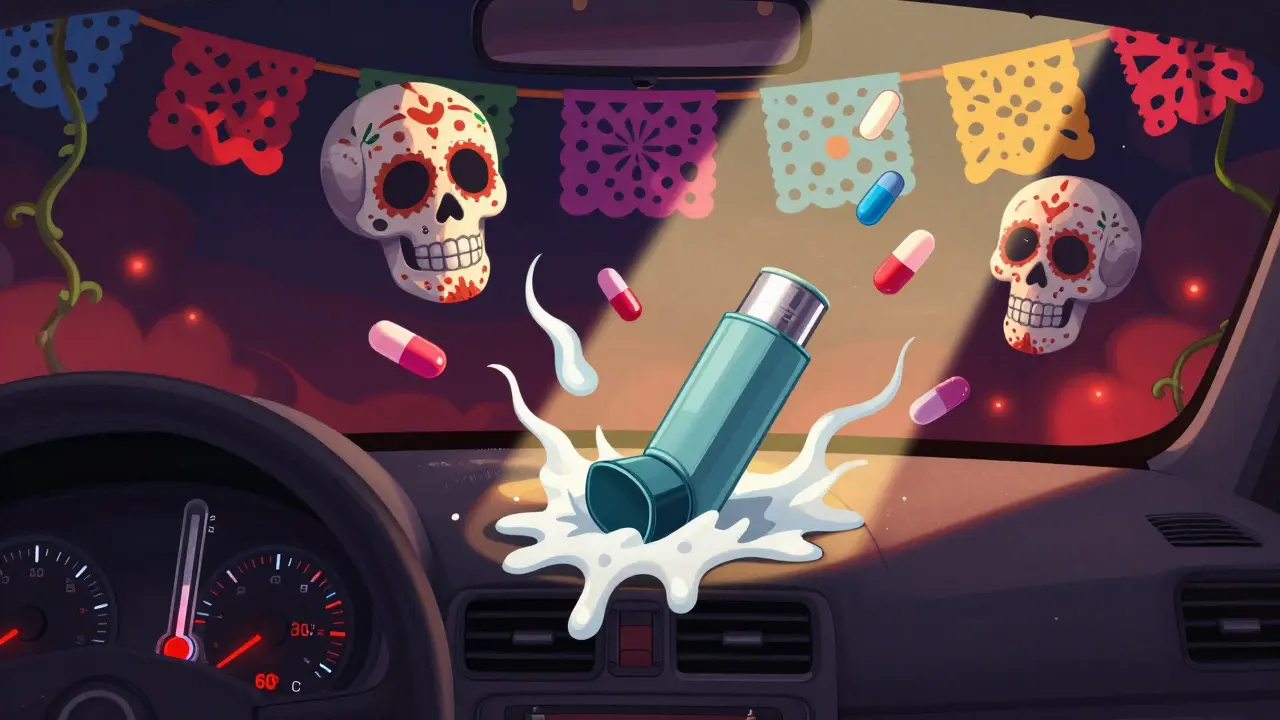
What Does Degraded Medicine Look Like?
Sometimes, the damage shows up. Look for:- Color changes-pills turning yellow, brown, or faded
- Unusual smells-like vinegar (that’s aspirin breaking down into salicylic acid)
- Tablets that stick together, crumble, or feel harder or softer than usual
- Capsules that are cracked, swollen, or leaking
- Liquids that look cloudy, discolored, or have particles floating in them
What Happens When You Take Weak Medicine?
Taking degraded meds isn’t just useless-it’s risky. Antibiotics: If they’re too weak, they don’t kill all the bacteria. The survivors become resistant. That’s how superbugs form. Insulin: Lower potency means higher blood sugar. That leads to nerve damage, kidney problems, vision loss-slow, silent damage. Nitroglycerin: A failed dose during a heart attack? That’s not a near-miss. That’s life or death. EpiPens: If the spring doesn’t fire, you’re relying on luck. And luck doesn’t come with a prescription. The FDA is clear: “Using expired medicines is risky and possibly harmful to your health.” That warning applies even if the expiration date is still months away. Storage matters more than the printed date.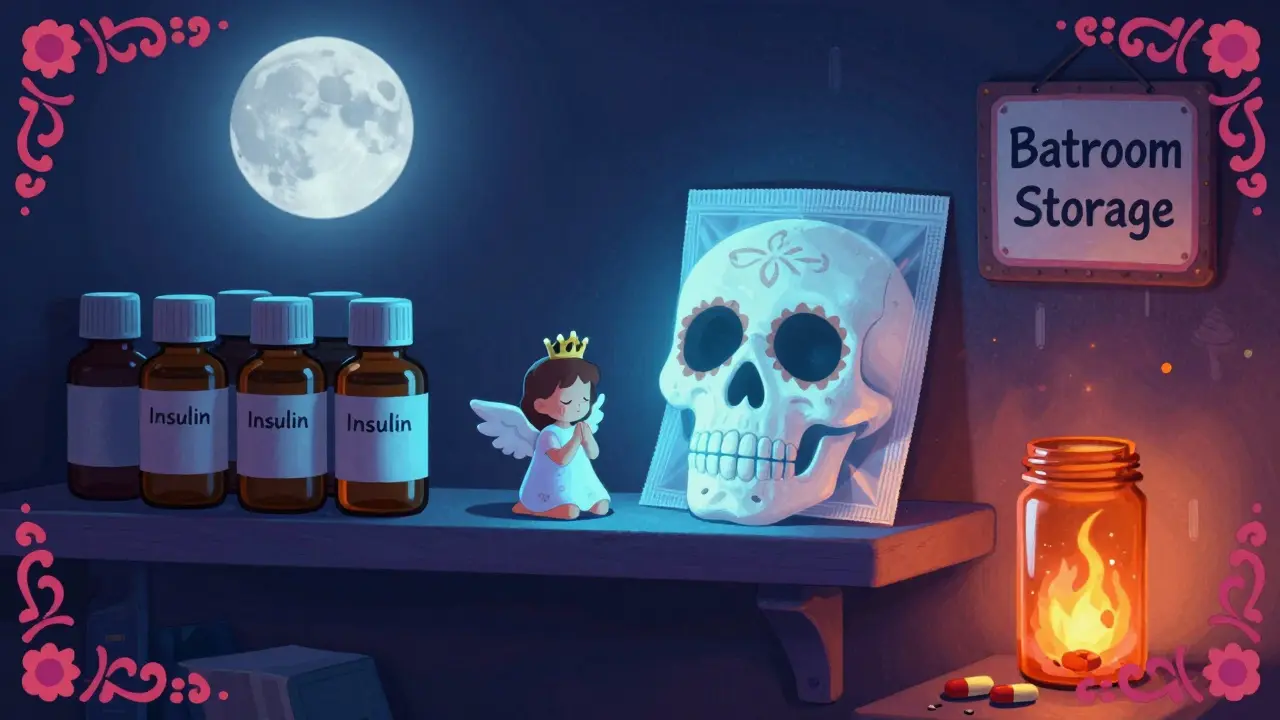
How to Store Medicine Correctly
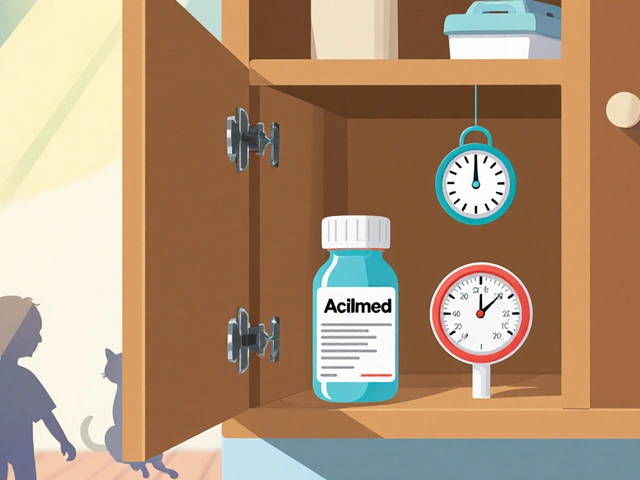
Follow these simple rules:- Keep meds in a cool, dry place-between 15-25°C (59-77°F)
- Avoid bathrooms, kitchens, and windowsills
- Use a bedroom drawer, a closet shelf, or a dedicated storage box
- Keep bottles tightly closed. Don’t transfer pills to pill organizers unless you’re using them right away
- Protect from light-opaque containers help
- For insulin, thyroid meds, or biologics: refrigerate until first use, then store at room temperature below 25°C
- When traveling: Use a small insulated bag with a cool pack for sensitive drugs. Pharmacies sell these for under £5
- Never leave meds in a car, even for 10 minutes
What About Climate Change?
It’s getting harder to keep medicine safe. Heat waves are longer. Summers are hotter. In places like southern Europe or parts of the U.S., temperatures regularly hit 35°C (95°F)-well above the safe range. The World Health Organization now calls medication stability in extreme heat a growing public health threat. Pharmacies are starting to use better packaging: desiccants to absorb moisture, dark bottles to block light, and temperature-sensitive labels that change color if the drug got too hot. In the future, smart pill bottles with Bluetooth sensors might alert you if your meds got too warm. But for now, the best protection is still simple: store them right.When in Doubt, Throw It Out
If you’re not sure whether your medicine is still good, don’t guess. Don’t risk it. Talk to your pharmacist. They can check the stability of your meds based on how they were stored. If you’ve had your insulin in a hot car, your EpiPen in the glovebox, or your antibiotics in the bathroom-replace them. It’s cheaper to replace a pill than to pay for a hospital visit because your meds didn’t work. Your health isn’t a gamble. Your medicine shouldn’t be either.Can I still use medicine after the expiration date if it looks fine?
No. The expiration date is only valid if the medicine was stored correctly. Even if it looks normal, heat and humidity can weaken it without visible signs. Taking degraded medicine can be ineffective or dangerous, especially for life-saving drugs like insulin or EpiPens.
Is it safe to store medicine in the fridge?
Only if the label says so. Most pills don’t need refrigeration-cold can cause moisture buildup when you take them out. But insulin, some antibiotics, and biologics must be kept cold until opened. Always check the instructions.
What should I do if my medicine got left in a hot car?
Discard it. Temperatures over 40°C (104°F) can permanently damage pills, liquids, and inhalers. Even if you only left it for an hour, the risk isn’t worth it. Replace it and ask your pharmacist for advice on what to do next.
Do desiccants in medicine bottles really help?
Yes. Those little packets absorb moisture and protect pills from humidity. Never throw them out. Keep them in the bottle-even after you’ve opened it. They help extend shelf life if stored in a dry place.
Can expired medicine be harmful?
Yes. Aspirin breaks down into salicylic acid, which can irritate your stomach. Degraded antibiotics can cause resistance. Weak insulin can lead to dangerous blood sugar spikes. Some drugs become chemically unstable and may produce harmful byproducts. Never take medicine you suspect is damaged.
There are 8 Comments
Angela Goree
This is why I keep my meds in a locked drawer in my bedroom-no excuses. If you're storing insulin in the bathroom like some kind of amateur, you're not just careless-you're endangering your life. And don't even get me started on leaving EpiPens in the glovebox. That's not negligence; that's criminal stupidity.
Hank Pannell
It's fascinating how we treat pharmaceuticals as if they're inert objects, when in reality they're dynamic molecular systems governed by thermodynamics and kinetics. The degradation pathways-hydrolysis, oxidation, photodegradation-are all accelerated exponentially under elevated T and RH. The FDA's 20-25°C standard isn't arbitrary; it's the equilibrium point where degradation rates are minimized. Anything beyond that, and you're playing Russian roulette with your biochemistry.
And yet, we treat our meds like canned beans. We toss them in sun-baked cars, humid bathrooms, and unregulated drawers. The real tragedy? Most people don't even know what 'potency loss' means. They think if it looks the same, it works the same. But chemistry doesn't care about appearances.
Lori Jackson
Of course, the real problem isn't just poor storage-it's the fact that people refuse to take responsibility for their own health. You think a pill bottle is a magic talisman? That the expiration date is some divine guarantee? No. It's a contract. And if you break the storage terms, you void the warranty. And now you want the system to bail you out when your insulin fails? That's not healthcare-that's entitlement.
And don't even get me started on the 'but it looks fine' crowd. If your medication could talk, it'd scream at you for being so ignorant. You're not just wasting money-you're gambling with your organs.
Wren Hamley
My grandma used to keep her pills in a mason jar on the windowsill-'so the sun keeps 'em strong,' she'd say. She also thought the microwave could sterilize everything. Turns out, she was right about one thing: heat does something. Just not what she thought. Her nitroglycerin turned to chalk by July. She didn't know why her chest pain didn't go away. I found the jar. It smelled like vinegar and regret.
Now I keep mine in a tiny insulated pouch with a gel pack. Costs $6. Saved my life twice. Don't be a hero. Don't be a martyr. Just be smart.
Sarah Little
Just curious-do you have any data on how many ER visits are directly tied to degraded meds? I'm thinking of writing a paper on this. Also, have you considered the socioeconomic angle? People in apartments without AC or with shared kitchens can't exactly control their environment. Is this just a privilege issue disguised as personal responsibility?
innocent massawe
Thank you for this. 🙏 In Nigeria, we often store medicines in plastic bags under beds or near stoves. Many don't even know what 'humidity' means. I shared this with my village clinic. Now we use old shoeboxes with silica packets. Small thing. Big difference.
veronica guillen giles
Oh wow, so now we're blaming people for being poor? Let me guess-your meds are stored in a climate-controlled vault with a Bluetooth sensor and a personal pharmacist on speed dial? Cute. Meanwhile, I'm a single mom with no AC, a $50 copay, and a fridge full of expired baby formula. But sure, let's shame her for not keeping her insulin in a 20°C lab. How about we fix the system instead of lecturing the broken?
Ian Ring
Excellent, comprehensive post. I’ve seen this firsthand in my pharmacy-patients bring in bottles with condensation inside, pills stuck together, capsules bloated like tiny balloons. One woman brought in her EpiPen after leaving it in her car for three days during a heatwave. The plunger was frozen. She didn’t realize it wouldn’t fire until her daughter had a reaction. She cried. We replaced it. But she didn’t have the cash. We covered it. That’s not charity-it’s basic care.
Desiccants? Keep them. Always. I’ve seen people throw them out like trash. They’re not packaging fluff-they’re lifesavers. And yes, if your meds got hot, toss them. No exceptions. Even if it’s ‘just one pill.’
Climate change isn’t coming-it’s here. And it’s turning our medicine cabinets into time bombs. We need better packaging, better education, and better access. Not more guilt.
Write a comment
Your email address will not be published. Required fields are marked *