
Every year, thousands of patients in the U.S. are harmed or die because of a simple mistake in a pharmacy. A wrong dose. A drug interaction missed. A label swapped. These aren’t rare accidents-they’re preventable. And the systems designed to stop them are now the backbone of modern pharmacy operations. If you’ve ever picked up a prescription and wondered how it got from the doctor’s office to your hands without error, the answer lies in pharmacy workflow and error prevention systems. These aren’t just fancy gadgets. They’re the invisible safety net that keeps medication errors from becoming tragedies.
How Medication Errors Happen-and Why They’re So Dangerous
Pharmacies are busy. A single community pharmacy can fill over 300 prescriptions in a day. A hospital pharmacy? That number jumps into the thousands. Behind every pill, injection, or liquid dose is a chain of human decisions: reading a handwritten note, interpreting a doctor’s order, selecting the right bottle, counting tablets, labeling the container, and finally handing it over. One slip at any point can mean disaster. A 1999 report from the Institute of Medicine found that between 44,000 and 98,000 people die each year in U.S. hospitals because of preventable medical errors, with medication mistakes making up a huge chunk of that number. That’s more than car accidents or breast cancer. And it’s not just hospitals. Community pharmacies make errors too-wrong strength, wrong patient, wrong drug. The most common? Confusing similar-sounding names like hydroxyzine and hydralazine, or misreading handwritten scripts. Even a 1% error rate in a busy pharmacy means dozens of mistakes every month.What Pharmacy Workflow Systems Actually Do
Pharmacy workflow systems don’t replace pharmacists. They empower them. These are integrated software and hardware platforms that automate the steps between when a prescription is received and when it’s dispensed. Think of them as a digital assistant that never gets tired, never misreads a handwriting, and never forgets to check for allergies. At the core, these systems combine several key technologies:- Barcode scanning-Every medication vial and patient wristband has a unique barcode. Before dispensing, the system scans both. If they don’t match? It stops.
- Electronic prescribing (e-prescribing)-No more handwritten notes. Prescriptions come in digitally, reducing misinterpretation.
- Drug interaction alerts-The system cross-checks every new prescription against the patient’s full medication history, allergies, and lab results. If a patient is on warfarin and a new antibiotic is prescribed that increases bleeding risk? The system flags it before the pharmacist even sees it.
- Automated dispensing machines-Robots like BD Pyxis™ count pills, fill blister packs, and store medications under secure, temperature-controlled conditions. They’re used in hospitals to prevent theft and reduce human handling.
- Integration with EHRs-These systems talk to electronic health records. So when a pharmacist opens a patient’s profile, they see not just the current prescription, but recent hospital visits, lab values, and even notes from nurses.
This isn’t science fiction. It’s happening in hospitals and pharmacies across the U.S. every day. One study found that technology-assisted workflows detect 14 times more errors than manual checks alone. That’s not just efficiency-that’s lives saved.
The Rise of IV Compounding Systems
In hospitals, intravenous (IV) medications are especially risky. Compounding them-mixing drugs into bags or syringes-is complex. A tiny mistake in dosage or contamination can kill. That’s why specialized IV workflow systems like Wolters Kluwer’s Simplifi+ IV Workflow Management exist. These systems are built for sterile environments. They guide pharmacists step-by-step through the preparation process:- Verifying the order against the patient’s chart
- Confirming drug compatibility and stability
- Tracking the exact amount of each ingredient used
- Logging who prepared it and when
- Scanning the final product before it leaves the IV room
One hospital in Texas reported a 70% drop in IV preparation errors after adopting this system. Another, a 340B safety-net hospital, said the HL7 interface eliminated documentation chaos that used to delay treatments. These aren’t minor improvements-they’re game-changers.

Key Players and How They Compare
Not all pharmacy workflow systems are the same. Here’s a breakdown of the main types and what they do best:| System Type | Example | Best For | Key Feature |
|---|---|---|---|
| Enterprise Pharmacy Management | Epic, Cerner | Large hospitals | Full EHR integration, multi-department coordination |
| IV Compounding Specific | Wolters Kluwer Simplifi+ | Hospitals with infusion centers | Step-by-step sterile compounding workflow |
| Cloud-Based Workflow Automation | Cflow, Kissflow | Community pharmacies | Customizable task tracking, refill reminders |
| Automated Dispensing | BD Pyxis™ | Hospital floors, ERs | Secure, robotic medication storage and retrieval |
Enterprise systems like Epic and Cerner are powerful but expensive. They’re built for hospitals with thousands of staff and hundreds of prescriptions per hour. Smaller pharmacies might use Cflow or Kissflow-cloud-based tools that automate routine tasks like refill requests, prior authorizations, and inventory alerts. And then there’s BD Pyxis™, which isn’t software at all-it’s a machine. It sits on hospital units, dispensing meds directly to nurses with a swipe of a badge. No pharmacy staff needed. Just secure, accurate delivery.
Why Implementation Is Harder Than It Looks
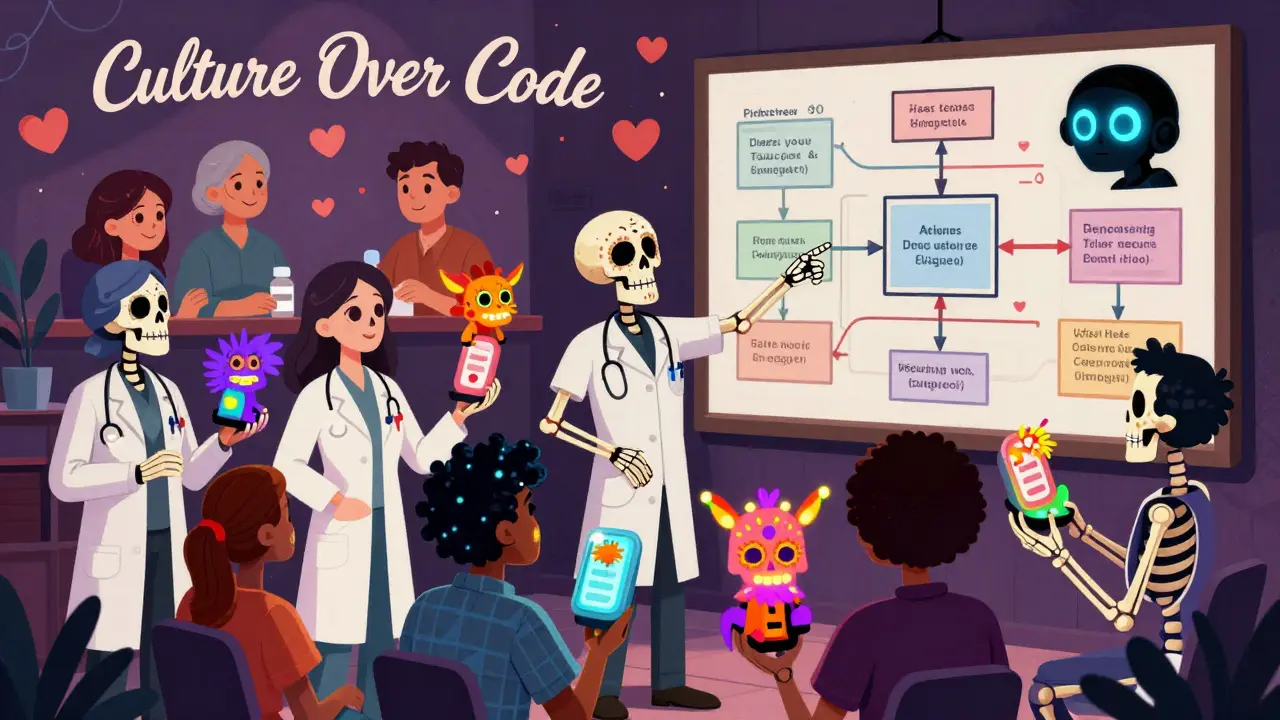
You’d think adding technology would make things easier. But in practice, it often makes things harder-at first. Many pharmacies struggle with the transition. Staff resistance is common. Pharmacists and technicians are trained to work manually. Now they’re told to scan, click, confirm, and wait for a system to approve every step. It feels slow. It feels bureaucratic. The truth? It’s not the technology that fails. It’s the lack of redesign. The American Society of Health-System Pharmacists (ASHP) says it plainly: "Adopting new software isn’t enough. You have to redesign the workflow around it." That means:- Training staff not just on how to use the system, but why it matters
- Changing how tasks are assigned-no more "just do it" culture
- Creating feedback loops so staff can report bugs or suggest improvements
- Keeping the system updated with current guidelines like USP <797> and <800> for sterile compounding
One pharmacy in Ohio spent six months transitioning. They had 12 staff members quit in the first month. The rest were overwhelmed. But after three months of retraining, redesigned shifts, and daily huddles to troubleshoot issues, error rates dropped by 65%. The key? They didn’t just install software. They changed how they worked.
Costs, Compliance, and What You Need to Know
Let’s talk money. Enterprise systems can cost $50,000 to $250,000 a year. That includes software licenses, hardware, training, and ongoing support. Smaller cloud-based tools? As low as $5,000 a year. But cost isn’t just the price tag-it’s the hidden cost of errors. A single medication error can cost a hospital over $10,000 in legal fees, extended stays, and lost reputation. Multiply that by dozens of errors a year, and you’re talking millions. That’s why most hospitals see a return on investment in under 18 months. Compliance is non-negotiable. Systems must meet:- HIPAA-to protect patient data
- USP <797>-for sterile compounding environments
- USP <800>-for handling hazardous drugs
If your system doesn’t log who accessed what, when, and why? It’s not compliant. And if it doesn’t alert you when a drug is about to expire? You’re risking patient safety and regulatory fines.
What’s Next? AI, Predictive Analytics, and the Future
The next wave of pharmacy workflow systems is smarter. Not just automated-predictive. Imagine a system that:- Notices your inventory of insulin is running low based on patient volume trends
- Flags a pattern where a certain doctor’s prescriptions are being rejected 30% of the time for unclear dosing
- Uses AI to suggest alternative medications based on a patient’s history and cost sensitivity
Some platforms are already doing this. Wolters Kluwer’s latest updates focus on aligning workflows with real-world pharmacy behavior-not just textbook rules. Others are testing AI that reads handwritten prescriptions and converts them into digital text with 99% accuracy.
And integration? It’s getting deeper. Soon, pharmacy systems will talk directly to telehealth apps. If a patient gets a virtual consult and a new prescription is sent, the pharmacy gets it in real time-with full history, allergies, and lab results already loaded. No delays. No miscommunication.




There are 11 Comments
Milad Jawabra
Megan Nayak
Divya Mallick
RacRac Rachel
Jane Ryan Ryder
Callum Duffy
Chris Beckman
Levi Viloria
Richard Elric5111
Dean Jones
Betsy Silverman
Write a comment
Your email address will not be published. Required fields are marked *