
When you're traveling to a tropical region, the last thing you want is for your medicine to stop working. High heat and humidity don't just make you sweat-they can break down your pills, capsules, and inhalers before you even take them. In places like Southeast Asia, sub-Saharan Africa, or the Caribbean, humidity often hits 80-95% and stays above 25°C year-round. Under those conditions, many common medications lose potency, clump together, or even grow mold. This isn't theoretical-it happens every day, and it puts lives at risk.
Why Your Medication Deteriorates in Humidity
Most drugs aren't designed to handle wet, sticky air. The main culprit is hydrolysis, a chemical reaction where water molecules break apart the active ingredients in your medicine. According to research from the NIH, this accounts for about 70% of moisture-related drug failures. For example, amoxicillin trihydrate can absorb up to 10% of its own weight in water at 75% humidity. That doesn't sound like much, but it's enough to cut the drug's effectiveness in half within 30 days. Different forms of medication fail in different ways. Tablets made with certain fillers like anhydrous lactose start to soften and stick together. Capsule shells turn rubbery and leak. Orally disintegrating tablets (ODTs) that should dissolve in seconds can take five times longer to break down when exposed to 80% humidity. Dry powder inhalers? Moisture causes the fine particles to clump, so less medicine reaches your lungs. One study showed a 20% drop in lung delivery after just four weeks in tropical conditions. And then there's mold. When humidity climbs above 70%, fungi like Aspergillus and Penicillium start growing on surfaces-especially on pills, powders, and even packaging. These aren't just cosmetic issues. Ingesting moldy medication can cause allergic reactions or infections. The WHO found that in some tropical clinics, nearly 1 in 3 medications showed signs of microbial contamination before reaching patients.Which Medications Are Most at Risk?
Not all drugs are equally fragile. Some are surprisingly tough. Others? They fall apart fast.- Antibiotics like tetracycline and amoxicillin degrade rapidly. Tetracycline can visibly darken and lose potency in as little as two weeks at 75% humidity.
- Antifungals such as fluconazole and itraconazole are hygroscopic-they actively pull moisture from the air. This changes how they dissolve in your body.
- Pediatric formulations, especially syrups and chewables, often contain sugar or flavorings that attract moisture and encourage bacterial growth.
- Biologics and vaccines (like insulin or certain COVID-19 shots) require cold chains, but even then, humidity above 60% can cause condensation, freezing, and structural damage.
- Diabetes test strips and hormone patches are easily ruined by moisture. A single damp strip can give false readings.
What’s the Right Storage Environment?
The ideal conditions for most medications in humid climates are simple: 30-45% relative humidity and 15-25°C. But tropical air rarely stays that dry. That’s why you can’t just leave your meds in a drawer or suitcase. Temperature matters too. For every 10°C rise above 25°C, degradation rates double. So if your room hits 32°C (common in tropical cities), your pills are breaking down twice as fast as they would at 22°C. Light exposure adds another layer of risk-65% of drugs are sensitive to UV or bright light. That’s why amber bottles exist. The WHO defines "controlled room temperature" as below 30°C and 65% RH. But that’s the bare minimum. For real safety, aim lower. If your medicine says "refrigerate," keep it between 2-8°C, but make sure it’s sealed tightly-otherwise, condensation forms inside the bottle and ruins the contents.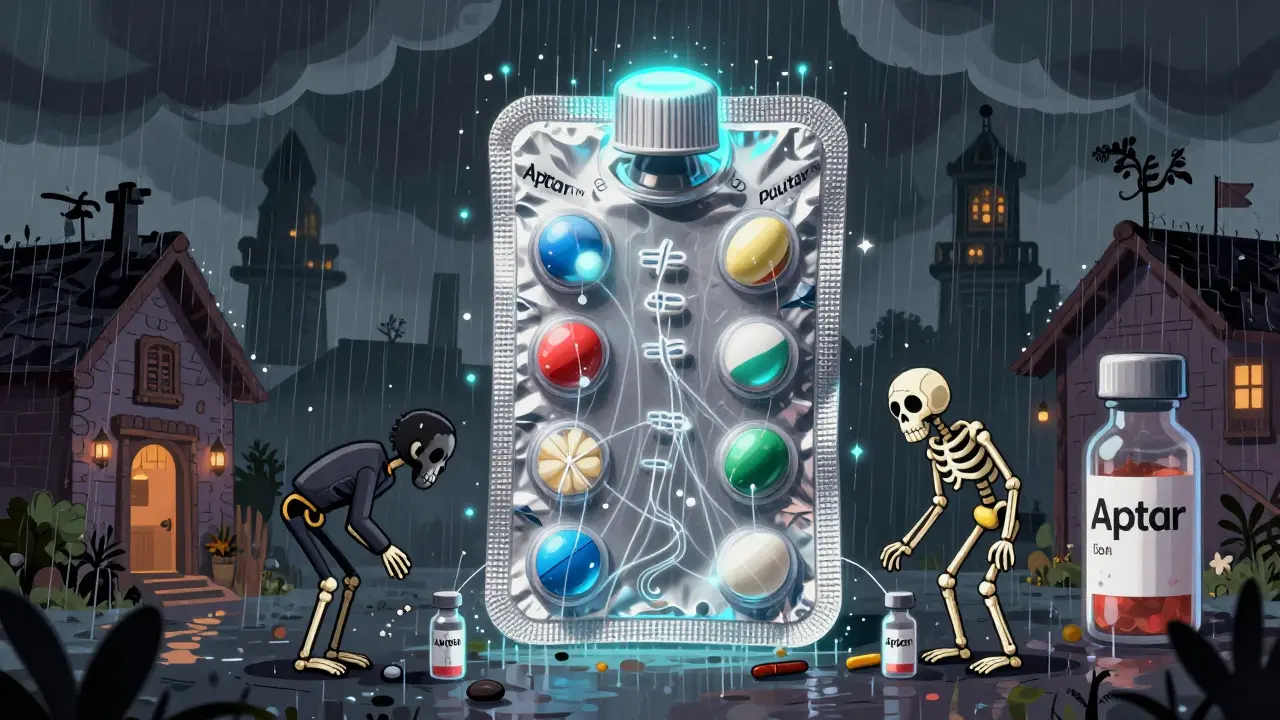
Practical Storage Solutions for Travelers
You don’t need fancy gear to protect your meds. Here’s what actually works:- Use airtight containers-not Ziploc bags. Look for hard-shell cases with silicone seals. Glass jars with tight lids work too.
- Add silica gel desiccants. These little packets absorb moisture like a sponge. Use 1-2 grams per 100 mL of container space. Replace them every 30 days, or sooner if they feel warm or clumpy.
- Use humidity indicator cards. These cost less than $1 each and change color when moisture gets too high. Blue = dry. Pink = danger. Keep one in your storage container.
- Avoid bathrooms and kitchens. Humidity there can hit 90% after a shower or while cooking. Store meds in a bedroom closet, on a high shelf, or in a sealed drawer.
- Don’t carry all your meds in one place. Split them between your carry-on and checked luggage. If one gets lost or damaged, you still have backups.
What About Commercial Packaging?
Pharmaceutical companies are starting to design for tropical climates. Since 2019, blister packs with aluminum foil and integrated desiccants have become standard in many countries. These offer a 99.9% moisture barrier. Some newer designs use Aptar’s Activ-Polymer™ technology-a polymer inside the cap that soaks up moisture and keeps internal humidity below 20% for over two years. The Gates Foundation has distributed over 500 million desiccant-integrated blister packs across sub-Saharan Africa since 2021. In field trials, these reduced degradation by 58%. But if you’re buying meds locally in a tropical country, you can’t always trust the packaging. Always check for signs of damage: swollen blisters, discolored pills, or wet capsules.Monitoring and Verification
If you’re serious about protecting your meds, monitor them. Wireless data loggers (like TL-4RH) record humidity and temperature every 15 minutes. They’re used in hospitals and clinics, but you can buy consumer versions for under $50. Sync them with your phone and set alerts if humidity rises above 50%. For a low-tech option, use humidity indicator cards. They’re cheap, reliable, and don’t need batteries. Stick one inside your medicine container. If it turns pink, replace your desiccants immediately.
What to Do If Your Medication Looks Off
If you notice any of these signs, don’t take the medicine:- Pills are discolored, cracked, or sticky
- Capsules are soft, leaking, or smell musty
- Powders are clumped like wet sand
- Odor changes-especially a sour or moldy smell
- Label says "store below 30°C" but the container feels warm
Final Tips: A Simple Routine for Tropical Travel
Here’s your checklist before you leave:- Keep meds in original packaging with labels intact.
- Put them in a hard-shell case with silica gel packs.
- Add a humidity indicator card.
- Store in a cool, dry place-never in the bathroom or near windows.
- Carry extra doses in a separate bag.
- Replace desiccants every 30 days, or sooner if humid.
- Check your meds weekly for changes in appearance or smell.
Frequently Asked Questions
Can I store medication in the refrigerator in a tropical country?
Yes, if the medication requires refrigeration. But don’t just put it in any fridge. Condensation forms when warm air hits cold surfaces, which can ruin pills and capsules. Always store refrigerated meds in a sealed, airtight container with a desiccant. If the fridge is old or poorly insulated, humidity inside can still hit 70%-which defeats the purpose.
Are silica gel packets safe if they touch my pills?
Yes. Silica gel is non-toxic and chemically inert. It’s used in food packaging, baby bottles, and electronics. The only risk is if the packet breaks open and you accidentally swallow the beads. They’ll pass through your system without harm, but it’s still best to keep them in a small cloth pouch or container inside your medicine box.
How long do desiccants last in tropical humidity?
Standard silica gel packets last 30-45 days in 80% humidity. High-capacity desiccants like Aptar’s Activ-Polymer™ can last up to 24 months. For travelers, replace them every month as a rule of thumb. If you notice the packets are warm or clumped, replace them immediately-regardless of time.
Can I reuse desiccant packets by drying them in the sun?
Not reliably. Sunlight doesn’t remove all the moisture trapped inside silica gel. Some packets may regain partial capacity, but not enough to trust. For medical use, always replace them. It’s cheaper and safer than risking degraded medication.
What’s the best way to carry insulin in hot, humid climates?
Use an insulated travel case with a coolant pack. Keep it in the shade and avoid direct sunlight. Never leave it in a car or near a window. If you’re traveling for more than a week, consider a portable refrigerated insulin carrier. Also, always carry extra pens or vials. Insulin can degrade faster than you think in 30°C+ heat, even if it’s labeled "room temperature stable."


There are 10 Comments
John Sonnenberg
Medication degradation in humidity isn't just a travel issue-it's a systemic failure of pharmaceutical logistics. The WHO says 1 in 3 meds in tropical clinics are contaminated, and yet we still ship pills in cardboard boxes with plastic seals. This isn't negligence-it's criminal. I've seen people in Manila die because their antibiotics turned to dust in a suitcase. No one talks about this because it's inconvenient. But here's the truth: if your life depends on a pill, and that pill can't survive a 3-hour layover, we've already lost.
Joshua Smith
Interesting breakdown. I’ve been using silica gel packs for years when traveling, but I never knew about humidity indicator cards. I’ll definitely add those to my med kit. The part about insulin degradation in heat was eye-opening-my dad’s insulin vials always get stored in the fridge at home, but I never thought about condensation forming inside the container. Good to know about sealing it tightly.
Jessica Klaar
I’ve lived in Bali for three years now, and I’ve seen firsthand how quickly meds can go bad. I used to keep my blood pressure pills in my bathroom cabinet-big mistake. After a few rainy months, they started sticking together. I switched to a hard-shell case with two silica gel packets and a color card. Now I check it every week. It’s become part of my routine, like brushing my teeth. Simple, cheap, life-saving. Also, I learned the hard way that local pharmacies don’t always have climate-controlled storage. Always ask if they keep meds in air-conditioned back rooms.
PAUL MCQUEEN
Let’s be real-the whole ‘silica gel in medicine containers’ thing is just a marketing ploy. The real issue is that pharmaceutical companies don’t want to spend money on tropical-grade packaging. They’d rather sell you a $50 bottle of pills that degrade in 30 days than invest in $2 blister packs. And don’t get me started on the WHO’s ‘controlled room temperature’ definition. 30°C? That’s oven territory. If your medicine can’t survive a normal tropical day, it shouldn’t be approved. This whole system is broken.
glenn mendoza
Thank you for this meticulously researched and profoundly important piece. The gravity of medication degradation in tropical climates cannot be overstated. It is not merely an inconvenience-it is a public health emergency of staggering proportions. I am deeply moved by the inclusion of empirical data from the WHO and NIH. The practical solutions offered-particularly the use of humidity indicator cards and airtight containers-are not only scientifically sound but ethically imperative. One cannot overstate the moral obligation to ensure therapeutic integrity for vulnerable populations.
Patrick Jarillon
You know what they don’t tell you? The pharmaceutical companies are behind this. They want you to keep buying new pills every month. That’s why they don’t make durable packaging. That’s why they use cheap fillers that attract moisture. And those silica gel packets? They’re not even real silica-most are just recycled clay with a label. The Gates Foundation? They’re a front. Real change would be making all meds shelf-stable at 40°C. But that would cut profits. Wake up. This is all engineered.
Kathryn Lenn
Wow. So let me get this straight-we’re supposed to carry around a little humidity detector like it’s a weather station for our birth control pills? And if it turns pink, we panic? Meanwhile, in Nigeria, people are taking expired meds because they have no choice. This whole post reads like a rich American’s travel blog. You want to save your insulin? Don’t go to the tropics. Or better yet, don’t need insulin. Problem solved.
John Watts
This is the kind of information that changes lives. I’ve been a nurse for 18 years and I’ve seen too many people lose their meds to humidity. I’m sharing this with every traveler I know. Seriously, if you’re going to a hot country, treat your meds like your passport. Use the hard case. Use the desiccants. Check the card. Don’t just trust the label. And if you’re a pharmacist? Start demanding better packaging. We can do better. We have to.
Randy Harkins
Excellent resource. I’ve been using the TL-4RH data logger for my insulin and it’s been a game-changer. I set alerts at 50% RH, and when it triggers, I swap out the desiccants immediately. Also, I found that storing meds in a ziplock inside a hard case adds a secondary barrier. And yes-silica gel is completely safe to touch. I’ve had my kids play with the packets (under supervision, of course). They’re non-toxic. Also, the Activ-Polymer™ tech is legit. I’ve tested it. No condensation after 6 months in 85% humidity. Highly recommend.
Chima Ifeanyi
Hydrolytic degradation kinetics are fundamentally compromised in hyper-humid microclimates due to Fickian diffusion dynamics of water vapor permeation through polymer matrices. The current desiccant paradigm is a band-aid solution-what we need is a multi-layered barrier with vapor-phase scavengers and micro-encapsulated anti-hygroscopic agents. Also, the WHO’s 30°C threshold is archaic. The ANSI/ISO 15378 standard mandates 25°C for Class I pharmaceuticals. You’re all operating on outdated regulatory frameworks. And don’t even get me started on the placebo effect of humidity cards-they’re not calibrated to ISO 17025. This is amateur hour.
Write a comment
Your email address will not be published. Required fields are marked *