
What Really Causes Gout?
It’s not just about eating too much steak or drinking too much beer. Gout happens because your body can’t properly handle purines-the building blocks of DNA and RNA. When these break down, they turn into uric acid. Normally, your kidneys flush it out. But when there’s too much, or your kidneys can’t keep up, uric acid forms sharp crystals in your joints. That’s when the pain hits: sudden, burning, and often in the big toe.
For decades, people thought gout was a punishment for rich diets. Hippocrates noticed it in wealthy men back in 400 BCE. But science now shows it’s more about biology than burgers. About 90% of gout cases come from your body making too much uric acid or not excreting enough-not from diet alone. And here’s the kicker: once you’ve had one flare, your risk of another goes up dramatically unless you treat the root cause.
Purine Metabolism: The Hidden Pathway Behind the Pain
Your body breaks down purines through a series of steps. Adenosine and guanosine turn into inosine and guanine, then into xanthine. Finally, an enzyme called xanthine oxidase turns xanthine into uric acid. That’s the endpoint. Humans lost the enzyme that breaks down uric acid further-uricase-about 15 million years ago. So we’re stuck with it.
Most uric acid leaves through your kidneys. But here’s the problem: your kidneys reabsorb about 90% of what they filter. Two transporters, URAT1 and GLUT9, pull it back into your bloodstream. If those are overactive-or if you make too much purine to begin with-uric acid builds up. Levels above 6.8 mg/dL mean crystals start forming. At 9 mg/dL or higher, nearly 28% of people will develop gout.
Genetics play a big role. Variants in the SLC2A9 gene affect how well your kidneys excrete uric acid. Some people are just born with a harder time clearing it out. That’s why two people eating the same diet can have wildly different uric acid levels.
Why Urate-Lowering Therapy Isn’t Optional
Many people think gout is just about managing flares. But that’s like treating a leaky roof by mopping the floor. The real fix is lowering uric acid levels so crystals dissolve and stop forming. The American College of Rheumatology says the goal is below 6.0 mg/dL for most people, and even lower-5.0 mg/dL-if you have visible tophi (those lumpy deposits under the skin).
Studies show that if you keep uric acid under 6.0 mg/dL for a year or more, tophi shrink. Joints heal. Flares become rare. But here’s the catch: most people stop their meds too soon. A 2022 survey found that 61% of gout patients quit their treatment within a year. Why? They feel fine. They don’t realize the crystals are still there, quietly damaging their joints.
Unlike other forms of arthritis, gout can be reversed-if you stick with the right treatment long-term.
The Three Types of Urate-Lowering Drugs
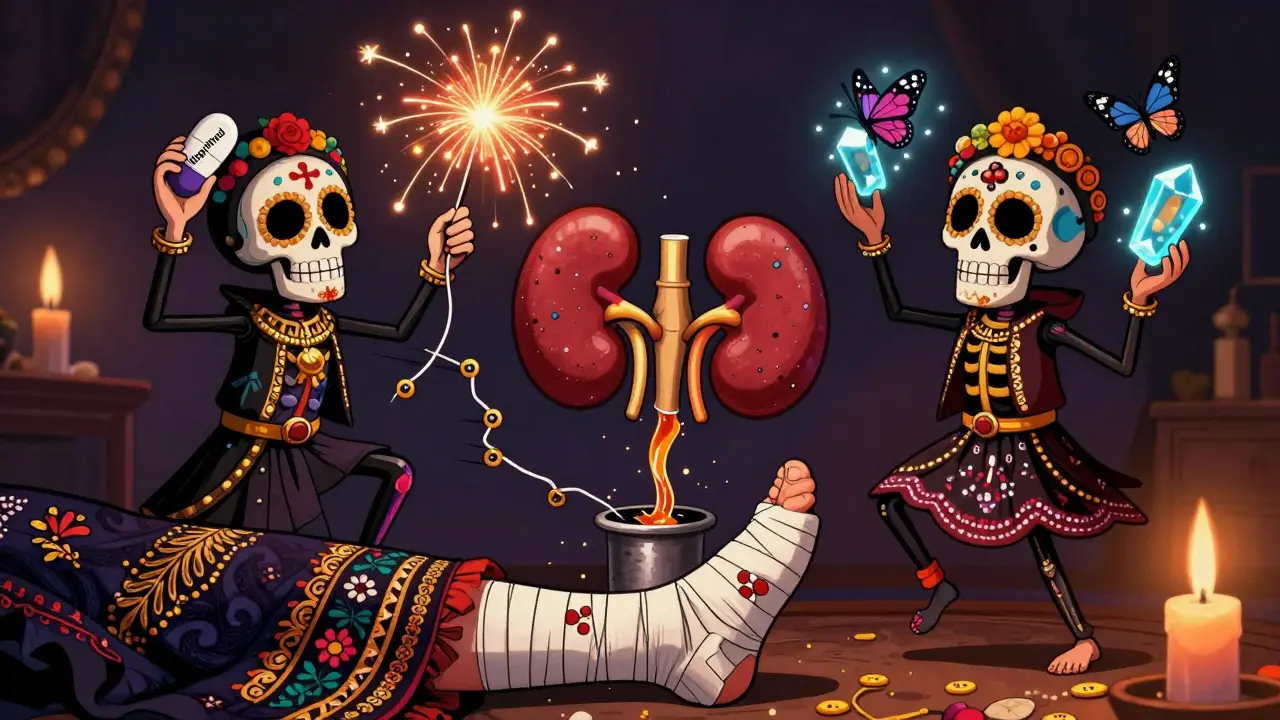
There are three main classes of drugs that lower uric acid. Each works differently.
Xanthine Oxidase Inhibitors (XOIs): Stop Production at the Source
These block the final step: xanthine → uric acid. The two main ones are allopurinol and febuxostat.
- Allopurinol has been around since 1966. It’s cheap-about $4 a month-and works well if you take enough. But most people don’t. Doctors often start at 100 mg/day, but the average effective dose is 300 mg or higher. Only 47% of patients hit target levels on 300 mg. At 600 mg, that jumps to 85%. The problem? Many doctors are afraid to increase the dose, fearing side effects.
- Febuxostat is stronger and doesn’t need dose adjustments for kidney problems. It hits target levels in 67% of patients at 80 mg/day. But it carries a black box warning from the FDA: higher risk of heart-related death in people with existing heart disease. Use it carefully.
Uricosurics: Help Your Kidneys Flush It Out
These drugs block URAT1, the transporter that pulls uric acid back into your blood. That means more gets excreted.
- Probenecid is old but still useful-if your kidneys are working well. It’s useless if your creatinine clearance is below 50 mL/min. Also, it can trigger a flare when you start it, so it’s always paired with anti-inflammatory meds.
- Lesinurad was approved in 2015 but pulled from the market in 2019 because it caused serious kidney damage. It’s a cautionary tale: even good science can have hidden risks.
Uricase Agents: Break Down Uric Acid Completely
These are the heavy lifters. They mimic the enzyme humans lost long ago.
- Pegloticase converts uric acid into allantoin, which your body easily removes. It’s the only drug that can dissolve large tophi in months. But it’s expensive-over $16,000 a month-and requires IV infusions every two weeks. About 26% of patients get serious allergic reactions. You need to be tested for HLA-B*58:01 gene first. Still, for people with severe, treatment-resistant gout, it’s life-changing.
What the Experts Are Saying
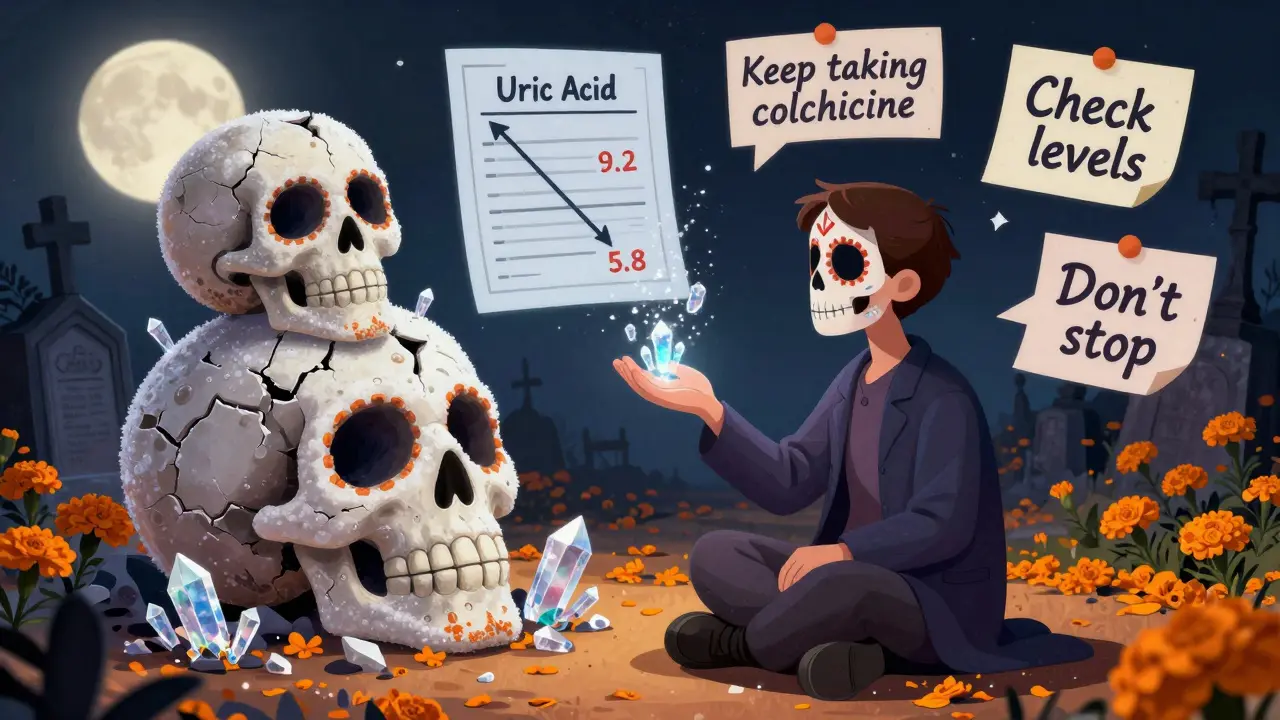
Dr. Michael Pillinger at NYU says the biggest mistake in gout care is under-dosing allopurinol. He’s seen patients go from 9.2 mg/dL to 5.8 mg/dL-after increasing to 300 mg/day. But 92% of patients who hit their target were on doses higher than 300 mg.
On the flip side, Dr. Nicola Dalbeth points out that only 37% of U.S. gout patients ever reach target levels. Why? Access, cost, and lack of follow-up. Many primary care doctors don’t monitor uric acid levels after starting treatment. One 2024 study found only 29% did.
And then there’s the cost problem. Allopurinol costs $4 a month. Febuxostat? $59. Pegloticase? $16,428. Insurance battles can take months. One Reddit user spent 17 appeals to get pegloticase covered. That’s not just a medical issue-it’s a systemic failure.
Side Effects and Real Patient Stories
Medications aren’t perfect. Allopurinol can cause a severe rash in 12% of users-sometimes fatal. That’s why HLA-B*58:01 testing is now standard in Asian populations, where the risk is higher. Febuxostat can raise liver enzymes. Pegloticase can cause infusion reactions in nearly a third of patients.
On MyGoutTeam, 68% of allopurinol users say it works, but 42% report side effects. Febuxostat users are more satisfied (73%) but worry about heart risks. One user wrote: "After 6 months on 300mg allopurinol, my uric acid dropped from 9.2 to 5.8-but I had 3 flares during titration. My doctor never warned me about that."
Flares during treatment are common. That’s why the ACR recommends starting colchicine (0.6 mg daily) at the same time as urate-lowering therapy. Keep it going for at least six months. It doesn’t prevent flares forever-it just helps you survive the transition.
Diet Matters-But Not Like You Think
Yes, liver, anchovies, and beer raise uric acid. But diet alone rarely brings levels down enough. A 2004 study showed dietary changes only lower uric acid by 1-2 mg/dL. That’s not enough if you’re at 9.
Still, cutting back helps. Avoid organ meats. Skip sugary drinks-fructose boosts purine production. Beer is worse than wine because it’s high in guanosine. Red meat? Limit it. But you don’t need to go vegan. Focus on consistency, not perfection.
What’s Next? New Drugs on the Horizon
Science isn’t standing still. Verinurad, a new selective URAT1 blocker, is in Phase III trials. When paired with febuxostat, it got 74% of patients to target in just 12 weeks. Arhalofenate, a dual-action drug that lowers uric acid and reduces inflammation, cut flare frequency by 58% in a 2024 trial.
The future is personalized. Genetic testing will tell you if you’re a slow uric acid excretor. That could guide whether you need an XOI or a uricosuric first. Longer-acting uricase injections are being tested too-maybe one shot a month instead of two weeks.
What You Need to Do Right Now
- If you’ve had a gout flare, ask your doctor for a serum uric acid test. Don’t wait for the next flare.
- If you’re on allopurinol and your level is still above 6.0 mg/dL, ask if you can increase the dose. Most people need more than 300 mg.
- Start colchicine 0.6 mg daily when beginning any urate-lowering drug. Keep it for at least six months.
- Get your uric acid checked every 2-5 weeks until you hit target, then every 6 months.
- Don’t stop your meds because you feel fine. The crystals are still there.
Gout is no longer a lifestyle curse. It’s a treatable metabolic condition. But it demands patience, persistence, and the right dose. You don’t need to live in pain. You just need to treat the root cause-not just the symptoms.



There are 12 Comments
Matt W
Anthony Massirman
Vatsal Srivastava
George Firican
larry keenan
Brett MacDonald
Ellie Norris
Matt W
phara don
Nick Flake
jay patel
Ansley Mayson
Write a comment
Your email address will not be published. Required fields are marked *