
Every year, millions of people in the U.S. take dietary supplements-vitamins, herbs, fish oil, probiotics, or plant extracts-thinking they’re harmless because they’re "natural." But here’s the truth: just because something comes from a plant doesn’t mean it’s safe to mix with your prescriptions. And if you don’t tell your doctor about it, you’re putting yourself at risk.
Why Your Doctor Needs to Know What You’re Taking
More than 77% of American adults use dietary supplements, according to the Council for Responsible Nutrition. That’s over 200 million people. And yet, only about one in three of them tells their doctor. Why? Many think supplements aren’t "real medicine." Others worry their doctor will judge them. Some just forget. But the consequences aren’t small.
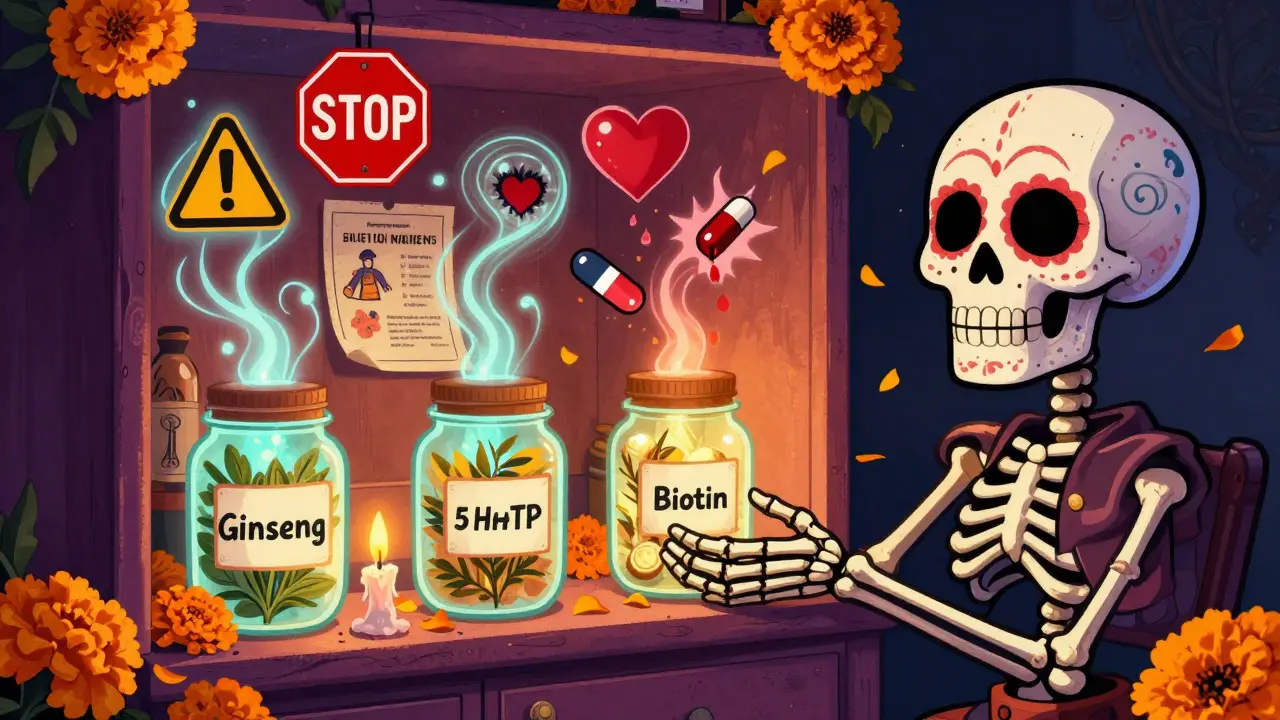
St. John’s wort, a popular herb for mood support, can make birth control pills, blood thinners, and even antidepressants stop working. Garlic supplements can thin your blood so much that they cause dangerous bleeding during surgery. Ginkgo biloba, often taken for memory, can spike your risk of stroke if you’re on aspirin or warfarin. These aren’t rare cases-they’re documented in medical journals and emergency room reports.
The FDA doesn’t approve supplements before they hit the shelves. Unlike prescription drugs, which go through years of testing, supplements are sold with no proof they work or are safe. The only rule? They can’t be outright poisonous or mislabeled. That means what’s on the bottle might not match what’s inside. A 2022 FDA report found nearly 1 in 5 supplements contained hidden drugs or contaminants not listed on the label.
The Disclosure Gap: What the Numbers Don’t Tell You
Only 33% of people who use herbal or dietary supplements tell their doctor. That number drops to 8.4% for St. John’s wort and 12.7% for Ginkgo biloba. Why? Because most doctors don’t ask.
Research shows that when providers use open-ended questions-like “What supplements or natural products are you using to manage your health?”-disclosure jumps to 72%. But if they just say, “Do you take any vitamins?” most people say no. They don’t think of turmeric capsules or melatonin gummies as "medications."
Patients with chronic conditions-diabetes, high blood pressure, heart disease-are at the highest risk. Nearly half of supplement users have one or more long-term illnesses. Yet, disclosure rates among this group are still only 51%. That’s like driving blindfolded while your doctor tries to steer.
International data shows this isn’t inevitable. In the U.K. and Australia, disclosure rates are nearly 60%. Why? Their healthcare systems train providers to ask routinely. In the U.S., medical students get less than three hours of training on supplements during four years of school. No wonder they’re uncomfortable asking.
What You Should Tell Your Provider
You don’t need to remember every brand name. But you do need to give your care team enough to work with. Here’s what matters:
- What: The exact name of the supplement. Say “Panax ginseng,” not just “ginseng.” Some products use different species with different effects.
- How much: The dosage. “One pill a day” isn’t enough. Was it 500 mg? 1,000 mg? 2,000 mg? Dose makes all the difference.
- Why: Are you taking it for sleep? Joint pain? Energy? Knowing your goal helps your doctor assess risk.
- How long: Have you been taking it for weeks? Years? Some interactions build over time.
Don’t leave out anything-even if it’s "just" a tea, a powder, or a home remedy your grandma swore by. Turmeric, green tea extract, ashwagandha, and even apple cider vinegar can interact with medications. One patient on blood pressure meds started drinking green tea daily. Within weeks, her BP spiked. The catechins in the tea blocked her medication’s absorption.
How to Bring It Up Without Feeling Awkward
If you’re nervous about bringing it up, try this script:
“I’ve been taking a few supplements to help with [sleep, energy, digestion, etc.]. I know they’re not prescription, but I want to make sure they’re safe with what you’ve given me.”
Or even simpler: “I don’t want to hide anything from you. Here’s what I’m taking.” Then hand them a list.
Many clinics now give patients a supplement log-paper or digital-to fill out before appointments. If yours doesn’t, make your own. Write it down. Bring it. Keep it updated. Treat it like your medication list.
One nurse practitioner in Boston started asking: “What supplements or natural products are you using that your pharmacist might not know about?” Disclosure in her practice doubled.
What Your Doctor Should Do
Doctors aren’t expected to memorize 1,200+ possible drug-supplement interactions. But they should know how to check.
Tools like the Natural Medicine Database and Micromedex are used in hospitals to flag risks. If your provider says, “I don’t know about that,” ask if they can look it up. Most can. If they brush you off, that’s a red flag.
Starting in 2024, major electronic health record systems like Epic will include a built-in supplement module that auto-checks for interactions. But until then, it’s on you to start the conversation.
Also, ask if your provider has been trained on supplements. The National Center for Complementary and Integrative Health offers free online courses. If they haven’t taken one, it’s worth mentioning. More clinicians are doing it-over 14,000 have completed the training since 2020.
What’s Changing-and What’s Not
The supplement industry is growing fast. The global market hit $152 billion in 2022. There are over 85,000 products in the U.S. alone. But regulation hasn’t kept up. The FDA inspects less than 1% of supplement factories. Only 1,200 new ingredients have been officially notified to the FDA since 1994-even though millions of products are sold.
There’s momentum for change. The Dietary Supplement Listing Act of 2022 would require manufacturers to register products with the FDA. The Supplement Safety Act, introduced in early 2023, would require pre-market safety reviews. Public support is strong-68% back it, according to a Kaiser poll.
But until laws change, you’re the last line of defense. No one else will check your supplements. Your pharmacist might not know. Your insurance won’t ask. Only you can make sure your care team has the full picture.

Real Risks, Real Stories
A 62-year-old man took glucosamine for his knees and St. John’s wort for anxiety. He didn’t think either mattered. Then he had a heart attack. His blood thinner, warfarin, had been rendered useless by the herb. His INR-the measure of blood clotting-was dangerously low. He survived, but barely.
A woman on antidepressants started taking 5-HTP to feel better. Within days, she was hospitalized with serotonin syndrome-a life-threatening overload of serotonin. Her doctor had no idea she was taking it.
These aren’t outliers. They’re textbook cases. And they’re preventable.
What to Do Right Now
Don’t wait for your next appointment. Take five minutes today.
- Look in your medicine cabinet. Write down every supplement, herb, tea, or powder you take-even if you only use it once a week.
- Write the name, dose, and why you take it.
- Bring it to your next visit. Hand it to your doctor or nurse. Say: “I want to make sure these are safe with everything else.”
- If you don’t have an appointment soon, call your provider’s office. Ask if you can send a list to your care team.
It’s not about being perfect. It’s about being honest. You’re not asking for permission. You’re protecting your life.
Do I need to tell my doctor about vitamins and minerals?
Yes. Even common vitamins like vitamin K, vitamin E, and vitamin D can interact with medications. Vitamin K reduces the effect of blood thinners like warfarin. High doses of vitamin E can increase bleeding risk. Your doctor needs to know your full intake, even if it’s just a daily multivitamin.
Are natural products safer than prescription drugs?
No. "Natural" doesn’t mean safe. Many powerful drugs come from plants-digoxin from foxglove, morphine from poppies. Supplements can be just as potent. The difference is they’re not tested for safety before sale. That’s why disclosure is critical: your doctor needs to know what you’re using to assess risk.
What if my doctor dismisses supplements as "just herbs"?
Stay firm. Say: "I’m not asking you to recommend them-I’m asking you to understand what I’m taking so you can keep me safe." If they continue to ignore it, consider finding a provider who takes integrative health seriously. Your safety matters more than loyalty to one doctor.
Can supplements affect lab tests?
Yes. Biotin (vitamin B7), often taken for hair and nails, can cause false results in thyroid and heart tests. High-dose vitamin C can make blood sugar readings inaccurate. Always tell your lab tech or doctor about supplements before any blood work.
Is it okay to stop a supplement before surgery?
Some should be stopped-especially those that affect blood clotting like garlic, ginkgo, fish oil, and ginger. But don’t stop without talking to your surgeon or anesthesiologist. Stopping abruptly can cause withdrawal or rebound effects. Ask for specific guidance at least two weeks before your procedure.
Where can I find reliable information on supplement safety?
Use trusted sources like the National Institutes of Health’s Office of Dietary Supplements (ODS), the Natural Medicine Database, or the Mayo Clinic’s supplement guide. Avoid websites that sell products-they often exaggerate benefits and hide risks. Stick to science-backed, non-commercial resources.
Next Steps: Protect Yourself
Don’t assume your supplements are invisible to your care team. They’re not. They’re in your body, affecting your chemistry, your labs, your medications. The system isn’t designed to catch these gaps-but you can be.
Start today. Write down what you take. Bring it to your next appointment. Ask the question. Say it out loud: "I need you to know this." It’s not awkward. It’s essential. And it might just save your life.

There are 10 Comments
Indra Triawan
So we're just supposed to trust doctors who haven't been trained to even ask about supplements? 😒 I've been taking ashwagandha for anxiety for two years and my PCP just nodded and said 'oh nice' like it was a smoothie. No follow-up. No research. Just vibes. Meanwhile, my thyroid levels are all over the place. Who's really in charge here?
Lily Lilyy
You are so brave for speaking up! 💪 Every time you tell your doctor what you’re taking, you’re not just protecting yourself-you’re helping change the system. One honest conversation at a time. Keep going, warrior! 🌿❤️
Joann Absi
AMERICA IS BEING POISONED BY LAZY DOCTORS AND STUPID SUPPLEMENTS!!! 🇺🇸🔥 I took ginkgo for a month and my brain felt like a wet sock-BUT MY DOCTOR DIDN’T ASK!!! THIS IS WHY WE NEED TO BAN ALL HERBS AND GO BACK TO REAL MEDICINE!!! 🤬💊 #StopTheHerbConspiracy
Mukesh Pareek
The pharmacokinetic interference profile of phytochemicals like hypericin in St. John’s wort is well-documented in CYP3A4 and P-glycoprotein modulation pathways. The lack of standardized dosing and bioavailability assays in nutraceuticals renders clinical risk stratification inherently unreliable. You are not ‘just taking vitamins’-you are engaging in unregulated polypharmacy with a 19% contamination rate per FDA 2022 data. This is not anecdotal-it is systems failure.
Rachel Wermager
Actually, the FDA doesn’t regulate supplements because they’re classified as food under DSHEA of 1994-not because they’re ‘untested.’ And ‘natural’ doesn’t mean safe? Please. Penicillin is natural. So is arsenic. The real issue is that most people can’t distinguish between ‘herbal’ and ‘pharmaceutical-grade.’ If you’re taking 1,000 mg of vitamin C daily, you’re just peeing out the excess. But if you’re on warfarin and suddenly start taking high-dose vitamin K? That’s when you’re playing Russian roulette with your INR.
Tom Swinton
I just want to say-I’ve been taking turmeric capsules for my arthritis for five years now, and honestly, I didn’t think it mattered until my cousin had that surgery and they found out she’d been taking fish oil every day and she almost bled out on the table… and I thought… wow… I’ve been doing the same thing. So I wrote everything down. Every capsule, every tea, every ‘just a little bit’ thing my mom gave me. I printed it. I brought it. And my doctor didn’t laugh. He actually said, ‘Thank you for this.’ And then he looked up my turmeric dose and said, ‘You’re fine, but maybe cut back.’ And I felt… seen. Like, for the first time, my ‘weird’ habits mattered. So yeah. Write it down. Bring it. Don’t be shy. You’re not annoying. You’re saving your life.
Leonard Shit
lol i took a 'natural' sleep aid that had melatonin + valerian + something called 'calmblend'... turned out it had a tiny bit of benadryl. my doctor didn't know either. i just told him 'i think i accidentally took an antihistamine' and he laughed and said 'welcome to the 2020s'. we're all just guessing here. but at least we're guessing together? 🤷♂️
Gabrielle Panchev
Wait-so you’re telling me that if I take a ‘natural’ weight-loss tea that says ‘detox’ on the label, it could be laced with sibutramine? And my doctor won’t know unless I tell him? And the FDA only inspects 1% of factories? And I’m supposed to trust this? And yet, the same people who scream about Big Pharma are the ones buying these ‘clean’ supplements from Instagram influencers? The cognitive dissonance here is so thick you could spread it on toast. And now I’m supposed to write a list? Like I’m filling out a grocery list for my soul? This isn’t healthcare. It’s a horror movie written by a marketing intern.
Venkataramanan Viswanathan
In India, we have used turmeric, neem, and ashwagandha for centuries without modern clinical trials. But we also had elders who knew dosage, season, and body type. Today, we take capsules like candy. The problem is not the herb. The problem is the loss of context. A doctor does not need to memorize 1,200 interactions. He needs to ask: 'Who taught you to take this?' and 'Why now?' That is the real medicine.
Saylor Frye
Wow. So the solution to corporate negligence and regulatory capture is… asking nicely? With a printed list? How quaint. You’re asking people to be their own pharmacists while the industry floods the market with 85,000 unregulated products. The real issue isn’t disclosure-it’s that we’ve outsourced our health to a system that profits from our ignorance. Your list won’t fix this. Only systemic reform will. But hey, at least you’re not a monster for taking ginkgo.
Write a comment
Your email address will not be published. Required fields are marked *