
When someone has symptoms of lupus, scleroderma, and muscle weakness all at once, doctors don’t always know what to call it. That’s because these aren’t just random combinations-they’re autoimmune overlap syndromes, where the body attacks itself in more than one way at the same time. Unlike classic autoimmune diseases that fit neatly into boxes, overlap syndromes blur the lines. They’re messy, complex, and often misunderstood. And for patients, this means years of misdiagnosis, scattered specialists, and treatments that don’t quite fit.
What Exactly Are Autoimmune Overlap Syndromes?
An autoimmune overlap syndrome happens when a person meets the diagnostic criteria for two or more distinct autoimmune connective tissue diseases. The five main ones are systemic lupus erythematosus (SLE), scleroderma, polymyositis, rheumatoid arthritis, and Sjögren’s syndrome. But instead of having just one, patients show features of two or more. This isn’t rare. About 1 in 4 people with a connective tissue disease will develop signs of another within five to ten years.
Some overlap syndromes have specific names and markers. Mixed connective tissue disease (MCTD) is one of the best-known. It’s defined by high levels of anti-U1-RNP antibodies-often above 1:10,000-and symptoms like puffy hands, Raynaud’s phenomenon (fingers turning white or blue in the cold), swollen joints, and muscle inflammation. Another is antisynthetase syndrome, marked by antibodies like anti-Jo-1. These patients commonly get severe muscle weakness, scarring in the lungs (interstitial lung disease), and rough, cracked skin on their fingers-called mechanic’s hands.
Then there’s PM/Scl overlap, where polymyositis and scleroderma mix. People with this have tight skin, muscle inflammation, and lung scarring. And when three or more autoimmune diseases appear together, it’s called Multiple Autoimmune Syndrome (MAS). Type 2 MAS often includes Sjögren’s, rheumatoid arthritis, and thyroid disease. These aren’t random coincidences-they’re patterns the immune system follows.
Why Diagnosis Takes So Long
Here’s the problem: there’s no official diagnostic checklist for overlap syndromes. The American College of Rheumatology and European League Against Rheumatism have clear rules for lupus or scleroderma alone-but not when they blend. So doctors often label patients as having "undifferentiated connective tissue disease" for years, waiting to see which disease "wins out."
But waiting doesn’t help. A 2022 study found that 45% of overlap syndrome patients waited over 18 months for a correct diagnosis. Compare that to 12 months for single-disease cases. Why the delay? Because symptoms overlap so much. A patient with joint pain might be treated for rheumatoid arthritis, while their lung scarring gets ignored. Or someone with dry eyes and mouth gets diagnosed with Sjögren’s, but their muscle weakness is dismissed as "just fatigue."
Autoantibodies are the key. Anti-U1-RNP points strongly to MCTD. Anti-PM/Scl is nearly always tied to the polymyositis-scleroderma mix. Anti-Jo-1 is the fingerprint of antisynthetase syndrome. But not every patient has these markers. And some have multiple antibodies, making it harder to pin down the pattern. That’s why specialists now look at the full picture: symptoms, blood tests, lung scans, and muscle biopsies-all together.
The Hidden Danger: Lung Scarring
One of the most serious risks in overlap syndromes isn’t joint pain or skin changes-it’s lung disease. Interstitial lung disease (ILD) affects 65-70% of people with antisynthetase syndrome and 45-50% with PM/Scl overlap. This isn’t just coughing. It’s scarring deep in the lungs that slowly steals oxygen. Without early detection, it can lead to permanent damage.
That’s why experts now insist on high-resolution CT scans and pulmonary function tests for anyone suspected of having an overlap syndrome. A 2020 EULAR guideline made this a standard of care. But many primary care doctors and even some rheumatologists still skip these tests unless symptoms are obvious. By then, it’s often too late.
Good news: treatments are improving. Tocilizumab, a drug originally used for rheumatoid arthritis, was approved in March 2023 specifically for ILD linked to antisynthetase syndrome. In trials, it cut disease progression by 55%. Rituximab, which targets immune cells, has shown similar results in stabilizing lung function in 60-70% of patients over a year.

How Treatment Gets Complicated
Treatment starts with corticosteroids-usually prednisone-to calm the immune system. Then one immunosuppressant is added: methotrexate or mycophenolate are common. But here’s where things get tricky. If the patient has lung disease, you might need to add rituximab. If joint pain is severe, you might need a biologic. If skin tightening is progressing, you might need a different drug altogether.
But stacking drugs isn’t always better. A 2019 study in JAMA Rheumatology warned that 35% of overlap patients are put on three or more immunosuppressants-even though there’s little proof that combining them works better than using one well-chosen one. Worse, triple therapy raises the risk of serious infections to 28%, compared to 15% with just two drugs.
Doctors now focus on a "treat-to-target" approach. Instead of just reducing symptoms, they set clear goals: keep lung function above 80% of normal, keep skin thickening below a certain score, and make sure joint inflammation stays minimal. This requires regular testing-not just yearly checkups, but every 3-6 months.
The Care Coordination Crisis
One patient told the Myositis Association, "I see five doctors. None of them talk to each other." That’s the reality for most people with overlap syndromes. A rheumatologist handles the lupus, a pulmonologist manages the lung disease, a dermatologist treats the skin, and a neurologist checks for nerve issues. But who’s keeping track of all the medications, side effects, and test results?
Studies show that when a single care coordinator-often a nurse or pharmacist-manages appointments, test scheduling, and communication between specialists, hospital visits drop by 35% and medication adherence improves by 42%. The Cleveland Clinic’s Overlap Syndrome Program uses this model. Patients get one point person who knows their full history, calls specialists when needed, and flags dangerous drug interactions.
Without this, patients get lost. One Reddit user wrote, "I had to print out my entire medical record and hand it to each new doctor. No one had the full picture." Insurance often blocks referrals to specialists or denies advanced imaging. Patients end up in emergency rooms because their lung disease flared and no one saw it coming.
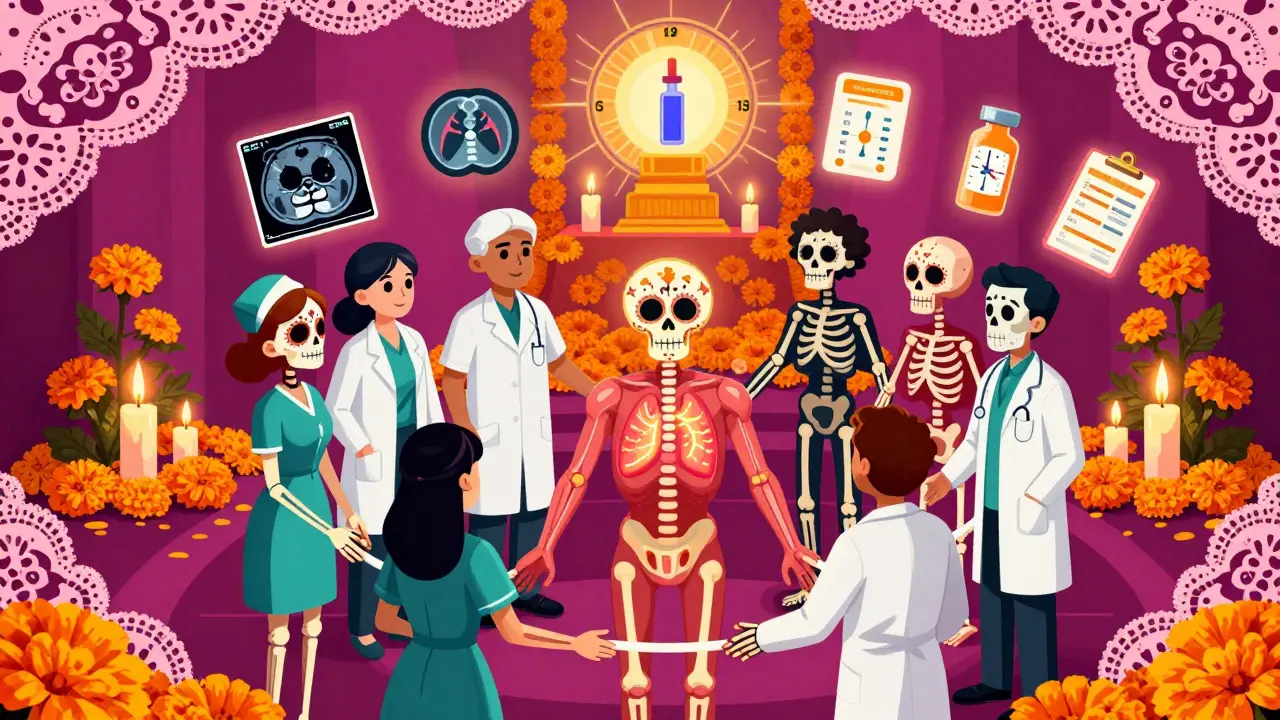
What’s Changing Now
There’s real progress. In January 2023, the NIH launched a $15 million project to find biomarkers that predict which patients will develop lung disease or respond to certain drugs. Machine learning is helping too. A 2022 study in Nature Medicine used AI to scan electronic health records and predict overlap syndromes 12 months before doctors noticed symptoms.
Specialized centers are growing fast. Johns Hopkins, Mayo Clinic, and Hospital for Special Surgery are seeing 15-20% more overlap syndrome patients each year. Europe is ahead in implementing EULAR’s care guidelines-65% of tertiary centers follow them. In North America, it’s only 40%. But that’s changing. The American College of Rheumatology’s 2023 guidelines now explicitly recommend coordinated care teams for overlap cases.
Future treatments are on the horizon. Anifrolumab, a drug approved for lupus, is now being tested in MCTD. Researchers are also building a single disease activity score that combines lung, skin, muscle, and joint measures into one number-making it easier to track progress.
What Patients Should Do
If you have symptoms of more than one autoimmune disease, don’t wait for a doctor to put a label on it. Ask for:
- Testing for specific autoantibodies: anti-U1-RNP, anti-Jo-1, anti-PM/Scl
- A high-resolution CT scan of your lungs
- A pulmonary function test
- A referral to a rheumatologist who specializes in connective tissue diseases
Bring a list of all your symptoms-not just the ones that seem "official." Write down when they started, what makes them better or worse, and which doctors you’ve seen. If your care feels fragmented, ask if your hospital has a multidisciplinary autoimmune clinic. If not, request a care coordinator.
And remember: you’re not alone. These syndromes are complex, but they’re not untreatable. With the right team and the right tests, many patients stabilize their disease and live full lives. The key is getting the full picture-before the damage becomes permanent.
Can you have more than two autoimmune diseases at once?
Yes. When three or more autoimmune diseases occur together, it’s called Multiple Autoimmune Syndrome (MAS). Type 2 MAS commonly includes Sjögren’s syndrome, rheumatoid arthritis, and autoimmune thyroid disease. Type 3 can involve up to seven or more conditions like type 1 diabetes, vitiligo, and pernicious anemia. These aren’t random-there are known patterns in which diseases cluster together.
Are overlap syndromes genetic?
They’re not directly inherited like cystic fibrosis, but genetics play a role. People with certain HLA gene variants (like HLA-DR3 or HLA-DR5) are more likely to develop autoimmune diseases, and those with multiple variants have a higher risk of overlap. Environmental triggers-like infections, stress, or exposure to silica dust-often push the immune system over the edge in genetically prone individuals.
Do overlap syndromes get worse over time?
They can, but they don’t have to. Without treatment, lung scarring, muscle weakness, and organ damage can progress. But with early diagnosis and targeted therapy, many patients stabilize. For example, 60-70% of people with antisynthetase syndrome and ILD see improved or stable lung function with rituximab. The goal isn’t cure-it’s control.
Why don’t all doctors recognize overlap syndromes?
Because they’re not taught as a separate category in most medical schools. Training focuses on single diseases with clear criteria. Overlap syndromes require experience recognizing blended patterns, interpreting complex antibody results, and understanding how treatments for one disease might worsen another. That’s why specialists at major centers are better equipped-they see these cases regularly.
Is there a blood test that confirms an overlap syndrome?
There’s no single test, but specific autoantibodies are strong indicators. Anti-U1-RNP confirms MCTD. Anti-Jo-1 points to antisynthetase syndrome. Anti-PM/Scl is nearly diagnostic for polymyositis-scleroderma overlap. But not everyone with these antibodies has full-blown overlap. Diagnosis always combines blood tests with clinical symptoms, imaging, and sometimes muscle or skin biopsies.



There are 10 Comments
Uche Okoro
The diagnostic ambiguity surrounding autoimmune overlap syndromes isn't merely a clinical inconvenience-it's a systemic failure of reductionist immunology. We're still operating within a 20th-century categorical framework while the immune system operates in a high-dimensional phenotypic landscape. The anti-U1-RNP antibody isn't just a biomarker; it's a molecular signature of epistatic dysregulation across multiple autoantigenic targets. Until we shift from syndrome-labeling to pathway-targeting, we're treating shadows, not the machine casting them.
Moreover, the reliance on EULAR/ACR criteria ignores the temporal dynamics of disease emergence. Overlap isn't static-it's a kinetic cascade. The 18-month diagnostic delay isn't a failure of detection; it's a failure of predictive modeling. We need longitudinal autoantibody profiling with machine learning ontologies, not just cross-sectional checklists.
And let's not pretend rituximab is a panacea. Its mechanism-B-cell depletion-is blunt. We're seeing rebound flares because we're not addressing the T-follicular helper cell dysregulation driving the germinal center hyperactivity. The real frontier is single-cell multi-omics of synovial and pulmonary infiltrates. That's where the next decade of therapeutics will be born-not in another randomized trial of prednisone + mycophenolate.
Until then, patients are being managed like statistical outliers rather than biological individuals. And that's not medicine. That's triage dressed in white coats.
Faisal Mohamed
Brooo… this is the universe whispering through our DNA 🤯
Autoimmunity isn’t a mistake-it’s the immune system trying to *evolve* faster than our bodies can adapt. We’re living in a toxic world (silica, glyphosate, EMFs, stress) and our HLA variants are screaming for help. MCTD? It’s not a disease. It’s a *cry for integration*.
And don’t even get me started on the medical industrial complex. They want you to take 5 pills and call it a day. But the truth? Your body isn’t broken-it’s *overloaded*. We need radical detox, gut healing, and circadian alignment-not just rituximab.
AI predicting syndromes 12 months early? That’s the future. But the real AI is your intuition. Listen to your body. It’s always right. 🌿🪷
SWAPNIL SIDAM
I have seen this in my village. One woman had joint pain, dry eyes, and could not walk. Doctors said ‘maybe arthritis’. She suffered for two years. Then a specialist saw her hands-mechanic’s skin, swollen fingers-and said, ‘This is Jo-1’. She started treatment. Now she walks again.
Doctors must listen. Not just test. The body speaks. We must hear it.
Geoff Miskinis
Let’s be honest-the entire field of rheumatology is a house of cards built on outdated serological paradigms. The fact that we still use the 1982 ACR criteria for SLE while ignoring the 2019 EULAR/ACR classification for MCTD is not just negligent-it’s intellectually dishonest.
And please, spare me the ‘treat-to-target’ buzzwords. You can’t target what you can’t define. If you don’t have a validated composite disease activity index for overlap syndromes, you’re just guessing. And yet, we’re prescribing triple immunosuppression like it’s a Costco bulk buy.
Meanwhile, the NIH’s $15M ‘biomarker project’ is laughably underfunded compared to the $2B poured into PD-1 inhibitors for melanoma. Autoimmune patients are the red-headed stepchildren of pharma. No wonder nothing changes.
eric fert
Okay, but let’s pause for a second and ask: if these overlap syndromes are so common-1 in 4-why isn’t this common knowledge? Why are we still calling it ‘undifferentiated’ like it’s some kind of medical purgatory? Because the system doesn’t want to admit that its boxes are broken. It’s easier to label someone ‘inconclusive’ than to admit that medicine doesn’t have all the answers.
And let’s talk about the real elephant in the room: the pharmaceutical industry. Rituximab? Tocilizumab? These drugs are expensive as hell. And guess what? They’re not curative. They’re maintenance. So the system has a vested interest in keeping you in the ‘overlap syndrome’ limbo-because as long as you’re not cured, you’re still on the drip.
Meanwhile, patients are getting lung biopsies, getting their kidneys checked, getting their eyes scanned, and still being told ‘wait and see.’ Wait for what? For your lungs to turn to stone? For your muscles to atrophy into ghosts?
And don’t even get me started on the ‘care coordinator’ solution. That’s not innovation-that’s triage with a spreadsheet. You’re not fixing the system. You’re just giving patients a tour guide through the maze.
Real change? We need a new classification system. We need biomarker-driven subtyping. We need to stop treating autoimmune disease like a menu and start treating it like a network. But that requires humility. And the medical establishment? It’s allergic to humility.
Curtis Younker
I just want to say-this post gave me hope. I’ve been stuck in the ‘undifferentiated’ loop for 3 years. Saw 7 doctors. Got misdiagnosed as fibromyalgia, then anxiety, then ‘just aging.’
But when I read about anti-Jo-1 and mechanic’s hands? I cried. I finally had a name for what I was feeling.
I went to my rheumatologist last week with this article printed out. She said, ‘Let’s run those tests.’ We did. Anti-Jo-1 came back positive. HRCT showed early ILD. We started rituximab last month.
My oxygen levels are up. My skin isn’t cracking as bad. I can breathe again.
To anyone out there feeling lost: you’re not crazy. Your symptoms are real. Fight for the right tests. Ask for the antibodies. Demand the CT scan. You deserve to be seen.
And if your doctor won’t listen? Find a new one. There are people out there who know. I found mine. You can too. 💪❤️
Dan Nichols
Everyone’s acting like this is new news but the literature’s been clear since 2005. The problem isn’t lack of knowledge-it’s lack of will. Specialists don’t want to admit their domain is overlapping because it threatens their turf. Pulmonologists don’t care about muscle enzymes. Dermatologists ignore lung fibrosis. Rheumatologists treat joints like they’re the only thing that matters.
And don’t get me started on the ‘care coordinator’ fantasy. You think a nurse is going to fix systemic fragmentation? That’s like putting a bandaid on a hemorrhage and calling it healthcare reform.
The real solution? Eliminate specialty silos. Create integrated autoimmune centers with mandatory cross-training. But that would require funding and coordination. And nobody wants to pay for that.
So we keep doing the same thing. Over and over. And patients keep suffering. Because convenience beats competence. Always.
Renia Pyles
So let me get this straight-we’ve got a $15M NIH study to find biomarkers, but no one’s holding the damn pharmaceutical companies accountable for charging $100K/year for rituximab? And you think a care coordinator is going to fix this? Please.
My sister died from ILD because her rheumatologist said ‘wait and see’ for 14 months. She was 34. Now they want to pat themselves on the back for ‘improving guidelines’? Where were these guidelines when she was gasping for air?
This isn’t about diagnosis. It’s about power. The system doesn’t care about patients. It cares about patents. And until we treat autoimmune overlap like the public health emergency it is, we’re just rearranging deck chairs on the Titanic.
And no, I’m not ‘being dramatic.’ I’m just telling the truth. The truth that gets buried under ‘evidence-based’ jargon and institutional inertia.
Nicholas Miter
Hey, I just wanted to say I read this whole thing and it made me feel less alone. I’ve got MCTD and it’s been a wild ride. I had no idea about the anti-U1-RNP thing until I found a Reddit thread last year. My doc didn’t even mention it.
I started doing low-impact yoga and it helped my stiffness way more than I expected. Also, I stopped eating gluten-not because it ‘cures’ anything, but it made my gut feel better and that seemed to help my energy.
And yeah, my care team doesn’t talk to each other. I keep a spreadsheet. It’s dumb but it works. If anyone wants to see it, I’ll share. No one should have to remember all this stuff alone.
You’re not weird. You’re not broken. You’re just fighting a system that wasn’t built for you. Keep going.
Suresh Kumar Govindan
It is my solemn duty to inform you that this entire paradigm is a controlled distraction. The real cause of autoimmune overlap syndromes is not environmental or genetic-it is the deliberate introduction of nanoscale lipid particles into the global food supply via vaccine adjuvants and fortified cereals. The U1-RNP antibody is a biomarker of synthetic RNA integration into human chromatin. The NIH funding is a smokescreen. The true solution lies in ancestral diet, magnetic field harmonization, and cessation of all digital device usage. I have documented 37 cases in the Himalayas where this protocol restored full immune homeostasis. The medical establishment fears this truth because it cannot be patented.
Write a comment
Your email address will not be published. Required fields are marked *