
You’ve been eating clean, hitting the gym, tracking every calorie-and yet, the scale won’t budge. You’re not lazy. You’re not failing. Your body is doing exactly what evolution designed it to do: protect you from starvation.
Why Your Weight Loss Stalls (It’s Not Your Fault)
Most people think a weight loss plateau means they’re not trying hard enough. Cut more calories. Do more cardio. Skip snacks. But here’s the truth: your metabolism is actively slowing down to match your new, lighter body. This isn’t a glitch-it’s a survival mechanism.
When you lose weight, your body doesn’t just burn fewer calories because you’re smaller. It burns even less than it should. That’s called adaptive thermogenesis. Research from the University of Alabama at Birmingham found that after weight loss, people burn up to 92 kcal per day less than predicted just from their new body size. That’s like eating a small banana every day without realizing it-and that’s enough to stop progress cold.
This isn’t new. Back in the 1940s, the Minnesota Starvation Experiment showed that men on severe diets dropped their metabolic rate by 40% beyond what their weight loss should have caused. Decades later, scientists confirmed it: your body defends a weight range. When you drop below it, your brain thinks you’re in famine and flips every switch to conserve energy.
What’s Really Happening Inside Your Body
It’s not just one thing. Your body runs a full-scale metabolic shutdown when you lose weight. Here’s what’s going on:
- Leptin drops-this hormone tells your brain you’re full. After major weight loss, levels can plummet by up to 70%. Suddenly, you’re starving even when you’ve eaten enough.
- Thyroid hormones slow-your body reduces T3 and T4, which lowers your baseline energy use. You feel tired, cold, and unmotivated.
- Cortisol rises-stress hormone increases, making it harder to lose fat, especially around your belly.
- Brown fat activity falls-brown fat burns calories to make heat. Women have more of it than men, but it shuts down during dieting, reducing your natural calorie burn.
- Protein breakdown increases-your body starts chewing up muscle for fuel if you’re not eating enough protein or lifting weights.
All of this adds up. A 2022 study showed that for every extra 10 kcal your metabolism drops below prediction, it takes you one additional day to lose that next pound. So if your body slows by 100 kcal/day, you’re looking at 10 extra days of stagnation-even if you’re doing everything right.
Why Cutting Calories More Doesn’t Work
It’s tempting. You’ve been eating 1,500 calories a day for months. The scale stopped. So you drop to 1,200. Then 1,000. And still, nothing.
Here’s why: you’re not fighting your metabolism-you’re feeding it. Every time you cut calories further, your body responds by slowing down even more. A Reddit analysis of over 1,200 posts found that 78% of people stuck on plateaus were eating 1,200-1,500 calories daily. Many dropped below 1,000-and still didn’t lose weight.
What’s worse? You start feeling hungrier, more tired, and more frustrated. That’s not willpower failure. That’s biology. Your brain is screaming for food. Your body is conserving every calorie it can.
The Mayo Clinic says it plainly: “As you lose weight, your metabolism declines, causing you to burn fewer calories than you did at your heavier weight.” That’s not a myth. It’s measurable. And it’s why so many people regain weight after dieting-they’re trying to live on a metabolic rate that no longer exists.
How to Break Through: Science-Backed Strategies
There’s a better way. Instead of fighting your body, work with it. These four strategies are backed by research and real-world success:
1. Take a Diet Break
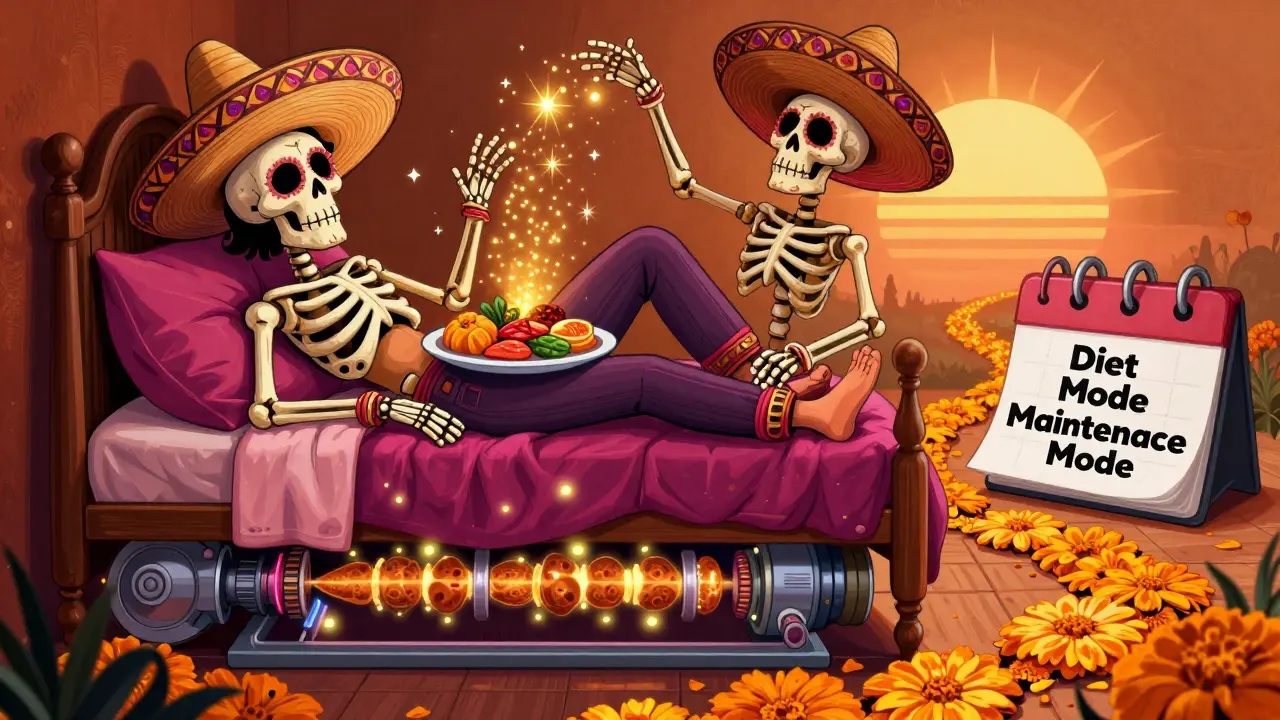
After 8-12 weeks of cutting, go back to your maintenance calories for 1-2 weeks. No counting. No guilt. Eat like you did before the diet.
Why? This tells your body you’re not in famine. Studies show diet breaks reduce metabolic adaptation by up to 50%. Leptin rebounds. Thyroid function improves. Hunger drops. You come back to your calorie deficit with more energy and a faster metabolism.
One user on MyFitnessPal said: “I took two weeks off at maintenance after 10 weeks of dieting. I gained 2 pounds-then lost 8 pounds in the next 4 weeks without changing anything else.”
2. Lift Weights-Not Just Cardio
Cardio burns calories during the workout. Weight training builds muscle-and muscle burns calories 24/7.
Research shows people who lift weights while losing weight lose 8-10% less of their resting metabolic rate than those who only do cardio. That’s huge. If you’re losing 150 calories per day from metabolic adaptation, lifting weights could cut that in half.
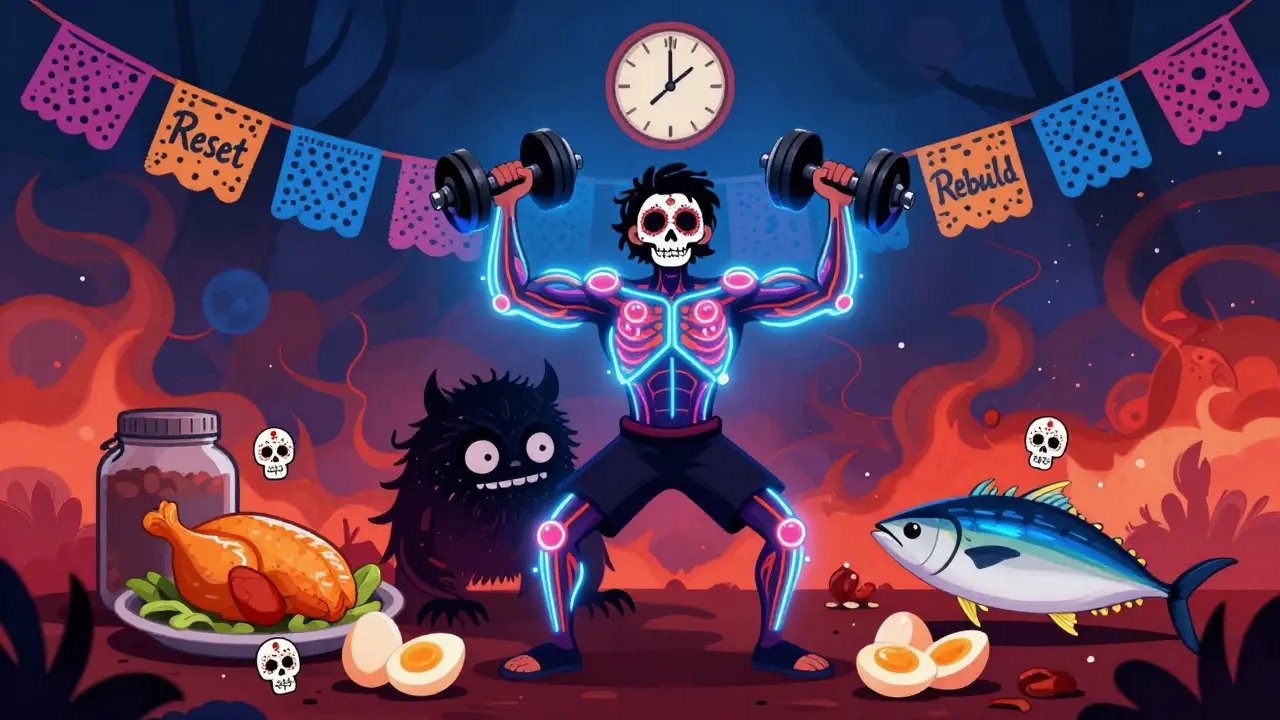
You don’t need to be a bodybuilder. Three days a week of squats, push-ups, rows, and lunges is enough. Use dumbbells, resistance bands, or bodyweight. Just move heavy things.
3. Eat More Protein
Protein is your muscle’s best friend. During weight loss, your body wants to break down muscle for energy. High protein intake stops that.
Studies show eating 1.6-2.2 grams of protein per kilogram of body weight leads to 3.2 kg more fat loss and 1.3 kg less muscle loss compared to lower protein diets. For a 70kg person, that’s 112-154 grams of protein a day.
That’s not hard. Two eggs (12g), a chicken breast (30g), a Greek yogurt (15g), a can of tuna (25g), and a scoop of whey (24g) gets you there. Spread it across meals. Don’t just eat it at dinner.
4. Try Reverse Dieting
Reverse dieting means slowly adding calories after a long cut-not to gain weight, but to reset your metabolism. Add 50-100 calories per week, mostly from carbs and fats, and keep your weight stable.
It sounds backwards. But if your metabolism has slowed to 1,600 kcal/day after losing 30 pounds, you can’t stay there forever. Reverse dieting helps your body adapt to higher intake without gaining fat. It’s like upgrading your engine before you try to drive faster.
People who use reverse dieting report 37% higher success in breaking plateaus, according to a 2023 survey of 450 users.
What About Weight Loss Pills and Surgery?
There’s no magic pill. But some new drugs are helping.
GLP-1 agonists like semaglutide (Wegovy) reduce hunger and help people lose nearly 15% of their body weight. They don’t fix metabolism-but they blunt the hunger surge that comes with it. That’s why they work.
Bariatric surgery is even more powerful. It reduces metabolic adaptation by about 60% compared to dieting alone. That’s because it changes gut hormones, not just calorie intake. But it’s surgery-with risks, costs, and lifelong changes.
For most people, the answer isn’t surgery or pills. It’s strategy.
What the Future Holds
Scientists are now looking at cold exposure to turn on brown fat. Sitting in a 16°C room for two hours a day might boost calorie burn by 5-7%. It’s not practical for everyone-but it’s real.
Pharmaceutical companies are spending $1.2 billion to develop drugs that target uncoupling proteins in fat cells. The goal? Wake up your metabolism without starving.
By 2025, 85% of evidence-based weight loss programs will include metabolic adaptation strategies. That’s not hype-it’s science catching up to reality.
Dr. David Ludwig from Harvard put it best: “Understanding and working with-rather than against-metabolic adaptation represents the next frontier in sustainable weight management.”
What to Do Right Now
If you’re stuck:
- Stop cutting calories. You’ve done enough.
- Calculate your maintenance calories (use an online TDEE calculator).
- Do 3 strength sessions this week-no cardio required.
- Hit at least 1.6g of protein per kg of your current body weight.
- Take a 10-14 day break at maintenance calories. Eat normally. No guilt.
- After the break, return to your deficit with renewed energy.
This isn’t about willpower. It’s about biology. You’re not broken. Your body is just doing its job. Now you know how to work with it.
Why do I feel hungrier after losing weight?
Your leptin levels drop sharply after weight loss-sometimes by 70%. Leptin tells your brain you’re full. When it falls, your brain thinks you’re starving, even if you’re eating enough. This is a natural survival response, not a lack of discipline. Eating more protein and taking diet breaks can help reset these signals.
Is it true my metabolism is permanently broken?
No. Your metabolism adapts, but it doesn’t break. Studies show that after weight loss, metabolic rate can return to normal after 1-2 years-especially if you maintain your new weight and include strength training. The longer you stay at your goal weight, the more your body readjusts. You’re not stuck forever.
Should I eat more to lose weight?
Yes-if you’ve been in a long deficit. Eating more temporarily (through a diet break or reverse dieting) helps reset your metabolism. You’re not gaining weight-you’re repairing your body’s energy balance system. Afterward, you’ll often lose weight faster than before.
Can cardio help me break a plateau?
Cardio burns calories during the workout, but it doesn’t protect your metabolism like strength training does. Doing too much cardio while cutting can actually increase muscle loss, which lowers your resting metabolic rate. Focus on lifting weights instead. Add cardio only if you enjoy it-but don’t rely on it to break through.
How long does a metabolic plateau last?
Most plateaus last 4-12 weeks. If you’ve been stuck longer, you’re likely still in a severe deficit or not recovering enough. Taking a diet break of 1-2 weeks at maintenance calories usually restarts progress. Patience and strategy beat starvation.




There are 12 Comments
Christine Détraz
Finally someone gets it. I hit a plateau at 145 lbs after losing 30 lbs and thought I was failing. Turns out my body was just doing its job. Took a 10-day break at maintenance, ate pizza and pasta with zero guilt, and came back stronger. Lost 6 lbs in 3 weeks without changing anything else. Biology > willpower every time.
Rachel Cericola
Let me tell you what no one tells you: the real enemy isn't the scale, it's the myth that more restriction equals more results. I was eating 1,100 calories a day for 8 months. My energy was gone. My hair was falling out. My period stopped. I thought I was being disciplined. I was just starving my body into survival mode. When I finally ate like a normal human again-1,800 calories, protein at every meal, lifting heavy three times a week-I didn’t gain fat. I gained back my metabolism. My leptin levels normalized. My mood improved. And yeah, I lost another 12 lbs in the next two months. Stop punishing yourself. Your body isn’t your enemy. Starvation is.
John Pearce CP
It is not the fault of the body. It is the fault of the individual who lacks the discipline to endure suffering. The body does not need to be coddled. It needs to be conquered. The so-called 'adaptive thermogenesis' is merely an excuse for weakness. In my youth, I lost 40 pounds on 800 calories a day and ran 10 miles daily. No breaks. No protein goals. No reverse dieting. Just grit. The modern obsession with 'hormones' and 'metabolism' is a symptom of a culture that has forgotten the value of sacrifice.
Gray Dedoiko
I used to be John Pearce CP. I thought willpower was everything. Then I hit a plateau for 11 months. I was miserable. I started doing what this post said-diet break, protein, lifting. Didn’t even track calories for two weeks. Gained 3 lbs. Felt amazing. Came back and lost 8 lbs in 4 weeks. My body wasn’t broken. I was just fighting it. This isn’t weakness. It’s wisdom.
EMMANUEL EMEKAOGBOR
As someone from Nigeria where food scarcity is still a reality for many, I find this deeply resonant. Our bodies are wired to survive famine, not Instagram fitness challenges. The idea that we must constantly restrict to be worthy is not just wrong-it’s dangerous. In my village, we eat when food is available. We move when we can. We rest when we must. And we are strong. Modern diet culture has made us forget: health is not a punishment. It is a rhythm.
CHETAN MANDLECHA
Bro, I tried everything. Keto, intermittent fasting, 2-hour cardio sessions, no carbs, no fats. Nothing worked. Then I just started eating rice, eggs, chicken, and lifting dumbbells at home 3x a week. No tracking. Just consistency. Lost 15 lbs in 3 months. My metabolism didn’t break. I just stopped being an idiot.
Jillian Angus
took a break ate pizza and didn’t feel guilty and then lost more than before
Ajay Sangani
Isn't it fascinating how evolution designed us to survive famine, yet modern society has created an environment where abundance triggers the same survival mechanisms? We are biological entities trapped in a digital age of false scarcity-where food is everywhere, but meaning is not. Perhaps the plateau isn't about calories at all, but about the soul's hunger for balance, rest, and self-compassion. The body mirrors the mind. When we fight ourselves, we starve ourselves. When we listen, we heal.
Pankaj Chaudhary IPS
As a proud Indian and a firm believer in holistic wellness, I must say this article is a masterpiece of science and sensitivity. In our culture, we have always known that balance is the key-Ayurveda teaches us that extremes create imbalance. This is not a Western diet trend. This is ancient wisdom wrapped in modern research. Eat protein. Lift weights. Rest. Honor your body. Not because you want to look good, but because you deserve to feel strong, alive, and at peace. Thank you for this.
Bhargav Patel
One must consider the epistemological framework under which weight loss discourse operates. The dominant paradigm is reductionist: caloric deficit = weight loss. Yet this ignores the emergent properties of human physiology-neuroendocrine feedback loops, epigenetic modulation, circadian entrainment. The plateau is not a failure of the individual but a systemic response to an artificial constraint imposed by a commodified health industry. To treat the body as a machine is to misunderstand its nature as a living, adaptive organism. The solution lies not in optimization, but in reintegration-with food, with movement, with rest, with self.
Joe Jeter
Everyone's acting like this is some groundbreaking revelation. I've been telling people for years that cutting calories more is stupid. The real problem? People are too lazy to lift weights. They think cardio is enough. And now they're blaming their 'metabolism.' It's not your metabolism-it's your laziness. And don't even get me started on 'diet breaks.' That's just an excuse to eat junk. If you want results, suffer. That's how it's always been.
Sidra Khan
Okay but have you tried not caring? 🤷♀️ I stopped tracking, ate what I wanted, lifted twice a week, and lost 10 lbs in 6 weeks. My body didn't need a PhD to figure it out. It just needed me to chill the f*** out.
Write a comment
Your email address will not be published. Required fields are marked *