
When your eyes don’t line up - one turns in, out, up, or down while the other looks straight ahead - you’re dealing with strabismus. It’s not just a cosmetic issue. Left untreated, it can mess with your depth perception, cause double vision, and even lead to permanent vision loss in one eye. This isn’t rare. About 5 in every 100 children have it, and adults can develop it too - often after a stroke, head injury, or as a result of nerve damage. The good news? Most cases can be fixed. And when they can’t be fixed with glasses or patches, surgery is a proven, effective option.
What Does Strabismus Actually Look Like?
Strabismus isn’t one thing. It’s four main types, each named for the direction the eye turns:- Esotropia - the eye turns inward (about 50% of cases)
- Exotropia - the eye turns outward (30% of cases)
- Hypertropia - the eye turns upward (15% of cases)
- Hypotropia - the eye turns downward (5% of cases)
You might notice a child squinting in bright light, tilting their head to see better, or avoiding eye contact. Adults often complain of double vision, eye strain, or headaches after reading. In fact, 78% of adult patients report discomfort around the eyes, and nearly 60% of kids with untreated strabismus struggle with depth perception - making things like catching a ball or judging steps tricky.
It’s not always obvious. Some people only have a slight misalignment that shows up when they’re tired. Others have constant misalignment. Intermittent cases can come and go, which makes them easy to ignore - until they start affecting schoolwork, driving, or even job performance.
Why Does It Happen?
Most of the time, strabismus isn’t about weak eye muscles. It’s about the brain. The brain controls where your eyes look, and if the signals get mixed up - especially in early childhood - the eyes won’t coordinate. About 30% of pediatric cases run in families, suggesting a genetic link. But in adults, the causes shift. Strokes, head trauma, and nerve damage (like to cranial nerves IV or VI) are the top culprits. This type, called paralytic strabismus, often hits suddenly and can come with dizziness or nausea.Some kids are born with it. Others develop it after being very farsighted. Glasses can fix that kind - but not always. If the brain has already learned to ignore input from the misaligned eye, it can lead to amblyopia, or lazy eye. That’s why early detection matters. If you wait too long, even surgery won’t fully restore 3D vision.
Non-Surgical Treatments: First Steps
Before anyone suggests surgery, doctors try simpler options. These aren’t just backups - they’re often enough.- Corrective glasses - Especially for farsighted kids. Glasses can sometimes pull the eyes back into alignment.
- Patching - Covering the stronger eye forces the weaker one to work. This helps prevent or treat amblyopia.
- Vision therapy - A series of eye exercises done under supervision. It’s not just eye movements - it’s training the brain to use both eyes together. Studies show it can reduce the need for surgery in up to 35% of children with intermittent exotropia.
These methods work best when started early. A child under age 2 who gets patching or glasses right away has a much better shot at developing normal depth perception than one who waits until age 5.
When Is Surgery the Right Choice?
Surgery isn’t a last resort - it’s the right tool for the right case. You need it when:- The misalignment is constant and greater than 15 prism diopters (a measurement of eye turn)
- Double vision doesn’t go away with prism glasses
- The person tilts their head constantly to see straight
- Non-surgical treatments haven’t worked after 6 months
For kids with large-angle congenital esotropia, surgery as early as 3-4 months old is now recommended - a shift from the old standard of waiting until 6 months. Why? Because the brain’s ability to learn to use both eyes together fades after infancy. The earlier you align the eyes, the better the chance of true binocular vision.
For adults, surgery is often about restoring function - not just looks. Someone who’s had double vision for years might finally be able to drive again, read without strain, or make eye contact without embarrassment.

What Happens During Strabismus Surgery?
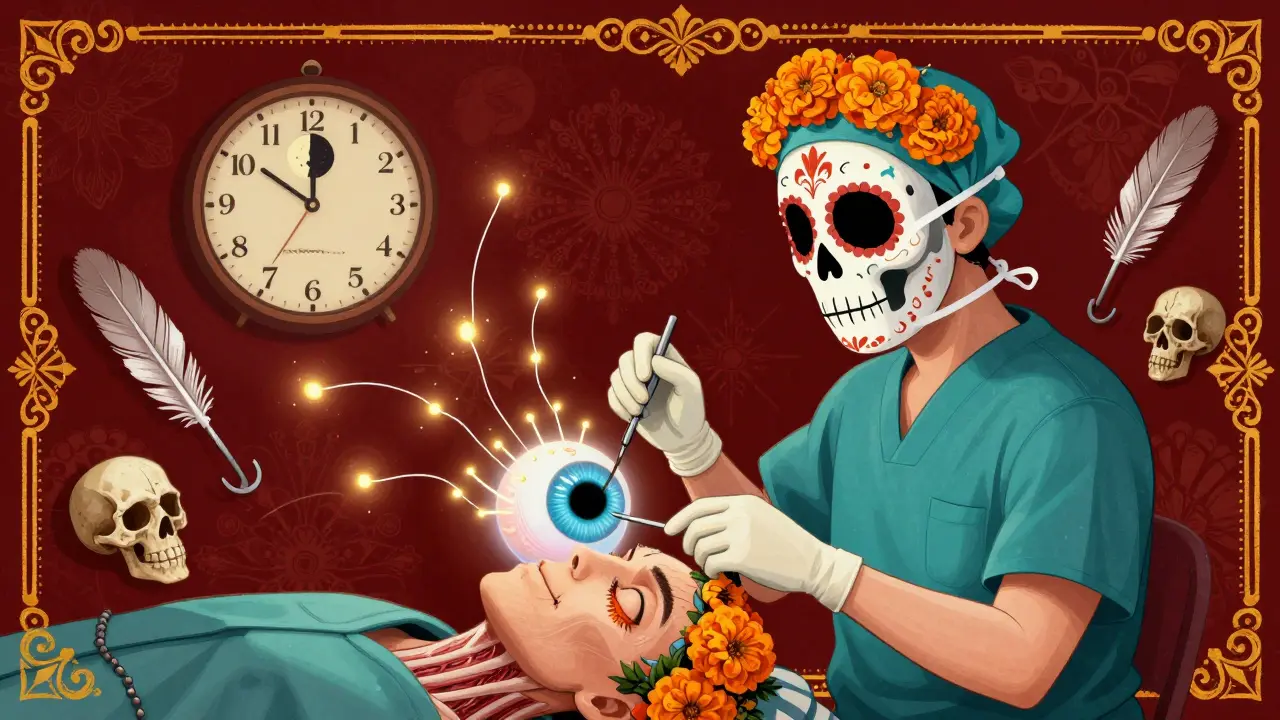
The surgery doesn’t touch the eyeball. It works on the muscles around it. There are two main moves:- Recession - The surgeon loosens a muscle by moving its attachment point farther back. This weakens the pull.
- Resection - The surgeon shortens a muscle by removing a small piece and reattaching it tighter. This strengthens the pull.
For inward-turning eyes (esotropia), the most common procedure is a bilateral medial rectus recession - loosening both inner eye muscles. For outward-turning eyes, the outer muscles are tightened.
Modern surgery often uses adjustable sutures. That means the surgeon doesn’t lock the final position during surgery. Instead, they use a temporary knot that can be fine-tuned within 24 hours - while you’re awake. This cuts down on repeat surgeries by nearly 30%.
The procedure takes 45 to 90 minutes. Kids get general anesthesia. Adults usually get local anesthesia with sedation. You’re out for the surgery, but you’re not in the hospital overnight.
Success Rates and Risks
Surgery isn’t perfect - but it’s effective. Overall, 60-80% of patients get good alignment after one surgery. Kids under 2 have the best results: 75-85% success. Adults? Around 55-65%. Why the difference? Kids’ brains are still learning how to use both eyes. Adults’ brains have already adapted to seeing with one eye.But here’s the catch: alignment isn’t the same as vision. You can look straight - but still not see in 3D. That’s why some patients are disappointed even after “successful” surgery. A 2022 study found 28% of patients were unhappy because their double vision or depth perception didn’t improve - even though their eyes looked aligned.
Complications are rare but real:
- Undercorrection - The eye still turns. Happens in 20-30% of cases. Might need another surgery.
- Overcorrection - The eye turns the other way. About 10-15% of cases.
- Temporary double vision - Almost everyone gets this right after surgery. It usually fades in days or weeks.
- Retinal detachment - Extremely rare (0.1% chance).
- Endophthalmitis - A serious eye infection. Happens in 0.04% of cases.
Most people recover fully within 2-4 weeks. Redness and swelling fade. But full healing - including vision adaptation - can take months.
What Happens After Surgery?
Surgery isn’t the end. It’s the beginning of recovery.- Eye drops - Antibiotic and anti-inflammatory drops are used daily for 2 weeks. Most patients stick to the schedule.
- Vision therapy - Recommended for 85% of patients. Starts 4-6 weeks after surgery. This is critical. Without it, the brain doesn’t relearn how to use both eyes together.
- Follow-ups - You’ll see your doctor at 1 day, 1 week, 3 weeks, and 6 weeks. These aren’t optional. They catch problems early.
Patients who get clear pre-op counseling - knowing what to expect, including possible double vision or the need for therapy - report 40% higher satisfaction. One Reddit user said, “I thought the surgery would fix everything. It fixed the look. But I had to do vision therapy to fix how I saw.”
Who Performs the Surgery?
Not every eye doctor does this. Only about 35% of general ophthalmologists are trained in strabismus surgery. You need someone with specialized fellowship training in pediatric ophthalmology or neuro-ophthalmology. They’ve done at least 50-75 supervised procedures before going solo.If you’re considering surgery, ask: “How many strabismus surgeries do you do each year?” If the answer is fewer than 20, consider seeking a specialist.
Real People, Real Results
On patient forums, the stories are powerful:- “I couldn’t look anyone in the eye at work for 20 years. After surgery, I made eye contact for the first time. I cried.” - Reddit user
- “After 30 years of double vision, I read a book without squinting. It felt like a miracle.” - HealthUnlocked forum
- “I’m a dentist. I couldn’t focus on teeth properly. Now I can. My hands don’t shake anymore.” - Patient survey
Eighty-two percent of patients on RealSelf.com say the surgery was “worth it.” The biggest wins? No more double vision, better social confidence, and improved job performance.
But it’s not magic. Some people still have issues. About 22% report persistent double vision. 15% of adults take longer than 6 weeks to recover. And 12% are unhappy with how their eyes look - even if they see better.
The Bigger Picture
The global market for strabismus surgery is growing - expected to hit $1.8 billion by 2027. But access isn’t equal. In the U.S., 120,000 surgeries are done yearly. In Germany, it’s 45,000 - but Germany has a higher rate per capita. Why? Better screening, earlier diagnosis, and fewer insurance barriers.In developing countries, only 28% of kids with strabismus get evaluated by age 5. In the U.S., it’s 72%. That gap means thousands of children lose the chance to develop normal vision.
Insurance is also changing. Medicare and private insurers now often require 6 months of failed non-surgical treatment before approving surgery. That delays care - and can cost kids their vision.
What’s New in 2025?
The field is advancing fast:- Adjustable sutures are now used in 68% of adult surgeries, thanks to better tools like the MiLoop system.
- Robotic-assisted surgery is in trials at Johns Hopkins. Early results show 32% more precision in muscle placement.
- Virtual reality training before surgery is now proven to boost success rates by 18%.
- Botulinum toxin injections are being used before surgery to temporarily weaken overactive muscles - reducing the amount of muscle adjustment needed.
The most exciting shift? The focus is no longer just on “straight eyes.” It’s on functional vision. Can you see in 3D? Can you read without strain? Can you make eye contact without stress? That’s the real goal.
Final Thoughts
Strabismus isn’t something you just grow out of. It doesn’t fix itself. And it’s not just about appearance. It’s about how you see the world - and how the world sees you.If you or your child has misaligned eyes, don’t wait. See an eye specialist. Get a full evaluation. Try glasses and patches first - but don’t be afraid to ask about surgery if it’s not working. The tools today are better than ever. The success rates are high. And the impact on quality of life? Life-changing.
Alignment isn’t just cosmetic. It’s the foundation of seeing clearly, confidently, and completely.
Is strabismus the same as lazy eye?
No. Strabismus is when the eyes point in different directions. Lazy eye (amblyopia) is when one eye has poor vision because the brain ignores it. But they often happen together. If strabismus isn’t treated early, it can cause amblyopia. That’s why patching and early intervention are so important.
Can adults benefit from strabismus surgery?
Absolutely. While children have a better chance of developing full 3D vision after surgery, adults often see dramatic improvements in double vision, eye strain, and confidence. Many report being able to drive, read, or work without discomfort for the first time in decades. Surgery doesn’t just fix alignment - it restores function.
How long does recovery take after strabismus surgery?
Most people feel better within 1-2 weeks. Redness and swelling fade in that time. But full healing takes longer. Vision adaptation - especially learning to use both eyes together - can take 3 to 6 months. That’s why vision therapy after surgery is so important. Skipping it increases the chance of the eyes drifting again.
Is strabismus surgery painful?
The surgery itself isn’t painful - you’re asleep or sedated. Afterward, most people feel mild discomfort, like having a scratchy or sore eye. It’s usually described as a dull ache or pressure. Painkillers help. The biggest discomfort for many is the temporary double vision, which can be disorienting but fades within days or weeks.
Will I need more than one surgery?
About 20-30% of patients need a second surgery, usually because the first didn’t fully correct the alignment. This is more common in adults and in cases with large eye turns. Adjustable sutures have reduced this rate, but some people’s eyes naturally drift over time. Follow-up care and vision therapy help lower the chance of needing another procedure.
Can strabismus come back after surgery?
Yes - but it’s not common if you follow post-op care. About 10-15% of cases show slight drifting over time, especially if vision therapy isn’t done. The brain can revert to old habits. That’s why ongoing eye exercises and regular check-ups matter. Most people maintain good alignment for life with proper care.
Does insurance cover strabismus surgery?
Yes - because it’s considered medically necessary, not cosmetic. Most insurance plans, including Medicare, cover it. But many now require proof that non-surgical treatments (glasses, patches, therapy) were tried for at least 6 months. Make sure your doctor documents all attempts. If your claim is denied, appeal - it’s often approved on review.
Strabismus affects millions - children and adults alike. But with today’s tools, better understanding, and targeted care, it’s no longer a lifelong burden. Whether it’s glasses, therapy, or surgery - help is out there. And the right treatment can change how you see the world - and how the world sees you.


There are 12 Comments
Linda Caldwell
Just had my son’s strabismus surgery last month and wow-what a difference. He’s making eye contact for the first time. No more head tilting at school. Vision therapy is a grind but totally worth it.
Jonathan Morris
Let me guess-this was funded by some surgical device conglomerate. Adjustable sutures? Robotic-assisted? Of course. They don’t care if you see better-they care if you keep coming back for ‘follow-ups’ and ‘therapy.’ The real cure? Stop letting corporations monetize your child’s eyes.
Did you know the FDA approved botulinum injections for strabismus in 2011 without a single long-term outcome study? They’re just repackaging poison as progress.
My cousin had surgery at 4. Now he’s 28 and still gets migraines. ‘Successful alignment’ doesn’t mean functional vision. It means they got paid.
Anna Giakoumakatou
How quaint. We’ve reduced the profound neurological dissonance of binocular dysfunction to a surgical checklist. ‘Recession vs. resection’-how poetic. You speak of ‘functional vision’ as if it were a product you could order from Amazon. The brain doesn’t ‘relearn’-it surrenders. And you call that success?
At least the ‘real people’ stories are honest: they cry because they finally feel seen. Not because they see better. The irony is exquisite.
Erik J
Interesting that 35% of pediatric cases are genetic. Wonder if there’s any data on epigenetic triggers-stress, screen exposure, lighting conditions in early development. The paper mentions brain signaling but doesn’t explore environmental modulation.
Also curious: why is insurance requiring 6 months of failed therapy before surgery? Is that based on outcome studies or cost containment?
BETH VON KAUFFMANN
Strabismus management is a textbook example of the biopsychosocial model in action. The surgical intervention is merely a biomechanical correction; the real therapeutic payload lies in neuroplastic rehabilitation via vision therapy, which addresses the cortical suppression cascade. Without addressing the perceptual integration deficit, you’re just performing ocular realignment without functional restoration.
And let’s not forget the comorbidity with amblyopia-60% of untreated pediatric cases exhibit reduced VEP amplitude. You can’t fix the eye without fixing the cortex.
Raven C
Oh, how utterly tragic. To be told that your child’s eyes are ‘misaligned’-as if it were a mere aesthetic flaw-while the medical-industrial complex quietly profits from your desperation. And now, they want you to pay for ‘vision therapy’? As if the soul could be rehabilitated through exercises? I weep for the modern parent, forced to navigate this labyrinth of corporate medicine.
And yet… you still trust them? You still sign the consent forms? You still believe in ‘adjustable sutures’ and ‘robotic precision’? How naive. How… human.
Donna Packard
My sister had this surgery at 8 and now she’s a graphic designer. She says she never realized how blurry everything looked until it was fixed. I’m so glad she didn’t wait.
Patrick A. Ck. Trip
I think this post is very important. Many people dont understand that strabismus is not just about looks. It affects how you live. I had it as a kid and i never got treatment. Now i avoid eye contact. I wish i had known sooner. Thank you for sharing.
Sam Clark
Thank you for this comprehensive and clinically accurate overview. The emphasis on functional vision over cosmetic alignment is both timely and necessary. I would only add that multidisciplinary care-integrating neuro-optometry, occupational therapy, and psychological support-significantly improves long-term outcomes. Early referral remains the most critical factor.
Jessica Salgado
I didn’t know strabismus could cause headaches until I started getting them after 10 hours of screen time. I thought I was just tired. Then I saw my reflection in a window-one eye was drifting out. I cried. I went to a specialist. They said it was adult-onset exotropia from chronic eye strain. Surgery in 3 weeks. I’m terrified. But also… hopeful.
Chris Van Horn
YOU’RE ALL BEING MANIPULATED. This isn’t medicine-it’s a scam. Adjustable sutures? ROBOTIC SURGERY? You think they care about your vision? They care about the $12,000 bill you’ll get from the hospital. And don’t get me started on insurance requiring 6 months of ‘therapy’-that’s a delay tactic to make you pay out of pocket. I’ve seen the contracts. They’re written in legalese to hide the profit margins. Stop trusting these ‘doctors.’
And that ‘Reddit user’ quote? Probably an ad. Real people don’t talk like that. This whole thing is a marketing campaign disguised as medical advice.
amanda s
Why are we letting foreigners dictate our healthcare standards? In America, we used to fix this fast-no waiting 6 months for ‘therapy.’ Now we’re following Germany’s lead? They have more surgeries per capita? That’s because they’re more disciplined. We need to stop being soft. If your kid’s eye is out-FIX IT. NOW. No more ‘maybe try glasses first.’ We’re losing our edge.
And why are we letting robots do surgery? I don’t trust machines with my eyes. We need American surgeons. Real ones. Not algorithms with scalpels.
Write a comment
Your email address will not be published. Required fields are marked *