
Why Your Skin Is Getting Darker Than It Should Be
You notice it in the mirror-patches on your cheeks, spots on your hands, a haze across your forehead. It’s not a rash. It’s not acne. It’s hyperpigmentation: areas of skin that have gotten darker than the rest. Many people assume it’s just "sun spots" or "aging," but that’s not always true. Two of the most common forms-melasma and sun damage-look similar but behave completely differently. And treating them the same way can make things worse.
Melasma Isn’t Just a Sun Spot
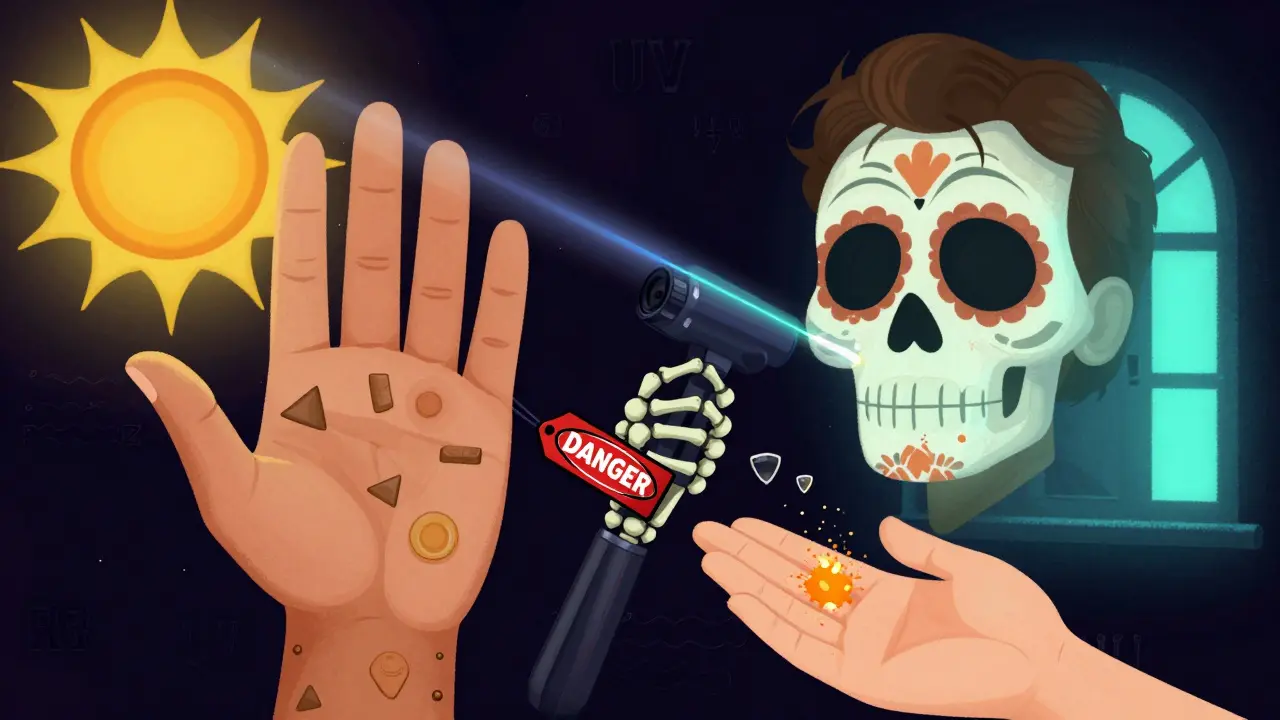
Melasma shows up as large, blurry, symmetrical patches-usually on the face. Think: both cheeks, forehead, upper lip. It’s not random. It’s predictable. And it’s mostly women, especially those with medium to dark skin tones (Fitzpatrick III-VI). It’s not just about the sun. Hormones play a big role. Pregnancy, birth control pills, hormone therapy-they can all trigger it. Heat and visible light (yes, the kind that comes through windows) also turn on pigment cells in your skin. That’s why someone sitting near a sunny window indoors can still get melasma worsening.
Studies show melasma affects Black, Asian, and Hispanic women 3 to 5 times more often than Caucasian women. About 60-70% of cases in women of childbearing age are tied to hormones. And here’s the hard truth: even if you get it under control, over 80% of people see it come back within a year if they skip sun protection.
Sun Damage Is Simpler-But Just as Common
Solar lentigines, or sun spots, are different. They’re smaller, sharper-edged, and show up where the sun hits most: face, hands, shoulders. They’re caused by years of UV exposure. Every time your skin gets burned or tanned, melanocytes (your skin’s pigment makers) get a little more active. Over time, they cluster and make dark spots.
Ninety percent of fair-skinned people over 60 have them. But you don’t need to be old to get them. Someone in their 30s who spent summers without sunscreen can already have them. Unlike melasma, sun damage doesn’t care about hormones. It cares about one thing: UV radiation. That’s why it responds so well to laser and light treatments. One or two sessions can clear them up.
Why You Can’t Treat Them the Same Way
This is where most people mess up. They buy a cream labeled "for dark spots" and use it on melasma. Or they go for IPL (intense pulsed light) thinking it’ll fix everything. That’s dangerous.
IPL heats the skin to break up pigment. Great for sun spots. Terrible for melasma. Heat triggers more pigment production in melasma-prone skin. Studies show 30-40% of melasma patients get worse after IPL. That’s not a side effect-it’s a common outcome.
Melasma needs a slow, gentle, multi-step approach. Sun damage can be tackled fast. Melasma? You’re in it for the long haul. Treatment takes 3-6 months just to see improvement. And even then, you can’t stop.
What Topical Treatments Actually Work
Not every cream on the shelf helps. Here’s what dermatologists actually prescribe, and why:
- Hydroquinone (4%): This is the gold standard. It blocks the enzyme that makes melanin. Used alone, it works in about half of melasma cases. But when combined with tretinoin and a steroid (a triple combo), success jumps to 50-70% in 12 weeks. The catch? Don’t use it longer than 3 months. Overuse can cause ochronosis-a rare but permanent blue-black discoloration.
- Tretinoin (0.025-0.1%): This is vitamin A acid. It speeds up skin cell turnover. Think of it like a gentle scrub from the inside. It helps push out old, pigmented cells faster. Used daily, it takes 8-12 weeks to show results. It also makes skin more sensitive to the sun, so sunscreen is non-negotiable.
- Vitamin C (10-20% L-ascorbic acid): This antioxidant doesn’t just brighten. It neutralizes free radicals from UV and visible light. It also reduces oxidized melanin, the kind that looks brown and dull. Applied in the morning, it boosts sunscreen protection. Look for serums with ferulic acid-they’re more stable and effective.
- Tranexamic acid (5%): Originally a blood-clotting drug, it’s now used topically for melasma. It blocks signals that tell pigment cells to activate. A 12-week study showed 45% improvement with no major side effects. It’s becoming a go-to for people who can’t use hydroquinone.
- Cysteamine cream (10%): Newer and gentler. A recent trial found it improved melasma by 60% in 16 weeks with little irritation. It’s not yet widely available, but it’s promising for sensitive skin.
Most dermatologists now start with triple therapy for moderate melasma. It’s more effective and reduces the chance of rebound pigmentation. But it’s also more irritating. About 30-40% of people get redness or peeling. That’s why you start slow-every other night-and build up over 4-6 weeks.
Sun Protection Isn’t Optional-It’s the Foundation
Dr. Kourosh from Harvard says it best: "The sun is stronger than any medicine I can give you." If you’re not protecting your skin every single day, nothing else will work.
Standard sunscreens only block UV. That’s not enough for melasma. Visible light-blue and green wavelengths from the sun and screens-can trigger pigment too. That’s why you need mineral sunscreens with iron oxides. They block UV AND visible light. Zinc oxide alone isn’t enough. Look for products labeled "broad spectrum" with iron oxide listed in the ingredients.
Apply at least a quarter teaspoon for your face. Reapply every two hours if you’re outside-even if it’s cloudy. And yes, even indoors if you’re near a window. UV and visible light penetrate glass.
People who skip this step? 70% of them see no improvement, no matter what cream they use.
What About Lasers and Peels?
Laser treatments can help-but only under the right conditions.
For sun damage: IPL, Q-switched lasers, and fractional lasers work fast. One or two sessions. Spot removal in days.
For melasma: Lasers are risky. Only use them after 8-12 weeks of topical treatment to "rest" the pigment cells. Dermatologists call this a "melanocyte rest" protocol. It cuts recurrence rates from 60% down to 25%. Chemical peels (like glycolic or kojic acid) can help too, but only if done every 4-6 weeks and only on skin that’s already calm. On darker skin, peels carry a 25% risk of making pigmentation worse.
Bottom line: Don’t rush lasers for melasma. Let the topicals do their job first.

The Real Cost and the Real Challenge
Prescription topicals cost $50-$150 a month. Laser sessions run $300-$600 each. Most patients start with over-the-counter products-brightening serums, whitening creams-and wait months before seeing a doctor. By then, the condition is deeper and harder to treat.
The biggest problem isn’t cost. It’s adherence. Only 35% of people stick with their regimen for the full 12 weeks. They get discouraged when they don’t see results in two weeks. But hyperpigmentation doesn’t work like acne. It’s slow. It’s stubborn. It requires patience.
What’s Next? The Future of Treatment
Research is moving fast. The FDA is considering letting hydroquinone be sold without a prescription-with strict safety labeling. New agents like tranexamic acid and cysteamine are gaining traction. And in the next five years, dermatologists may use genetic testing to figure out why your skin overproduces pigment. Is it hormones? Heat sensitivity? A specific enzyme glitch? That could lead to truly personalized treatments.
What You Can Do Today
Here’s a simple, realistic plan:
- Stop using any product that doesn’t have SPF 50+ with iron oxide.
- Apply vitamin C serum every morning, followed by sunscreen.
- At night, alternate between hydroquinone (4%) and tretinoin (0.05%) every other night. Skip if your skin is irritated.
- Stick with it for 12 weeks before judging results.
- If you don’t see improvement, see a dermatologist. Don’t wait.
Hyperpigmentation isn’t just a cosmetic issue. It’s a signal. Your skin is reacting to light, heat, hormones, or stress. Treat it like the complex condition it is-and you’ll see results. Ignore it, or treat it like a quick fix, and you’ll be back where you started.
Is melasma the same as sun spots?
No. Melasma is caused by hormones, heat, and visible light, and appears as large, blurry patches on the face. Sun spots (solar lentigines) are caused by UV exposure, appear as small, sharp dark spots on sun-exposed areas, and respond quickly to lasers. Treating them the same way can make melasma worse.
Can I use hydroquinone forever?
No. Hydroquinone should be used for no longer than 3 months at a time. Long-term use can cause ochronosis-a rare but permanent darkening of the skin. After 3 months, switch to alternatives like tranexamic acid, niacinamide, or cysteamine for maintenance.
Do I need sunscreen if I’m indoors?
Yes-if you’re near a window. UV and visible light (especially blue light) penetrate glass and can trigger melasma. Use a mineral sunscreen with iron oxides daily, even if you’re working at your desk all day.
Why does my skin get darker after laser treatment?
Laser treatments generate heat, which can overstimulate pigment cells in melasma-prone skin. This is called post-inflammatory hyperpigmentation. It’s common if lasers are used too early or without proper prep. Always wait 8-12 weeks of topical treatment before considering lasers for melasma.
What’s the best sunscreen for melasma?
Look for mineral sunscreens with zinc oxide (at least 15%) and iron oxides. Iron oxides block visible light, which triggers melasma. Brands like EltaMD UV Clear, Colorescience Sunforgettable, and SkinCeuticals Physical Fusion are formulated with these ingredients. Avoid chemical sunscreens-they don’t block visible light.
Can men get melasma?
Yes, but it’s rare-only about 10% of cases. When men get melasma, it’s often linked to hormone imbalances, stress, or certain medications. The same treatments apply, but because men typically have thicker skin, they may tolerate stronger topical agents better.
How long until I see results?
For melasma, expect to wait 8-12 weeks for any noticeable change. Full results take 3-6 months. Sun spots may fade in 4-8 weeks with topical treatment, or in days after laser. Patience is key. If nothing changes after 12 weeks, see a dermatologist.




There are 9 Comments
kabir das
Jasneet Minhas
Eli In
Megan Brooks
Ryan Pagan
1. Turmeric paste? Nah.
2. Lemon juice? That’s just chemical peeling with a side of sunburn.
3. Hydroquinone + tretinoin + steroid? That’s the holy trinity.
4. Sunscreen with iron oxide? Non-negotiable.
5. Lasers before 12 weeks of topicals? You’re not treating melasma-you’re doing performance art on your face. I’ve seen it. It’s ugly.
Paul Adler
Robin Keith
Sheryl Dhlamini
Doug Gray
Write a comment
Your email address will not be published. Required fields are marked *