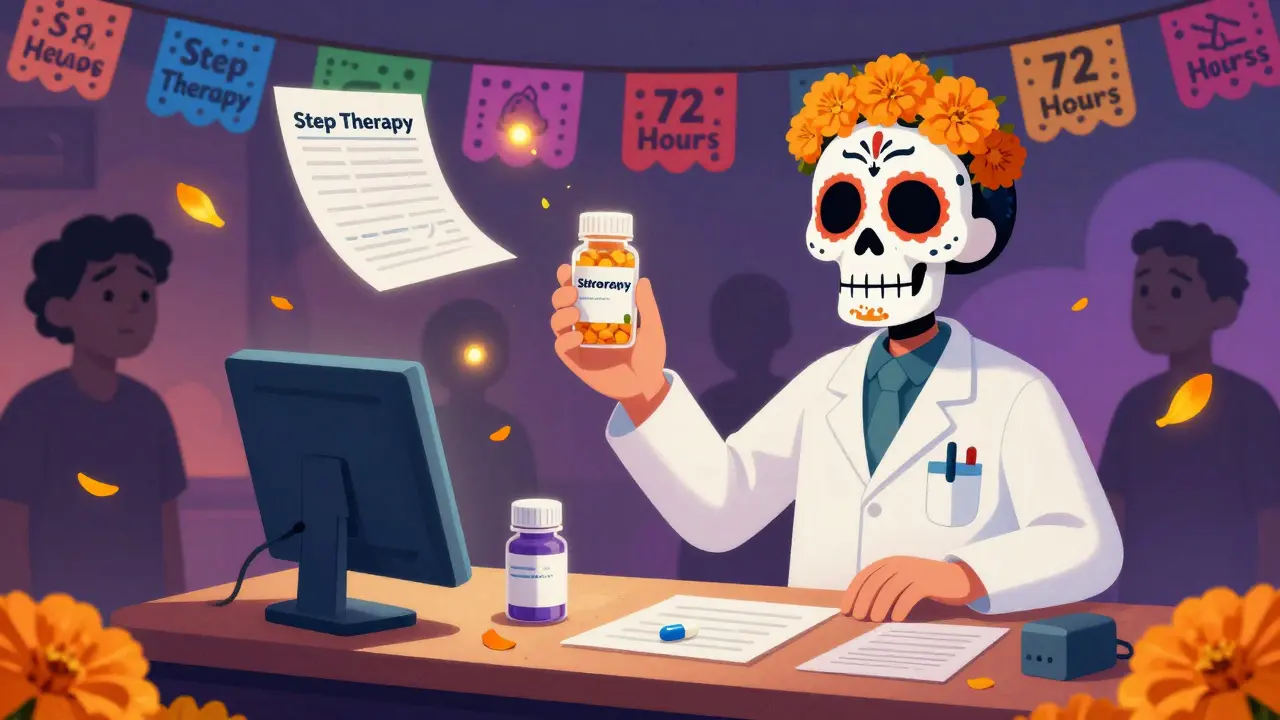
When a pharmacist fills a prescription for a brand-name drug, but the patient’s insurance denies coverage because a cheaper generic is available, it’s not just a paperwork issue-it’s a barrier to care. This is the reality of prior authorization for generic alternatives, a system meant to cut costs but often slowing down treatment instead. In 2025, nearly every major insurer in the U.S. still requires doctors and pharmacists to jump through hoops before approving a brand-name medication, even when a generic exists that’s proven to work just as well. And for pharmacy teams on the front lines, this isn’t just an inconvenience-it’s a daily grind that eats into patient time, increases stress, and sometimes leads to people skipping their meds entirely.
How Prior Authorization for Generics Actually Works
Prior authorization isn’t random. It’s a rule-based system built into insurance contracts. If a drug has a generic version that’s FDA-approved as therapeutically equivalent (an AB rating), insurers will often refuse to pay for the brand-name version unless the patient has first tried-and failed-the cheaper alternative. This is called step therapy. The logic? Save money by starting low-cost. The problem? It doesn’t always match how real patients respond.
The process follows a strict seven-step flow:
- A provider prescribes a brand-name drug, but the pharmacy’s system flags it because a generic exists.
- The pharmacy or provider gathers clinical documentation: diagnosis codes (ICD-10), lab results, past treatment attempts, and proof the patient didn’t respond to the generic.
- The request is submitted-electronically, by fax, or over the phone.
- The insurer’s clinical team (often a pharmacist, not a doctor) reviews it against their internal policy.
- They decide: approve, deny, or ask for more info.
- The pharmacy gets the answer-sometimes in hours, sometimes in weeks.
- If denied, the provider can appeal, but that adds even more time.
Timing matters. Cigna gives you 5-10 business days. UnitedHealthcare says 7-14 calendar days. But starting January 1, 2026, Medicaid plans must respond in just seven days for standard requests-and 72 hours for urgent cases. That’s a big shift, and it’s forcing insurers to get faster.
Why This System Fails Patients
On paper, step therapy sounds smart. Use the generic first. If it doesn’t work, move up. But in practice, patients don’t always have the luxury of waiting.
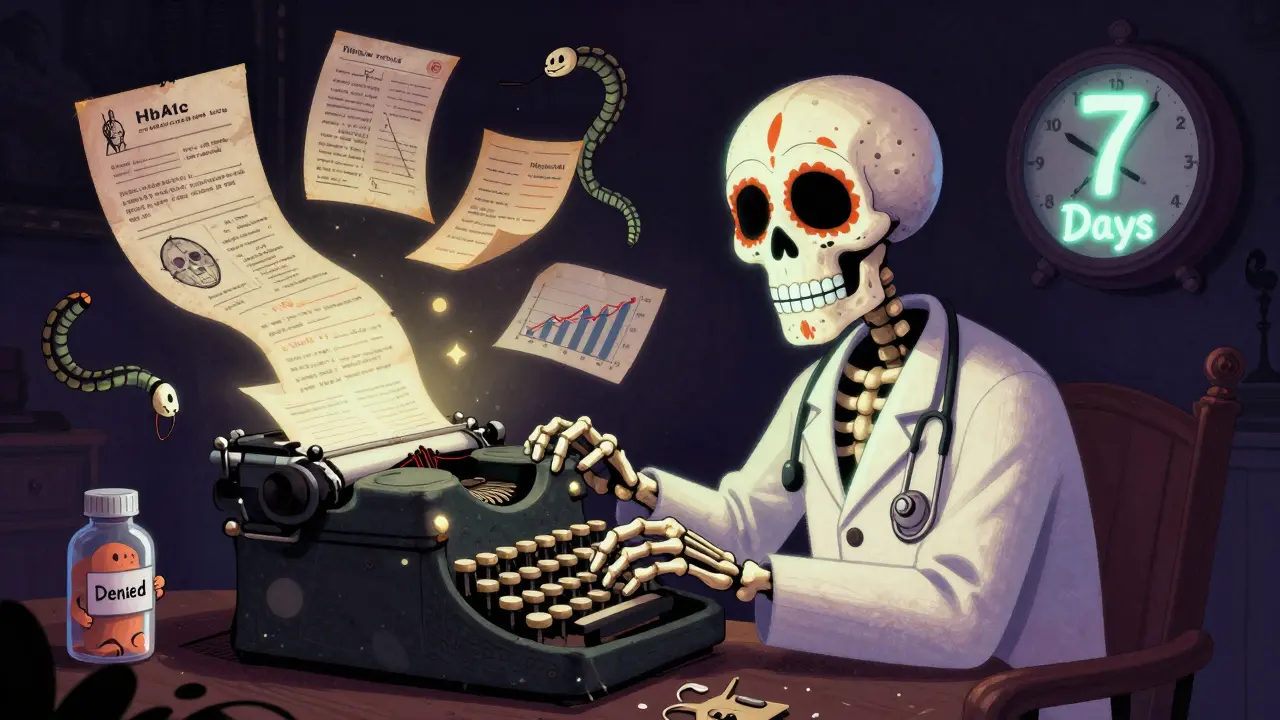
Take diabetes. A patient is prescribed a brand-name GLP-1 agonist because metformin didn’t control their blood sugar. But their insurer requires two failed generic trials before approving it. The patient tries one generic, then another. Each trial takes four to six weeks. By the time they get approval, their HbA1c has climbed to dangerous levels. They’re now at higher risk for kidney damage, nerve pain, or hospitalization. And that’s not hypothetical-studies show 12% of diabetes patients abandon treatment after step therapy delays.
It’s worse for mental health. A patient with depression gets prescribed a brand-name SSRI because two generics caused side effects. But the insurer says, “Try one more generic.” They do. Still no improvement. By the time the approval comes through, the patient has already stopped taking meds altogether. Patients Rising found that 67% of people abandon treatment because of prior authorization delays-especially for psychiatric drugs.
And it’s not just about time. Documentation is brutal. One study found that prior authorization requests for multiple sclerosis treatments average 7.3 pages of paperwork per case. Most of it isn’t medical-it’s administrative. Insurance forms asking for irrelevant details, redundant lab reports, or outdated patient history. Pharmacists spend hours chasing down records that should already be in the EHR.
How Insurers Are Different-And Why It Confuses Pharmacies
Not all insurers play by the same rules. That’s the biggest headache for pharmacies.
UnitedHealthcare might require a 30-day trial of two generics before approving a brand-name diabetes drug. Aetna? Just 14 days, but they demand documented HbA1c readings. Medicare Part D plans require prior authorization on 18.7% of brand-name prescriptions with generics available. Commercial insurers? That number jumps to 32.4%. And for specialty drugs like cancer treatments? Nearly all (94%) require prior authorization when a biosimilar exists.
Some insurers offer “gold carding”-automatic approval for providers who consistently get approvals on the first try. But here’s the catch: only 29% of eligible providers even know they have gold card status. Most don’t realize they can skip the paperwork entirely if they’ve built a track record with that insurer.
And the submission method matters. Electronic prior authorization (ePA) is now used by 89% of insurers. Requests sent electronically get approved the same week 78% of the time. Fax? Only 34%. Phone? Forget it-most insurers don’t even accept it anymore.
What Works: Real Strategies for Pharmacies and Providers
Pharmacists aren’t powerless. There are proven ways to cut through the red tape.
- Submit early. Don’t wait until the patient is at the counter. Submit the prior authorization 14 days before the medication is needed. That’s the sweet spot, according to the American Medical Association.
- Document failure clearly. Vague terms like “didn’t work” get denied. Specifics like “<30% symptom reduction after 4 weeks of 20mg generic” get approved 87% of the time.
- Use payer templates. Every insurer has a preferred form. Using their exact template reduces denials by 37%.
- Go electronic. If your pharmacy uses an ePA platform like CoverMyMeds or Surescripts, use it. Same-day approvals are common for straightforward cases.
- Assign a dedicated person. Pharmacies that assign one staff member to handle prior authorizations cut processing time by over half. No more juggling it between filling scripts and answering calls.
- Track everything. Use a digital tracker to log every request, deadline, and denial reason. Lost requests drop by 89% when you have a system.
One success story? The University of Pittsburgh Medical Center automated their prior authorization workflow. Before: 9.2 days average approval time. After: 2.1 days. First-pass approval rate jumped from 58% to 89%. They didn’t change the rules-they just got better at playing them.
The Bigger Picture: What’s Changing in 2025 and Beyond
The system is under pressure-and change is coming fast.
In 2026, CMS will enforce new rules: all Medicaid plans must respond within seven days for standard requests and 72 hours for urgent ones. That’s not optional. It’s law. And it’s forcing insurers to upgrade their tech. Right now, 61% of large health systems are testing AI tools that auto-fill prior authorization forms by pulling data from electronic records. Early results show a 44% drop in submission time.
Another big shift? Real-time benefit checks. By 2026, prescribers will see whether a prior authorization is needed right when they write the prescription. No more surprises at the pharmacy counter. The Congressional Budget Office estimates this could cut prior authorization disputes by 31%.
And the future? Blockchain pilots are underway at Mayo Clinic and other academic centers. Their system uses a distributed ledger to verify treatment history instantly. For generic alternative requests, approval rates hit 92%-because the insurer sees the full clinical picture upfront, without chasing down records.

Why This Matters to You
If you’re a pharmacist, you’re not just filling prescriptions-you’re navigating a broken system. Every denial you fight, every fax you send, every patient who walks away because they can’t wait-it adds up. The cost? $13.4 billion a year in wasted provider time, according to JAMA Internal Medicine. And 63% of that is from generic alternative requests.
But you’re not alone. The American College of Physicians says prior authorization should only be used for high-cost drugs-and automatic approval should be given for generics with FDA’s AB rating. That’s common sense. And more states are listening. As of 2024, 27 states have passed laws limiting step therapy for generics, including Texas, which now requires 72-hour turnaround for urgent cases.
There’s hope. Technology is catching up. Rules are changing. But until then, the best tool you have is knowledge. Know your payer’s policy. Know your documentation standards. Know your deadlines. And don’t be afraid to push back-when a patient’s health is at stake, the system should bend, not break.
Why do insurers require prior authorization for generic alternatives?
Insurers require prior authorization for generic alternatives to control costs. The idea is to use cheaper, equally effective generics first before approving more expensive brand-name drugs. This practice, called step therapy, is based on the assumption that most patients will respond to generics. However, insurers often set strict rules-even when the patient has already tried and failed multiple generics-leading to delays and treatment abandonment.
How long does prior authorization for generics typically take?
Processing times vary by insurer. Cigna takes 5-10 business days, UnitedHealthcare 7-14 calendar days, and Medicare Part D averages 7-10 days. Starting January 1, 2026, Medicaid plans must respond within seven calendar days for standard requests and 72 hours for urgent ones. Electronic submissions (ePA) can get approved in as little as 24 hours, while fax requests often take over a week.
What’s the most common reason for prior authorization denials?
The most common reason is inadequate documentation of generic failure. Many providers write vague notes like “patient didn’t respond,” which insurers reject. Successful requests include specific, measurable criteria: “HbA1c remained above 8.5% after 8 weeks of metformin 1000mg daily.” Clear, data-driven documentation increases approval rates by over 40%.
Can pharmacists help patients bypass prior authorization?
Pharmacists can’t bypass the system, but they can significantly improve success rates. By submitting requests early, using electronic portals, ensuring complete documentation, and following up with insurers, pharmacists reduce delays. They can also alert providers when a prior authorization is likely to be denied and suggest alternative medications that don’t require authorization. In some cases, they can help patients apply for patient assistance programs if the drug is denied.
What is gold carding, and how does it help?
Gold carding is a program where insurers automatically approve prior authorization requests from providers who have a history of high approval rates-usually 95% or higher-for specific drug classes. For example, if a doctor consistently gets approvals for GLP-1 agonists without denials, the insurer may waive the prior authorization requirement entirely. The problem? Only 29% of eligible providers know they have gold card status. Pharmacies should check with payers to see if their prescribers qualify.
Are there laws limiting prior authorization for generics?
Yes. As of 2024, 27 U.S. states have passed laws specifically targeting prior authorization for generic alternatives. These laws often limit step therapy to one failed trial, require faster turnaround times (like 72 hours for urgent cases), or ban prior authorization entirely for FDA AB-rated generics. Texas, California, and New York have some of the strongest protections. Pharmacies should know their state’s rules-they can use them to challenge denials.
What’s the future of prior authorization for generics?
The future is automation. By 2027, all major insurers must use FHIR-based APIs to share real-time benefit data at the point of prescribing. This means prescribers will know upfront if prior authorization is needed-and patients won’t get surprised at the pharmacy. AI tools are already auto-filling forms, reducing submission time by 44%. Blockchain pilots are proving 90%+ approval rates by giving insurers instant access to full patient histories. The goal: eliminate paperwork, not care.
What to Do Next
If you’re a pharmacist or pharmacy staff member:
- Check with your top 5 payers to see if your prescribers have gold card status.
- Switch to electronic prior authorization if you’re still using fax.
- Create a checklist for documenting generic failures-use measurable outcomes.
- Assign one person to manage prior authorizations full-time.
- Track every denial and share patterns with your prescribers.
If you’re a prescriber:
- Use payer-specific templates when submitting requests.
- Document failure with numbers, not opinions.
- Submit requests 14 days before the patient needs the medication.
- Ask your pharmacy to flag patients at risk of abandonment due to delays.
The system isn’t perfect. But it’s not unbeatable. The difference between a patient getting their medication and walking away is often one well-documented request, one timely submission, one person who knows the rules. You’re not just filling scripts-you’re fighting for care.


There are 9 Comments
BETH VON KAUFFMANN
Let’s be real-prior auth for generics is just insurance bureaucracy dressed up as ‘cost containment.’ They’re not saving money; they’re shifting labor onto providers and punishing patients for having bad luck with side effects. The 7-step flow? More like a Kafkaesque obstacle course where the goalpost moves every quarter. And don’t get me started on fax submissions. In 2025, we’re still sending paper trails through analog pipes while claiming to be ‘digitally transformed.’ Hypocrisy at scale.
Meanwhile, pharmacists are expected to be clinicians, data entry clerks, and patient advocates-all while getting paid minimum wage for the emotional labor. The system isn’t broken. It was designed this way.
And yes, I’ve seen the ‘gold carding’ loophole. Only 29% of providers know about it? That’s not a feature. That’s negligence. Someone’s getting paid to keep this opaque.
Also, Medicaid’s new 7-day rule? Too little, too late. But at least it’s a crack in the dam. Let’s hope it fractures the whole structure.
Meanwhile, patients are dying because their HbA1c spiked during a 14-day fax delay. That’s not policy. That’s malpractice by algorithm.
Donna Packard
I just want to say thank you to every pharmacist who’s stayed calm while dealing with this mess. You’re the real heroes in this system. I’ve seen friends delay meds because of prior auth and it breaks my heart. You’re not just filling prescriptions-you’re holding people together when the system fails them.
Keep pushing for change. Even small wins matter.
Patrick A. Ck. Trip
While i agree that the current system is flawed, i think we need to consider the broader context. Insurers are not evil-they’re responding to rising drug costs and fiduciary responsibility. The real issue is the lack of standardization across payers. If we had a national prior auth framework, with unified criteria and ePA mandates, we could cut through the noise.
Also, providers need to be better at documenting ‘failure.’ Too many say ‘didn’t work’ instead of ‘HbA1c remained >8.5 despite 12 weeks of metformin 1000mg BID with adherence confirmed.’ Precision matters.
And yes, fax is outdated. But not every clinic has EHR integration. We need infrastructure investment, not just outrage.
Peter Ronai
Oh, here we go again-the ‘patients are suffering’ sob story. Newsflash: generics are 80-90% cheaper. That’s not a ‘barrier,’ that’s responsible stewardship of healthcare dollars. You think Medicare is going to pay $500 for a brand-name drug when a $50 generic exists? That’s not ‘denial of care,’ that’s fiscal sanity.
And let’s be honest-most patients don’t even know what a GLP-1 agonist is. They just want the free stuff. Step therapy isn’t cruel-it’s common sense. If the generic doesn’t work, then move up. That’s how medicine works. You don’t start with a Ferrari when a Honda fits the route.
Also, ‘7.3 pages of paperwork’? That’s what you call a problem? I’ve filled out 20-page IRS forms. This is a spreadsheet with a pulse. Stop whining.
And don’t even get me started on ‘mental health’ exceptions. Depression? Try therapy first. Then exercise. Then SSRIs. Then generics. Then brands. That’s the hierarchy of care. Not the insurance company’s fault you’re too lazy to follow it.
Michael Whitaker
As someone who has reviewed over 1,200 prior authorization requests across three health systems, I must say: the real issue is not the process-it’s the lack of clinical authority in the review team. Insurers hire contract pharmacists with no prescriptive authority, no direct patient contact, and no understanding of longitudinal care. They’re evaluating complex neurology cases based on a 300-word template.
And yet, they hold the power to deny life-altering treatments.
It’s like letting a cashier decide whether you need a pacemaker.
Also, the term ‘gold carding’ is misleading. It’s not a reward-it’s a privilege reserved for providers who have already spent 300+ hours navigating the same system. The system doesn’t reward efficiency-it rewards endurance.
And yes, I’ve seen patients cry in the pharmacy because their insulin was denied. That’s not policy. That’s institutional cruelty disguised as compliance.
Brooks Beveridge
Hey everyone-just wanted to say this is such an important conversation. 🙏
I’ve been a pharmacy tech for 12 years and I’ve seen the toll this takes-not just on patients, but on the whole team. We’re not just filling scripts. We’re holding space for people who are scared, confused, and exhausted.
But here’s the good news: every time we push back, every time we submit a well-documented appeal, every time we connect a patient with a patient assistance program-we make a difference.
Small steps. Big impact.
And if you’re a provider reading this: don’t underestimate the power of a handwritten note on the fax. It humanizes the request. I’ve seen approvals turn around because someone took the time to write, ‘This patient lost her husband last month. She’s alone. Please help.’
We’re not just healthcare workers. We’re the last line of humanity in a broken system.
Keep going. You’re not alone.
💛
Sachin Bhorde
From India, I can say this: our system is worse. No prior auth, but drugs are unaffordable anyway. But here’s the kicker-generic quality varies wildly. Some are fine, some are useless. So maybe insurers have a point? Not to delay, but to ensure bioequivalence.
Also, ePA is a game changer. We use it in my clinic. 80% approval in 2 days. No fax. No calls. Just API. Why can’t US do this? Because bureaucracy loves friction.
And yes, documentation sucks. But if you write ‘patient intolerant’ instead of ‘didn’t work,’ you save 3 days. Try it.
Also, 12% diabetes abandonment? That’s a crisis. But it’s fixable. Just standardize the criteria. One form. One portal. Done.
Marie Mee
theyre lying about generics being just as good. the big pharma companies made the generics to look like the brand name but theyre full of fillers and cheap chemicals that make you sicker. the insurance companies are in cahoots with them. its all a scam. i know a lady who went blind after taking the generic for her glaucoma med. they told her it was the same. it wasnt. theyre killing people and no one cares.
and dont even get me started on the ehr systems. theyre all hacked. the government is watching. you think they let you submit your medical info for free? its all tracked. they know when you take your meds. they know if you skip. they use it to raise your rates. its all connected. its the new world order.
Kent Peterson
Let me be clear: prior authorization is not a ‘barrier to care’-it’s a necessary check against reckless prescribing. You think every doctor knows what they’re doing? I’ve seen prescriptions for brand-name statins for patients with no cholesterol issues. I’ve seen SSRIs prescribed for ‘low mood’ after one office visit. The system exists to prevent waste, fraud, and abuse.
And yes, some patients suffer delays-but that’s the cost of accountability. If you want to bypass the system, go private. Pay out of pocket. Don’t expect taxpayers to fund your entitlement to the latest $800/month drug when a $15 generic exists.
Step therapy isn’t cruel. It’s evidence-based. The studies show that 80% of patients respond to first-line generics. That’s not anecdotal-it’s statistical.
And if you’re spending ‘hours’ chasing records? That’s your EHR training problem. Not the insurer’s. Get better at your job.
Also, ‘gold carding’? That’s a merit badge. You earn it by doing things right. Not by complaining.
Stop blaming insurers. Start blaming lazy clinicians and patients who want the best without the responsibility.
And for the love of God, stop using ‘emotional vampire’ as a personality trait. It’s not a badge. It’s a cry for help.
Write a comment
Your email address will not be published. Required fields are marked *