Trimethoprim Hyperkalemia Risk Calculator
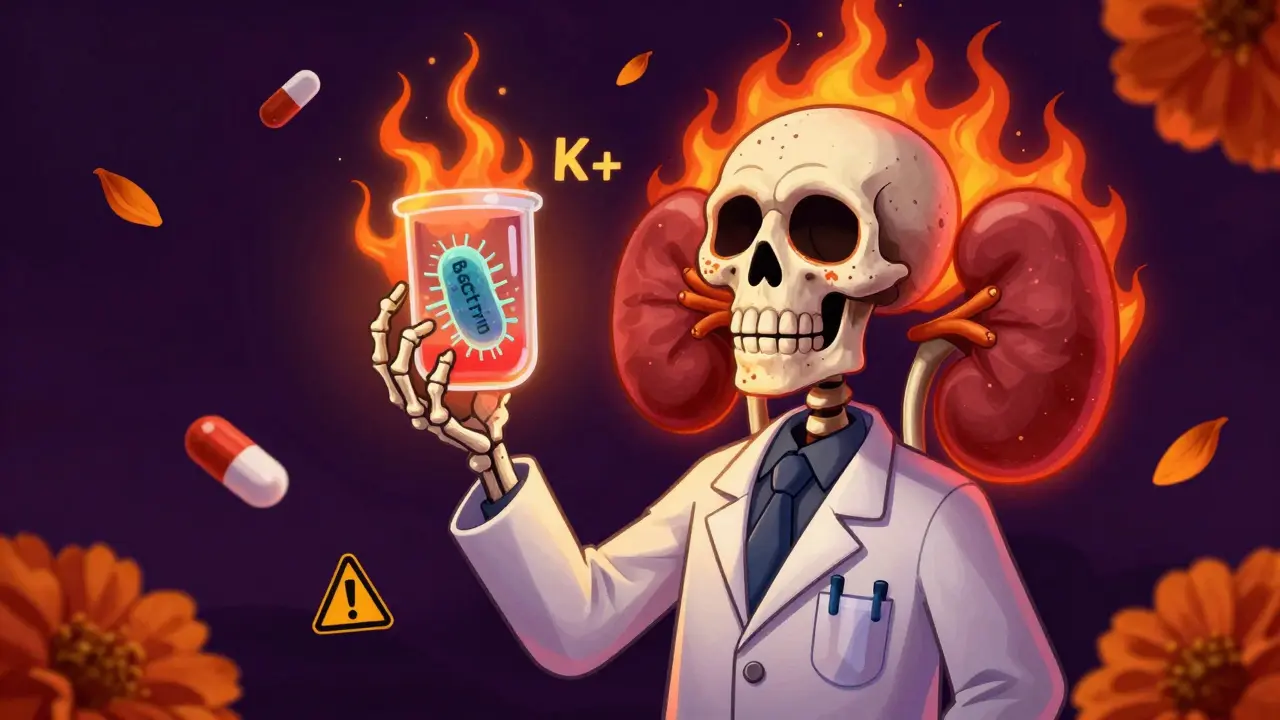
This calculator helps you understand your risk of developing hyperkalemia (elevated potassium levels) when taking trimethoprim-based antibiotics like Bactrim or Septra. Based on your age, kidney function, medications, and current potassium levels, it provides an assessment of your risk level and recommended actions.
When you take an antibiotic like Bactrim or Septra for a urinary tract infection, you’re probably not thinking about your potassium levels. But that’s exactly what you should be. Trimethoprim, one of the two active ingredients in these common antibiotics, can quietly push your potassium into dangerous territory-sometimes in just two or three days. And if you’re over 65, have kidney issues, or take blood pressure meds like lisinopril or losartan, this isn’t just a minor concern. It’s a silent, potentially deadly risk.
How Trimethoprim Turns Into a Potassium Trap
Trimethoprim doesn’t work like most antibiotics. It doesn’t just kill bacteria. In your kidneys, it acts almost exactly like a drug called amiloride-a potassium-sparing diuretic. That means it blocks sodium channels in the part of the kidney that handles urine finalization. When sodium can’t be reabsorbed properly, the electrical signal that normally pushes potassium out of your blood and into your urine gets disrupted. Result? Potassium builds up.
This isn’t theoretical. Studies show that even at standard doses (160 mg trimethoprim daily), about 8.4% of people develop elevated potassium levels. That’s more than seven times higher than with other antibiotics like amoxicillin. In people with reduced kidney function, the rate jumps to nearly 18%. And it doesn’t take long. Potassium levels can spike 0.5 to 1.5 mmol/L within 48 to 72 hours. That’s fast enough to catch even sharp doctors off guard.
Who’s Most at Risk?
Not everyone who takes trimethoprim will have a problem. But some groups are walking into a minefield without realizing it.
- People over 65: Aging kidneys clear trimethoprim slower. One study found that older adults had 2.3 times higher drug levels in their blood than younger people.
- Those on ACE inhibitors or ARBs: Medications like lisinopril, enalapril, or valsartan already reduce potassium excretion. Add trimethoprim, and the effect multiplies. One major study showed a 6.7-fold increase in hospitalization risk for hyperkalemia when these drugs were combined.
- People with chronic kidney disease: Even stage 3 kidney disease (eGFR under 60) raises the risk to over 30% when trimethoprim is added.
- Diabetics: Diabetes often comes with kidney changes and sometimes ACE inhibitor use-double trouble.
One case report described an 80-year-old woman with normal kidney function and no history of high potassium. She took a single daily dose of Bactrim for pneumonia prevention. Three days later, her potassium hit 7.8 mmol/L-well above the lethal threshold of 6.5. She suffered cardiac arrest. She survived, but barely.
Why Doctors Still Prescribe It
If it’s so dangerous, why is trimethoprim still everywhere? Because for certain infections, it’s hard to beat.
It’s the go-to drug for Pneumocystis pneumonia in people with HIV or those on immunosuppressants. It’s cheap, effective, and often the only option when allergies or resistance rule out alternatives. For uncomplicated bladder infections, though? There are better choices.
Nitrofurantoin, for example, has no known link to potassium spikes. Fosfomycin and cephalexin are also safe alternatives for UTIs. But many doctors still default to Bactrim because it’s familiar, widely available, and covered by insurance. A 2022 survey found that 41% of primary care doctors don’t check potassium levels before prescribing it-even in patients on blood pressure meds.

The Real Cost of Ignoring It
The numbers don’t lie. Between 2010 and 2020, over 1,200 cases of trimethoprim-induced hyperkalemia were reported to the FDA. Nearly 200 led to hospitalization. Forty-three people died.
Most deaths happened in patients over 65. Many were on ACE inhibitors. In nearly 70% of severe cases, potassium rose above 6.0 mmol/L within 72 hours. That’s when the heart starts to misfire. Irregular rhythms. Weak pulses. Cardiac arrest. Emergency treatment-calcium gluconate, insulin with glucose, or even dialysis-becomes necessary.
One doctor on Reddit shared how a 72-year-old woman on lisinopril developed a potassium level of 6.8 after three days of Bactrim. She needed emergency dialysis. Another physician said they’d reviewed 200 prescriptions and only 15% saw potassium over 5.5-but those 15% were the ones who almost died.
What You Should Do
If you’re prescribed trimethoprim, here’s what matters:
- Ask: Do I need this? For a simple UTI, ask if nitrofurantoin or cephalexin is an option. For Pneumocystis pneumonia? That’s different-this drug saves lives. But know the risk.
- Check your potassium before you start. If your potassium is already above 5.0 mmol/L, don’t take it. Period.
- Get tested again at 48-72 hours. This is the peak window. Most spikes happen here. A simple blood test can catch it before it’s too late.
- Know your meds. Are you on lisinopril, losartan, spironolactone, or eplerenone? Tell your doctor. These drugs amplify the risk.
- Watch for symptoms. Muscle weakness, irregular heartbeat, fatigue, nausea. These aren’t always obvious. But if you feel off after starting the antibiotic, get checked.
What’s Being Done About It
Experts are pushing for change. The American Geriatrics Society says trimethoprim should be avoided in older adults on ACE inhibitors or ARBs. The FDA added a boxed warning in 2019-but many prescribers still don’t know about it.
Hospitals are starting to use electronic alerts. One system that required a potassium check before allowing a Bactrim prescription cut hyperkalemia cases by over half. Pharmacist-led interventions reduced risky prescriptions by 63% in a recent trial.
A new tool called the TMP-HyperK Score helps predict risk by combining age, baseline potassium, kidney function, and use of blood pressure meds. It’s 89% accurate at spotting who’s likely to have a spike.
Bottom Line
Trimethoprim isn’t evil. It’s a powerful, life-saving drug for specific infections. But it’s also a hidden potassium bomb-especially for older adults and those on common heart or kidney medications. The risk is real, predictable, and preventable.
Don’t assume your doctor knows. Don’t assume your kidneys are fine. Don’t assume it’s safe just because it’s common. Ask the questions. Get the test. Know your numbers. Your heart might depend on it.





There are 10 Comments
Darren McGuff
Trimethoprim is a silent killer disguised as a simple antibiotic. I’ve seen it firsthand in the ER-80-year-old on lisinopril, takes Bactrim for a UTI, and three days later, they’re in cardiac arrest. No warning. No symptoms until it’s too late. This isn’t speculation-it’s clinical fact. The FDA warning exists for a reason, and yet, doctors still prescribe it like it’s Advil. We need mandatory potassium checks before prescribing, especially for anyone over 65 or on ACE inhibitors. It’s not complicated. It’s basic safety.
And don’t get me started on how insurance pushes this drug because it’s cheap. Lives aren’t commodities.
Angela Stanton
Let’s quantify the risk: 8.4% hyperkalemia rate vs. amoxicillin’s 1.1%. That’s a 7.6x increase. For patients with CKD stage 3+, it’s 30%. The pharmacokinetics are clear-trimethoprim inhibits ENaC channels in the collecting duct, mimicking amiloride. This isn’t a ‘maybe’-it’s a direct electrophysiological disruption. The 48–72 hour window is the critical period. No lab follow-up? That’s not negligence. That’s malpractice waiting to happen.
And yes, I’m a nephrologist. I’ve written up 12 cases in the last year. Stop guessing. Start testing.
Diana Stoyanova
Look-I get it. We’re all tired of being treated like we don’t know our own bodies. But this? This is one of those times where your gut feeling is screaming for a reason. My grandma took Bactrim for a ‘simple’ infection, and within 72 hours, she was shaking, weak, barely able to speak. They said it was ‘just old age.’ Turns out her potassium was 7.1. She spent a week in the ICU. They didn’t even check her levels before prescribing.
Don’t wait for your body to scream. Ask for the test. Demand it. Your heart doesn’t care how ‘common’ the drug is. It only cares if the numbers are safe. I’m not scared of asking questions anymore. I’m scared of silence.
Alicia Hasö
To everyone saying ‘my doctor knows best’-please stop. Your doctor might be busy, overworked, or just following habit. This isn’t about blame-it’s about empowerment. You don’t need to be a medical expert to ask: ‘Is there an alternative?’ or ‘Can we check my potassium first?’
I’m a nurse and I’ve trained dozens of older patients to ask these exact questions. It’s not rude. It’s responsible. You’re not being difficult-you’re being alive. And if your doctor resists? Find a new one. Your life is worth more than their convenience.
Heather Wilson
Interesting how the article ignores that trimethoprim is the ONLY effective treatment for PCP in immunocompromised patients. You’re demonizing a drug that saves lives daily. This feels like fearmongering disguised as education. Yes, there’s risk. But the benefit-risk ratio is still favorable for the right population. Stop generalizing. Not every UTI patient is a 75-year-old on lisinopril.
Also, 1,200 reported cases over 10 years? That’s less than 120 per year. Meanwhile, millions of prescriptions are written. The real story is that this is rare-but you’re making it sound like a pandemic.
Lindsey Wellmann
OMG I JUST REALIZED MY GRANDMA WAS ON THIS 😭 I’M SO SORRY I DIDN’T ASK 😭 SHE’S OK NOW BUT SHE WAS SO WEAK FOR WEEKS AND THE DOCTOR SAID ‘IT’S JUST AGING’ 🤬 I’M TELLING EVERYONE I KNOW. THIS NEEDS TO BE ON EVERY RX LABEL. 🚨❤️🩹 #BactrimIsNotSafe #CheckYourPotassium
Drew Pearlman
I know this sounds like a stretch, but hear me out: what if we’re looking at this all wrong? Instead of just banning or warning, what if we redesigned the system? Imagine a world where every prescription for trimethoprim auto-triggers a pharmacist consult, a potassium check, and a 24-hour follow-up reminder. No paperwork. No hassle. Just smart tech doing what humans forget.
Some hospitals are already doing this-and their hyperkalemia rates dropped by 60%. Why isn’t this standard everywhere? Because change is slow. But it doesn’t have to be. We can demand better. We can build better. We already have the tools.
Let’s not just warn people. Let’s protect them.
Elisha Muwanga
This article is a textbook example of liberal medical alarmism. We’re being told to fear a common, effective antibiotic because of a few outliers. Meanwhile, we ignore the real crisis: antibiotic resistance. If we stop prescribing trimethoprim because of potassium spikes, we’ll be forced to use broader-spectrum drugs-and that’s far more dangerous long-term.
Not every risk is a reason to abandon a tool. We need better monitoring, not blanket fear. And let’s be honest-this is just another way to make people distrust their doctors. Stop pushing panic. Start pushing responsibility.
Chris Kauwe
Let’s cut through the noise: this isn’t about medicine. It’s about power. The pharmaceutical industry profits from prescribing trimethoprim because it’s cheap and generic. The medical establishment resists change because it disrupts workflow. The patient? They’re just collateral in a system designed to optimize for cost and convenience, not safety.
The TMP-HyperK Score? It’s brilliant. But it won’t be adopted unless patients force it. We’re not patients-we’re consumers. And consumers demand transparency. Demand accountability. Demand a system that doesn’t treat your potassium like an afterthought.
This isn’t a medical issue. It’s a moral one.
Ashley Kronenwetter
As someone who has worked in clinical pharmacology for 22 years, I can confirm: the data is unequivocal. Trimethoprim-induced hyperkalemia is underrecognized, underreported, and preventable. The 48–72 hour window is critical. The risk is dose-dependent and cumulative. The alternatives exist. The guidelines exist. The tools exist.
What’s missing is consistent implementation. Not because we don’t know how-because we’ve chosen not to.
It’s not complicated. It’s just inconvenient.
Write a comment
Your email address will not be published. Required fields are marked *