
Getting a generic drug to market used to be a straightforward process of proving it behaves exactly like the brand-name version in the human body. But as we move into 2026, the drugs themselves are getting more complex. We aren't just dealing with simple pills anymore; we're looking at complex injectables, oligonucleotides, and advanced delivery systems. This shift has made traditional testing slow, expensive, and sometimes inaccurate. The industry is now pivoting toward a mix of artificial intelligence, virtual modeling, and high-tech imaging to keep up with the demand for affordable medicine.
The core problem is that traditional clinical trials-where you give a drug to a group of people and measure the blood levels-can be incredibly wasteful for complex products. That's why the focus is shifting toward bioequivalence standards that prioritize smarter, faster data collection. We're seeing a transition from "test and see" to "predict and verify," which is drastically cutting down the time it takes to get a generic drug from the lab to the pharmacy shelf.
The AI Revolution in Bioequivalence
Artificial Intelligence isn't just a buzzword here; it's actually doing the heavy lifting in regulatory reviews. One of the most significant shifts is the introduction of the Bioequivalence Assessment Mate (BEAM), which is an automated data and text analysis tool launched by the FDA's Office of Generic Drugs in 2024. Before BEAM, reviewers spent hundreds of hours manually scrubbing through data. Now, this tool automates those labor-intensive tasks, reducing the reviewer's workload by about 52 hours per application. It's a massive win for efficiency.
Beyond the regulatory side, Machine Learning is being woven into pharmacokinetic and pharmacodynamic (PK/PD) modeling. Instead of relying solely on a few human subjects, researchers use ML to predict how a drug will distribute and clear from the body. This approach can reduce study timelines by up to 50% and cut costs by roughly 35%. When you consider that a standard bioequivalence study can cost between $1 million and $2 million, these savings are a game-changer for smaller manufacturers.
Moving Beyond the Human Trial: Virtual and In Vitro Models
For complex drug products, the industry is moving toward "virtual bioequivalence." This doesn't mean the drug is fake, but rather that the testing is simulated using highly accurate mathematical models. The FDA has been funding platforms that use IVIVC, or in vitro-in vivo correlation, which allows scientists to predict how a drug will perform in a human based on how it behaves in a lab setting. For certain complex products, these virtual methods could reduce the need for comparative clinical endpoint studies by as much as 65%.
A great example of this is the Dissolvit system. Standard dissolution tests often fail to mimic the actual environment of the human lungs or gut. Dissolvit provides a more physiologically relevant way to test orally inhaled products, helping manufacturers spot failures in the lab before they ever reach a human subject. We're also seeing the development of mechanistic IVIVC specifically for PLGA implants, which helps solve the nightmare of testing long-term release medications.
| Feature | Traditional Approach | AI-Enhanced/Virtual Approach |
|---|---|---|
| Average Study Timeline | Standard (Baseline) | 40-50% Reduction |
| Estimated Cost | $1M - $2M (Simple Generics) | Up to $4M (Initial Setup/High-Tech) |
| Data Accuracy | Manual/Variable | ~28% Improvement |
| Human Subject Requirement | High/Mandatory | Significantly Reduced (Virtual BE) |
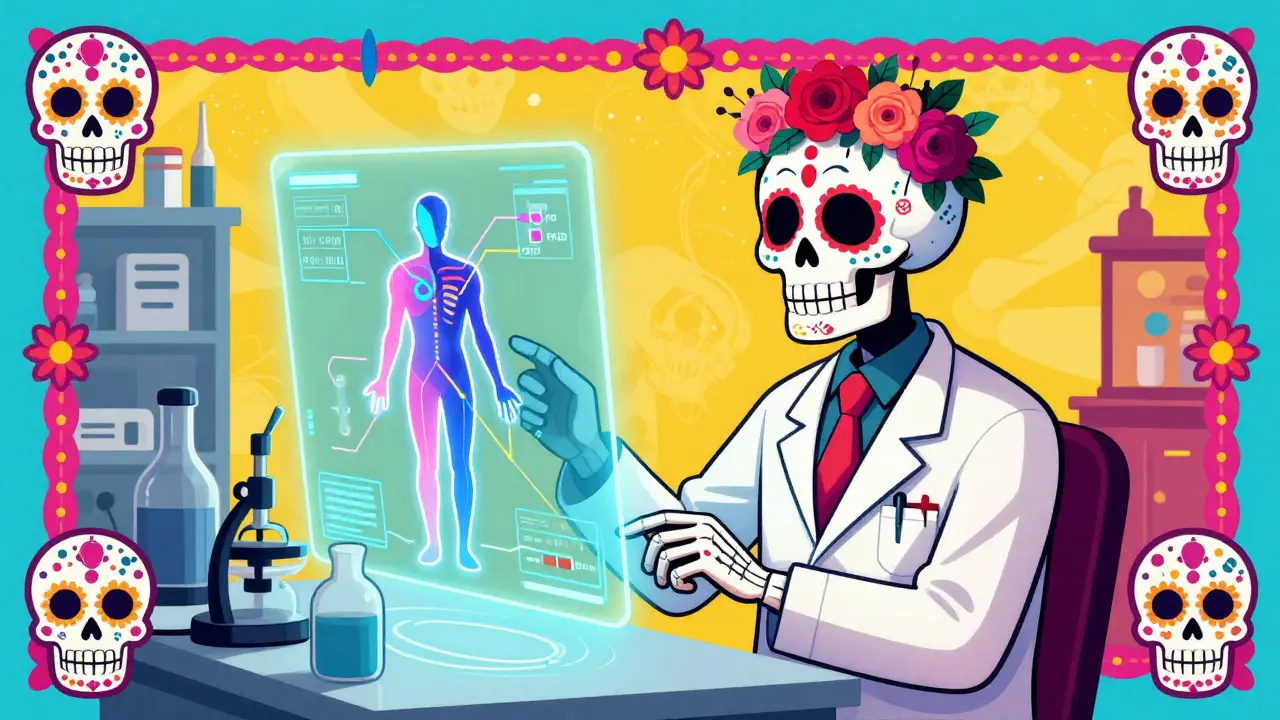
High-Precision Imaging and Bioanalytics
Sometimes, a chemical analysis isn't enough; you need to actually see what's happening at a molecular level. To achieve this, the FDA has integrated several advanced imaging techniques into their research initiatives. These aren't just for academic curiosity-they are used to ensure a generic drug's physical structure matches the original perfectly.
- Scanning Electron Microscopy (SEM): Used to examine the surface morphology of drug particles.
- Atomic Force Microscopy Infrared Spectroscopy: Provides a way to map chemical composition at an incredibly small scale.
- Optical Coherence Tomography: Allows for non-invasive imaging of the drug's interaction with tissues.
These tools are paired with automated sample-handling systems. In late 2024, the FDA's Office of Data, Analytics, and Research reported that these digital workflows boosted throughput by 37% and precision by 29%. When you're dealing with thousands of samples, reducing human error in the handling process is just as important as the analysis itself.
Global Harmonization and the ICH M10 Guideline
One of the biggest headaches for pharma companies has always been that the FDA in the US and the EMA in Europe often wanted different things for the same drug. This changed in June 2024 with the adoption of the ICH M10 guideline. This is a unified global framework for bioanalytical method validation.
By creating a single set of rules, the industry has seen a 62% reduction in method validation discrepancies between different regulatory regions. For a company trying to launch a biosimilar globally, this means they no longer have to run three different versions of the same test to satisfy three different countries. It streamlines the entire pipeline and gets medicines to patients faster.
The Remaining Hurdles: Where Tech Hits a Wall
Despite all the AI and fancy microscopes, we aren't at a point where we can ditch clinical trials entirely. Some drug types are just too stubborn for current models. Transdermal patches, for instance, still struggle with "irritation and adhesion" studies-predicting if a patch will stay on a human's skin or cause a rash is still something that requires real-world testing.
There is also a safety concern. Experts like Dr. Michael Cohen have warned that relying too heavily on in vitro (lab-based) models without enough clinical correlation can be dangerous for "narrow therapeutic index" drugs. These are medications where a tiny difference in dosage can be the difference between a cure and a toxicity event. In these cases, the old-school, cautious approach is still the safest bet.
Looking Toward 2030
The trajectory is clear: the industry is moving toward a hybrid model. By 2030, it's projected that AI-driven testing will handle about 75% of all standard generic applications. We're also seeing a geopolitical shift in where this work happens. While the US is pushing for domestic API sources through new pilot programs, regions like the Middle East and Africa are rapidly expanding their capabilities through government-funded biotech parks and partnerships with global CROs.
For those in the industry, the goal is no longer just about "passing the test." It's about using every tool available-from the BEAM tool for data analysis to Dissolvit for inhalation testing-to create a safer, cheaper, and more predictable path to drug approval.
What is the BEAM tool and how does it help?
The Bioequivalence Assessment Mate (BEAM) is an automated data and text analysis tool launched by the FDA in 2024. It helps by automating labor-intensive data collection and review tasks, which has been shown to reduce the workload for FDA reviewers by approximately 52 hours per application.
How does ICH M10 impact drug manufacturers?
ICH M10 is a harmonized guideline for bioanalytical method validation. It allows manufacturers to follow a single set of standards that are accepted by the FDA, EMA, and WHO, reducing regional discrepancies in testing by about 62% and simplifying the global approval process.
Can AI completely replace human clinical trials in bioequivalence?
Not entirely. While virtual bioequivalence and machine learning can reduce the need for clinical endpoint studies by up to 65% for some products, human trials remain critical for narrow therapeutic index drugs and complex delivery systems (like transdermal patches) where safety and physical adhesion must be verified in vivo.
What is the difference between traditional and virtual bioequivalence?
Traditional bioequivalence relies on measuring drug concentration in human subjects (PK studies). Virtual bioequivalence uses mathematical modeling and in vitro-in vivo correlation (IVIVC) to simulate the drug's behavior, significantly reducing costs and timelines.
Why is the Dissolvit system important for inhaled drugs?
Standard dissolution tests often fail to mimic the physiological conditions of the lungs. The Dissolvit system provides a more biorelevant environment, allowing for more accurate testing of orally inhaled products before they move to human trials.


There are 14 Comments
Simon Jenkins
Honestly, it's about time. The sheer inefficiency of the manual scrubbing process was a tragedy of epic proportions. I've seen professionals waste an entire career on tasks that a basic algorithm could solve in seconds. It's absolutely scandalous that we're only now talking about BEAM as if it's a miracle when it's actually just the bare minimum of digital competency! 🙄
Chad Miller
ai is just a buzzword lol... prob just a way for big pharma to cut cornrs and save money while we get the leftovers. rly dont trust these
Doug DeMarco
I get the skepticism, but look at the data! Better precision and faster access to meds is a win for everyone. Let's give the tech a chance to prove itself! 🌟
Rakesh Tiwari
Oh, wonderful. Now we can have "virtual bioequivalence." Because nothing says "safe medicine" like a mathematical simulation. I'm sure the people taking narrow therapeutic index drugs will feel much better knowing their safety was verified by a very sophisticated calculator. Absolute genius. 👏
Sarina Montano
The integration of Optical Coherence Tomography is actually the most fascinating part here. Being able to visualize the drug-tissue interaction non-invasively is a total paradigm shift. It transforms the process from a black-box chemical analysis into a vivid, structural map of how the drug actually integrates into the biological environment. It's absolutely brilliant engineering.
Thabo Leshoro
ICH M10 is a total lifesaver!!! The PK/PD harmonization... just makes the whole global pipeline so much smoother... no more fighting with different regional specs!!! It's just a win-win for everyone involved!!!
emmanuel okafor
it is interesting how we try to replace the human body with math but some things like skin irritation still need a real person it shows that nature has secrets that code cannot find yet
Julie Bella
Umm why is the FDA letting these AI tools run the show?? 😱 Its totally irresponsible to trust an algorithm with our health! Who is even auditing these things?? Someone needs to take a closer look at the profit margins of the companies making these "virtual" tests!! 😡
Camille Sebello
Total lack of oversight... clearly!! BEAM is just a shortcut!!
Will Gray
Typical. The US pushes this "innovation" while quietly shifting API sources. It's a strategic move to regain control of the supply chain, but let's not pretend it's just about "efficiency." The global harmonization is just a way to standardize the rules so the US can dominate the biotech parks in the Middle East and Africa. Wake up.
Franklin Anthony
honestly the a-i part is just a cover for more surveillance data collection on the patient side i bet its all connected to a larger database for tracking bio-metrics without our consent haha but hey keep it friendly
Victor Parker
They want us to trust the "virtual" models because they're phasing out real human trials to hide the side effects 🙄 Total control move! 👁️
Emily Wheeler
I find it quite poetic that we are attempting to mirror the complexity of human biology through these mathematical models, and while I agree with the caution regarding narrow therapeutic index drugs, there is something fundamentally hopeful about the idea that we can reduce the suffering of trial participants by using in vitro correlations, provided we maintain a deeply ethical framework that prioritizes the patient's lived experience over the speed of the pharmacy shelf, as the synergy between AI and human intuition is where the real magic happens in medicine.
Danny Wilks
It is quite interesting to observe how the industry is navigating the tension between rapid technological acceleration and the inherent unpredictability of biological systems. The mention of the Dissolvit system is particularly noteworthy, as it acknowledges that a lab setting is often a poor proxy for the actual physiological environment of the human lung, and the move toward more biorelevant testing suggests a maturation of the industry's approach to risk management. While the projected shift toward AI-driven testing by 2030 seems ambitious, the historical trend of regulatory harmonization, as seen with the ICH M10, suggests that the structural barriers to this transition are finally being dismantled in a way that could legitimately lower the cost of essential medicines globally.
Write a comment
Your email address will not be published. Required fields are marked *