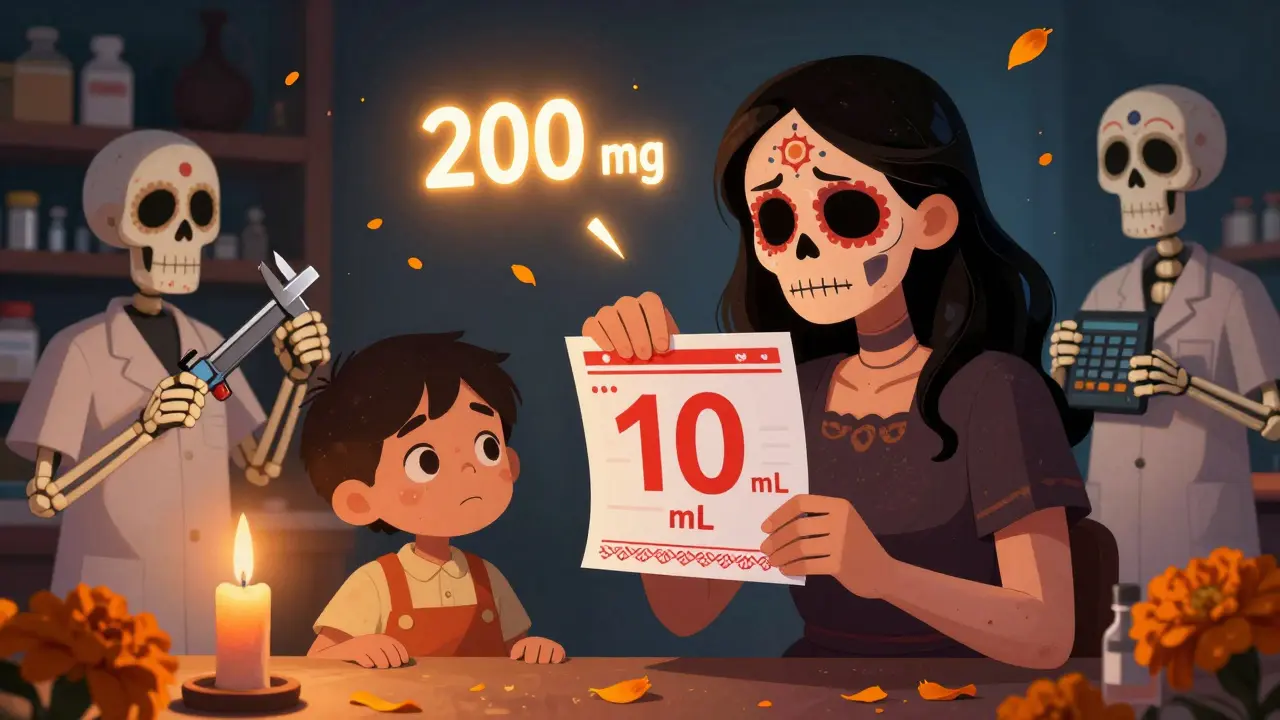
When your child gets a new prescription, the label might say 10 mL - but that’s not the dose. The real dose is 200 mg. Mixing up volume and medication amount is one of the most dangerous mistakes parents and even some providers make. Every year, thousands of children are at risk because the dose on the label doesn’t clearly show what’s safe. Confirming pediatric dosing isn’t optional. It’s a lifesaving step you must take every single time.
Why Pediatric Dosing Is Different
Children aren’t small adults. Their bodies process medicine differently. A dose that’s safe for a 150-pound teen could be deadly for a 25-pound toddler. That’s why dosing is based on weight - not age, not size, not guesswork. The standard method is mg/kg (milligrams per kilogram of body weight). Some drugs, especially chemotherapy, use mg/m² (milligrams per square meter of body surface area). If the label doesn’t show the weight-based calculation, ask for it. If it’s missing, the prescription isn’t complete.The Institute for Safe Medication Practices found that 56% of all pediatric medication errors are dosing mistakes. Most of these happen because the weight wasn’t converted correctly, the concentration was misunderstood, or the dose was rounded the wrong way. In one Pennsylvania study, 91.6% of serious incidents involved incorrect calculations. This isn’t rare. It’s common - and preventable.
Step 1: Find the Child’s Weight in Kilograms
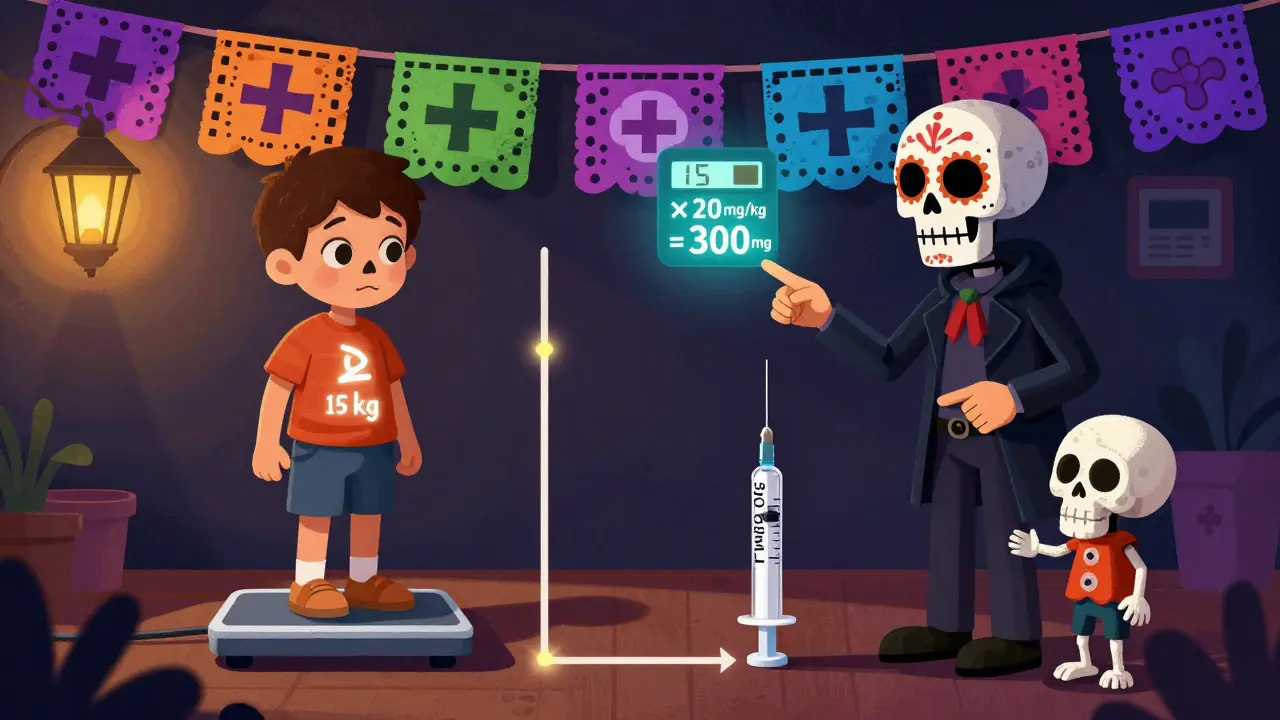
The first thing you need to check is whether the prescription includes the child’s weight - and in kilograms, not pounds. If it says 44 lb, that’s not enough. You need to know it’s 20 kg. Why? Because all pediatric dosing formulas use kilograms.Use the exact conversion: 1 kg = 2.2 lb. That’s not a suggestion. It’s the standard used in all medical guidelines, including Davis’s Drug Guide and the FDA. If someone says “just divide by 2,” they’re wrong. That’s how errors start.
Example: Your child weighs 33 pounds. Divide 33 by 2.2 = 15 kg. Write that down. Now you have the number you need to calculate the dose.
Step 2: Find the Dose in Milligrams, Not Milliliters
Look at the label. Does it say “Give 5 mL”? That’s the volume - not the amount of medicine. The real dose is in milligrams. Ask: “What is the exact dose in milligrams?” If the pharmacist or doctor can’t answer that immediately, pause. Don’t fill the prescription yet.Many liquid medicines come in different concentrations. Amoxicillin, for example, can be 40 mg/mL, 80 mg/mL, or even 125 mg/mL. If you’re given 5 mL of 80 mg/mL, that’s 400 mg. But if you think it’s 40 mg/mL, you’ll think it’s only 200 mg. That’s a 2x overdose. That’s how a near-miss becomes a tragedy.
The FDA’s 2023 Safe Use of Pediatric Liquid Medicines guide says parents should always ask three questions:
- What is the exact dose in milligrams, not milliliters?
- Is this dose appropriate for my child’s current weight?
- Can you show me how to measure this dose with the provided device?
These aren’t extra steps. They’re your safety net.
Step 3: Do the Math - mg/kg
Once you have the weight in kg and the recommended dose per kg, multiply them. For example:- Child weight: 15 kg
- Recommended dose: 20 mg/kg
- Total dose: 15 × 20 = 300 mg per day
If the dose is given twice a day, divide by 2: 300 mg ÷ 2 = 150 mg per dose.
Now check the label: Does 150 mg match the amount in the volume you’re being given? If the concentration is 30 mg/mL, then 150 mg = 5 mL. If the label says 5 mL and the math adds up - you’re good. If it says 7 mL, stop. Something’s wrong.
Don’t rely on memory. Write it down. Use a calculator. Even if you’re a nurse or doctor, you’re human. Mistakes happen.
Step 4: Watch for Rounding Errors
Pharmacies often round doses to make them easier to measure. But rounding can be dangerous if it’s not done right. For example, if the exact dose is 142.3 mg, should it be rounded to 142 mg or 140 mg? That’s a 2.3 mg difference - small, but in a 5 kg infant, it matters.Electronic systems like Cerner and EPIC have built-in rules:
- Doses under 10 mg → round to nearest 0.1 mg
- Doses over 10 mg → round to nearest 1 mg
But not all pharmacies follow this. Always ask: “Was this dose rounded? What was the original number?” If the system shows both the ordered and actual dose, compare them. If it doesn’t, ask for it.
Step 5: Dual Verification - Two Sets of Eyes
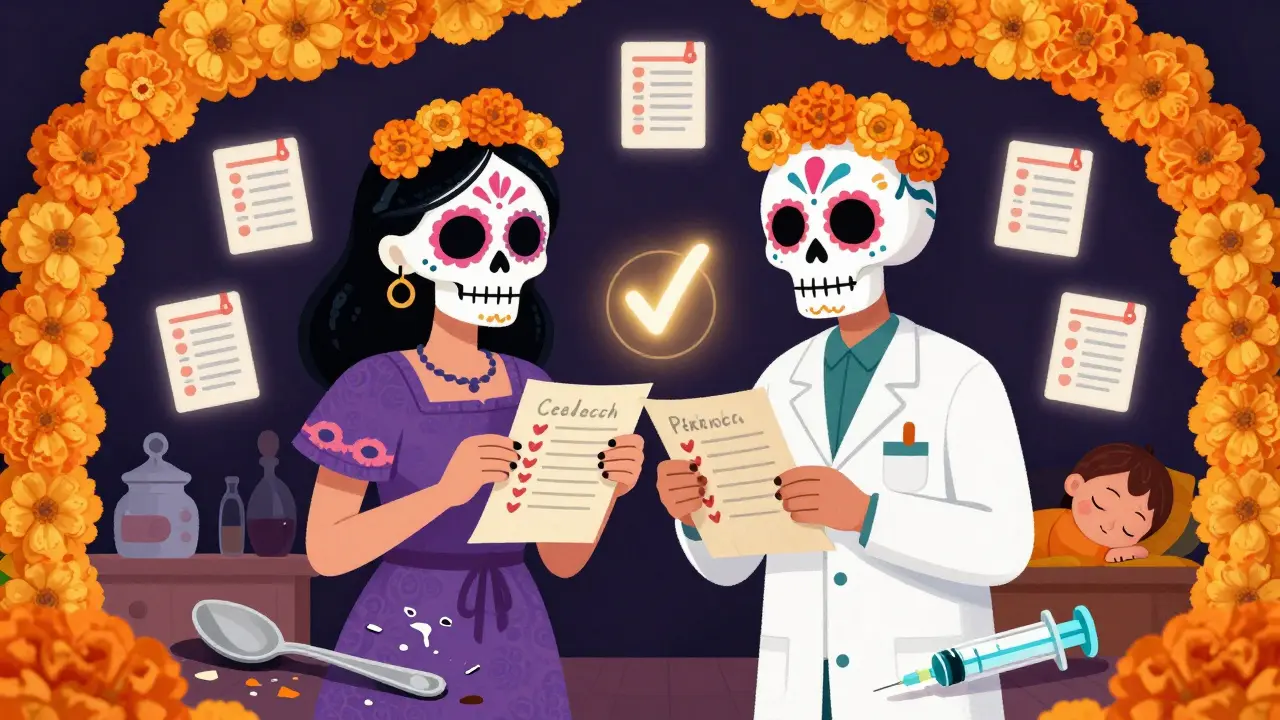
The American Society of Health-System Pharmacists (ASHP) says all pediatric doses must be checked by two people. One calculates. The other checks. That’s the standard in children’s hospitals. But in general clinics? Not always.If you’re the parent, be the second set of eyes. Do the math yourself. Use the same formula. If you get a different answer, go back. Don’t let anyone rush you. You’re not being difficult - you’re preventing a mistake.
One mother on Reddit shared how she caught a 2.5x overdose. The label said “10 mL” for her 4-year-old’s amoxicillin. She did the math: 10 mL × 80 mg/mL = 800 mg. The recommended dose for her child’s weight was 320 mg. She called the pharmacy. They corrected it. That’s how safety works - one parent, one question, one saved child.
Step 6: Use the Right Measuring Tool
Never use a kitchen spoon. Never guess. Always use the syringe, dropper, or cup that came with the medicine. Those are calibrated for the exact concentration. A teaspoon holds about 5 mL - but only if it’s the right teaspoon. Household spoons vary wildly.Some pharmacies now include dosing charts on the bottle. If yours doesn’t, ask for one. Or print one from the manufacturer’s website. Many drug companies, like Tylenol and Motrin, have clear charts on their sites showing doses by weight.
What to Do If Something Doesn’t Add Up
If the dose feels too high or too low - trust your gut. Here’s what to do:- Don’t give the medicine yet.
- Call the prescribing doctor or pharmacist. Say: “I did the math, and I’m concerned this might be too much/too little.”
- Ask them to confirm the weight, concentration, and calculated dose in writing.
- If they dismiss you, go to another pharmacy or ask for a second opinion.
There’s no shame in double-checking. In fact, the American Academy of Pediatrics says parents who ask questions reduce error rates by 60%.
Technology Is Helping - But You Still Need to Check
New tools are making dosing safer. AI-powered systems like DoseSpot can cross-check your child’s weight and age against 15,000+ dosing guidelines with 99.2% accuracy. EHRs like EPIC now flag doses that fall outside safe ranges. But these systems aren’t perfect. They can miss if the weight is entered wrong. They can’t read your child’s face or know if they’re 2 pounds heavier than last week.Technology helps. But you are the final safety check.
Real Cases. Real Consequences.
A 2022 study in BMC Pediatrics found that 43.5% of preventable adverse drug events in children came from confusing mg and mL. One child was given 10 mL of a 160 mg/5 mL acetaminophen solution - thinking it was the 80 mg/0.8 mL version. That’s a 3x overdose. The child ended up in the ER with liver damage.Another child, prescribed 200 mg of amoxicillin, got 10 mL of 80 mg/mL - which is 800 mg. The parent noticed the bottle looked different from last time. They called the pharmacy. The dose was wrong. The child was fine. Because someone asked.
These aren’t outliers. They’re symptoms of a system that still relies too much on human memory and guesswork. You can change that - for your child, and for others.
Final Checklist Before Giving Any Pediatric Medicine
Before you give your child any medication, run through this:- Is the child’s weight listed in kg on the prescription?
- Is the dose written in mg, not mL?
- Do I know the concentration (e.g., 80 mg/mL)?
- Did I calculate: weight (kg) × dose (mg/kg) = total mg?
- Does the volume (mL) match the concentration? (Total mg ÷ concentration = mL)
- Am I using the correct measuring device?
- Have I asked: “Is this dose safe for my child’s current weight?”
If you answered yes to all seven - you’ve done your job. You’ve turned a prescription into a safe treatment.
How do I know if a pediatric dose is too high or too low?
Compare the dose on the label to standard guidelines. For common antibiotics like amoxicillin, the typical dose is 20-50 mg/kg/day, split into two or three doses. For acetaminophen, it’s 10-15 mg/kg/dose every 4-6 hours. If your child’s dose is outside this range, ask why. If you’re unsure, check the manufacturer’s dosing chart or call your pharmacist. Never assume a dose is safe just because it’s on a label.
Can I trust the pharmacy’s calculation?
Pharmacists are trained to verify doses, but errors still happen - especially with weight conversions or concentration mix-ups. The ASHP recommends dual verification, but not all pharmacies do it. Always do your own quick math. Use the child’s weight in kg and multiply by the mg/kg dose. If it doesn’t match, ask for clarification. Your involvement reduces risk.
Why do some prescriptions list weight in pounds instead of kilograms?
Some providers still use pounds out of habit. But since 2024, the American Academy of Pediatrics requires all pediatric prescriptions to include weight in kilograms. If you see pounds only, ask the provider to add the kg value. It’s not just a formality - it’s a safety rule. A 44-lb child is 20 kg. Without that conversion, the math can’t be done correctly.
What if my child’s weight changed since the last prescription?
Always update the weight. Children grow fast. A dose that was safe last month might be too low now - or too high. If your child has gained or lost more than 2-3 pounds, tell the provider before refilling. Many hospitals now require a recent weight (within 30 days) for all pediatric prescriptions. Don’t assume the old weight still applies.
Are there apps or tools that can help me check pediatric doses?
Yes. Apps like Medscape’s Pediatric Dosing Calculator, DoseSpot, and the AAP’s Pediatric Dosage Calculator are free and reliable. Enter the child’s weight in kg, select the medication, and it shows the safe range. But don’t rely on them alone. Always cross-check with the prescription label and ask your pharmacist to confirm. Tools help - but human verification is still essential.




There are 11 Comments
Ron Williams
Man, I wish I had this when my kid got antibiotics last year. I just trusted the label said 5 mL and gave it. Turned out the concentration was different than last time. Scary stuff.
Thanks for laying it out so clear. This should be mandatory reading for every parent.
Dylan Smith
I work in a pediatric clinic and we still get prescriptions with weight in pounds only. It’s ridiculous. We have to do the math ourselves and sometimes the provider doesn’t even know the conversion. This post is spot on.
Every time I see a 44 lb kid with no kg value I cringe. We’re one typo away from disaster.
Kitty Price
Thank you for this. I’m a nurse and I’ve seen too many close calls. I always double-check with the parents now. They’re the ones who notice the bottle looks different or the syringe seems off.
❤️
Dave Alponvyr
You didn’t just write a guide. You wrote a survival manual.
Colleen Bigelow
They’re hiding this from us. Why does every pharmacy have different concentrations? Why don’t they standardize it like they do with batteries? This is all part of the Big Pharma control scheme. They want you confused so you’ll take more pills.
They even use pounds on purpose to mess with your math. The FDA is in on it. I’ve seen the documents.
Don’t trust anyone. Do the math. Then do it again. Then call your congressman.
Elizabeth Bauman
So many parents don’t know how to read a prescription. I’ve had friends give their kids Tylenol with a spoon and wonder why they got sick.
This is the kind of info that should be on every pediatric visit flyer. It’s not complicated - just common sense. But apparently, common sense is rare these days.
Thank you for being the voice of reason.
Mike Smith
As a father of three and a former ER tech, I’ve seen the aftermath of dosing errors. One child was given 10 mL of a 160 mg/5 mL solution thinking it was the 80 mg/5 mL version. Liver failure. ICU. Three days in the hospital.
This isn’t theoretical. It’s happening every single day in living rooms across America. The fact that we still rely on parents to be pharmacists is a systemic failure.
But here’s the good news: you don’t need to be a doctor. You just need to ask three questions: What’s the dose in mg? What’s the concentration? And does this match my child’s weight?
Write it down. Use a calculator. Don’t trust memory. Don’t trust the label alone. Don’t trust the pharmacist’s tone. Trust the math.
And if someone rushes you? Tell them you’re not in a hurry - your child’s life isn’t on a schedule.
I’ve trained every babysitter, grandparent, and relative who touches my kids’ meds. If you’re reading this, do the same. One conversation. One calculation. One saved life.
And if you’re a provider? Please, for the love of God, put the weight in kg on the script. It’s 2024. We have calculators. We have apps. Stop making parents do your job.
Aditya Kumar
Too much work. Just give the kid the pill. They’ll be fine.
Billy Poling
While I appreciate the intent behind this guide, I must raise a critical concern regarding the implicit assumption that all parents possess the mathematical literacy necessary to perform mg/kg calculations under stress. The cognitive load placed upon caregivers - particularly those with limited health literacy, non-native English speakers, or those managing multiple children - is not trivial. Furthermore, the reliance on manual computation introduces a latent risk of human error that cannot be fully mitigated by procedural checklists. A more robust solution would involve mandatory standardized labeling protocols across all pharmaceutical manufacturers, including color-coded concentration indicators and pre-calculated dosing charts embedded directly on the packaging, as is already done in parts of the EU. Until such systemic changes are implemented, we are asking parents to function as de facto clinical pharmacists, which is neither equitable nor sustainable. This is not a failure of parental diligence - it is a failure of pharmaceutical regulation.
Cassandra Collins
ok but did you know that the FDA is using these dosing errors to track how many kids get sick so they can sell more vaccines?? I saw a video on tiktok and it said they’re collecting data on liver damage from acetaminophen to justify mandatory shots. and the weight in pounds thing?? that’s so they can mess with the algorithm that controls the medicine supply chain. i called my pharmacist and he laughed and said ‘you’re paranoid’ but then he wouldn’t show me the paperwork. i’m not crazy. i’m just awake.
also i used a kitchen spoon once and my kid was fine so maybe this whole thing is fake news??
sue spark
I just wanted to say thank you for writing this. I didn’t know any of this until my daughter got her first antibiotic. I was so scared I’d mess up. I printed this out and put it on the fridge. Now I show it to every parent I know. It’s not just helpful - it’s lifesaving. I wish I’d had this two years ago
Write a comment
Your email address will not be published. Required fields are marked *