When a doctor writes a prescription, they’re not just choosing a medicine-they’re making a decision that affects your health, your wallet, and their own income. In the U.S., generic prescribing incentives are quietly reshaping how doctors pick medications. These aren’t random bonuses. They’re structured systems-financial and otherwise-that push providers toward cheaper, equally effective generic drugs. And the numbers show it’s working: 90% of all prescriptions filled in 2022 were generics, up from less than half in 2002. But behind that success is a complicated mix of rewards, risks, and real-world trade-offs.
Why Generic Prescribing Incentives Exist
The U.S. spends over $253 billion a year on prescription drugs. Generics make up 90% of prescriptions but only 23% of that spending. That gap is why payers-from Medicare to private insurers-started offering rewards. The goal? Cut costs without hurting outcomes. The Congressional Budget Office estimates generic drugs saved the system $1.7 trillion between 2009 and 2019. That’s not small change. It’s enough to fund entire hospital wings. The incentive movement took off after Medicare Part D launched in 2006. Suddenly, there was a national system where cost control mattered. By 2023, 89% of U.S. health plans had some kind of provider incentive tied to generic prescribing. It’s no longer an experiment. It’s standard practice.How the Rewards Work
There are two main types of incentives: financial and non-financial. Financial rewards come in different forms. Blue Cross Blue Shield plans pay doctors $5 to $15 per generic prescription in certain drug classes. Some providers earn up to $5,000 a year in bonuses. UnitedHealthcare’s Value-Based Prescribing Program ties payments to how often a doctor chooses generics over brand-name drugs. In primary care, this led to a 24.7% jump in generic use. Non-financial perks matter too. Some insurers give doctors faster prior authorizations if they stick to generics. Others offer priority scheduling or public recognition. One program even lets providers skip paperwork for certain generics-cutting down on administrative burnout. Electronic prescribing tools now default to generics. A 2020 study found that setting generics as the default option in EHR systems boosted prescribing rates by 22.4 percentage points. That’s more than any bonus could achieve. It’s not about money-it’s about making the right choice the easiest one.What Works Best-and What Doesn’t
Not all incentive designs are created equal. Formulary tiering-where generics are placed in the lowest-cost tier-is common but weak. It mostly pushes patients to choose cheaper options, not doctors. Studies show it only increases generic use by 8-12%. Direct provider incentives? They’re far more powerful. When doctors get paid for prescribing generics, usage climbs. But here’s the twist: some systems backfire. Doctors who work with 340B programs-where hospitals get deep discounts on brand-name drugs-actually prescribe fewer generics. Why? Because those discounts make brand-name drugs cheaper for the clinic than the generic. A 2023 study found 340B-eligible providers prescribed generics 6.8% less often than others. The incentive structure was upside-down. Even more troubling: physicians who receive payments or gifts from drug companies are 37% less likely to prescribe generics, especially in the first year after a generic hits the market. It’s not corruption-it’s influence. A free lunch, a branded stethoscope, or a sponsored conference can quietly shift prescribing habits.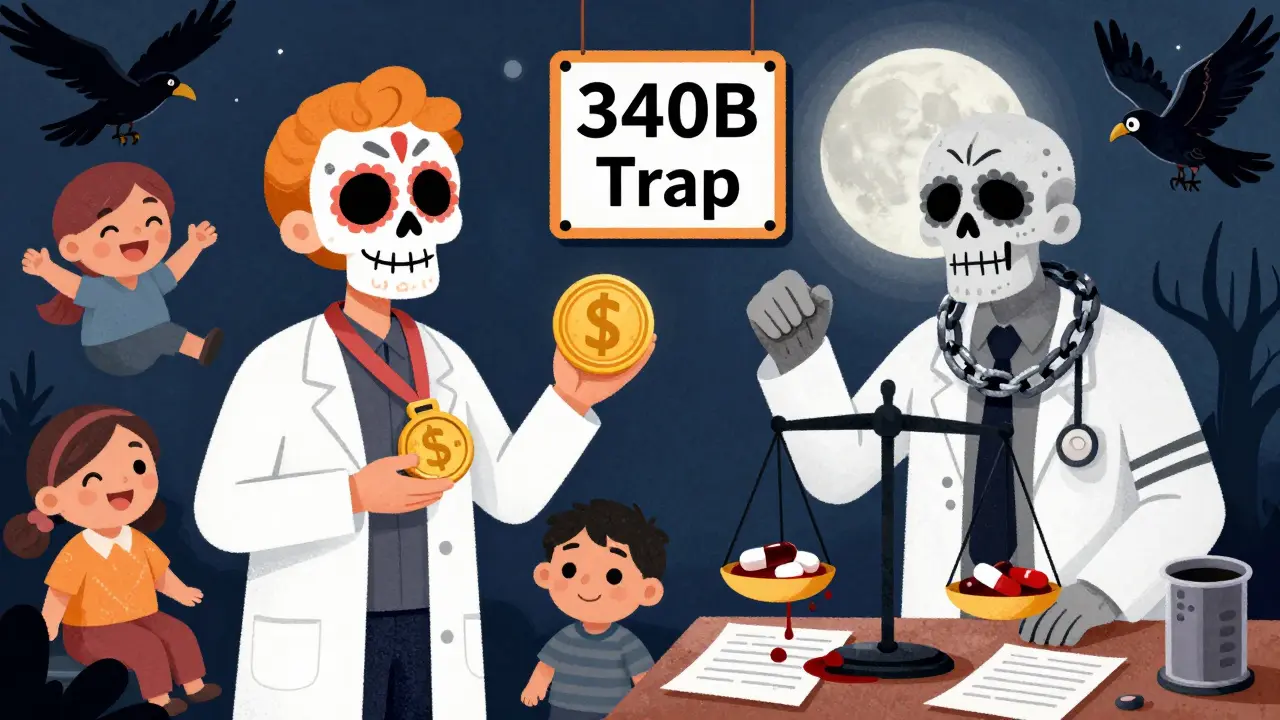
Provider Voices: The Real Experience
Doctors aren’t just passive recipients of these programs. They’re living with them every day. Dr. Michael Chen, an internist in California, says UnitedHealthcare’s bonus program added $2,800 to his annual income with almost no extra work. He likes it. He sees it as fair compensation for choosing cost-effective care. But Dr. Sarah Williams, a family doctor in Texas, feels differently. She says some programs feel coercive. “I have a patient with severe allergies. The generic version has a different filler. I can’t just switch them. But the system doesn’t care.” Online forums like Reddit and Sermo are full of similar stories. One user, MedDoc2020, wrote: “Generic incentives work great for high blood pressure or diabetes. But what about a patient with epilepsy who’s stable on a specific brand? You can’t just swap it out.” A 2021 survey of 1,200 providers found 63% supported incentives if they were voluntary and tied to quality-not just cost. But 78% worried that if patients found out their doctor was getting paid for prescribing generics, trust would erode.Where the U.S. Stands Compared to the World
The U.S. isn’t the only country using incentives. Germany’s “reference pricing” system sets the reimbursement rate for a drug class based on the cheapest option. If you prescribe a more expensive brand, the patient pays the difference. That system drives 93% generic use for off-patent drugs-higher than the U.S. average of 85%. In the UK, doctors who dispense drugs directly (a rare practice) prescribe 3.1% more expensive medications per patient. Why? Because they profit from the markup. It’s a conflict of interest built into the system. The U.S. is catching up. The 2022 Inflation Reduction Act includes patent reforms meant to speed up generic competition. CMS is now testing standardized $2 co-pays for essential generics in Medicare Advantage plans. Early results show a 22.7% improvement in adherence for chronic conditions.The Risks: When Incentives Hurt Care
The biggest danger isn’t cost-it’s clinical judgment. When incentives become too rigid, doctors start avoiding complex cases. They skip generics for patients with multiple conditions because they fear the system will punish them for not following the script. A 2023 AMA survey found 61% of physicians felt overwhelmed by the number of metrics they had to track. Burnout isn’t just from long hours-it’s from being monitored for every prescription. There’s also the risk of therapeutic substitution errors. A generic isn’t always identical. Fillers, coatings, and release mechanisms can matter-for patients with kidney disease, GERD, or neurological conditions. If the system pushes too hard, someone could end up on a drug that doesn’t work. The American College of Physicians warns against one-size-fits-all rules. They recommend excluding drugs where brand formulation is medically necessary. That’s not a loophole-it’s good medicine.
What Makes a Good Incentive Program?
The best programs don’t just reward cost-cutting. They reward smart prescribing. Successful models share these traits:- They’re transparent-providers know exactly how the bonus works.
- They’re flexible-exceptions are built in for complex cases.
- They’re tied to quality, not just cost-like adherence rates or fewer ER visits.
- They use clinical decision support-not alerts that pop up every five minutes.
- They don’t punish doctors for choosing the right drug, even if it’s expensive.
The Future: Where This Is Headed
By 2028, experts predict 94% of prescriptions in the U.S. will be generics. That’s not because of luck-it’s because incentives are getting smarter. UnitedHealthcare is rolling out “value-based prescribing contracts” in 2024. These tie payments to both cost savings and clinical outcomes. If a patient’s blood pressure drops and they stay on the generic? Bonus. If they end up in the hospital because the generic didn’t work? No bonus. The goal is no longer just to cut costs. It’s to cut waste-without cutting care. But the biggest challenge remains: trust. If patients believe their doctor is choosing a drug because they’re getting paid, not because it’s best for them, the relationship breaks. And that’s harder to fix than any formulary.Do generic prescribing incentives lower drug quality?
No. Generic drugs must meet the same FDA standards as brand-name drugs for active ingredients, strength, and effectiveness. The difference is in inactive ingredients like fillers or coatings-which rarely affect outcomes. In rare cases, a specific brand may be needed for patients with allergies or absorption issues, but these are exceptions, not the rule.
Are doctors forced to prescribe generics?
No, they’re not forced. But some systems make it harder to prescribe brands by requiring prior authorization or higher patient co-pays. Doctors still have clinical freedom, but incentives make the easier, cheaper choice more attractive. Programs that allow exceptions for complex cases work best.
Why do some doctors resist generic incentives?
Many feel it undermines their clinical judgment. They worry about being penalized for choosing the right drug for a complex patient. Others distrust the system because they’ve seen it used to push profit over care. Programs that feel punitive, not supportive, trigger resistance.
Can generic incentives lead to patient harm?
Yes-if they’re poorly designed. If a system doesn’t allow exceptions for patients with allergies, absorption issues, or neurological conditions, switching to a generic could cause problems. The key is clinical flexibility. The best programs use decision support tools that suggest alternatives only when safe to do so.
Do patients know their doctor is being paid to prescribe generics?
Usually not. Most incentive programs are confidential between the provider and payer. But if patients found out, trust could suffer. A 2021 survey found 78% of providers feared disclosure would damage patient relationships. Transparency is important, but it needs to be handled carefully.


There are 9 Comments
Gerald Tardif
It’s wild how a $5 bonus can shift entire prescribing habits. I’ve seen it in my clinic-doctors who used to default to brands now quietly slide generics into the script. Not because they’re greedy, but because it’s easier. And honestly? Most patients don’t even notice. The system works when it’s subtle.
Raushan Richardson
Love this breakdown. Seriously. The part about default settings in EHRs? That’s the real MVP. No bonus needed-just make the right choice the default one. I’ve had patients thank me for switching them to generics because their copay dropped from $80 to $5. That’s healthcare that actually helps.
John Barron
One must acknowledge the fundamental epistemological flaw in conflating cost-efficiency with clinical efficacy. The FDA’s bioequivalence thresholds permit a 20% variance in pharmacokinetic parameters-a statistically significant deviation in a subset of pharmacogenetically sensitive populations. Furthermore, the 340B program’s perverse incentives represent a structural market distortion, wherein institutional profit motives override therapeutic individualization. One cannot reduce medical decision-making to actuarial models without violating the Hippocratic Oath’s core tenet: primum non nocere.
Moreover, the implicit assumption that generics are universally interchangeable ignores the nuanced pharmacodynamics of extended-release formulations, particularly in patients with renal impairment or GI motility disorders. The American College of Physicians’ cautionary stance is not merely prudent-it is bioethically obligatory.
And yet, one cannot ignore the fiscal imperative. The $1.7 trillion savings figure is staggering. But savings without safeguards are not victories-they are liabilities in waiting.
Will Neitzer
While the data presented is compelling, the underlying assumption-that financial incentives are inherently benign-is dangerously oversimplified. The psychological phenomenon known as ‘motivation crowding out’ suggests that extrinsic rewards can erode intrinsic professional judgment. When physicians begin to associate prescribing with monetary gain-even modest sums-their fiduciary duty to the patient becomes subtly transactional.
Furthermore, the absence of patient disclosure is not a feature; it is a vulnerability. Trust in the physician-patient relationship is built on transparency, not confidentiality. If patients were aware that their provider received bonuses for prescribing generics, the erosion of trust would be immediate and irreversible.
Thus, while the economic rationale is sound, the ethical architecture is fragile. A better model would integrate education, clinical autonomy, and outcome-based rewards-not per-prescription payouts.
Janice Holmes
OKAY BUT WHAT ABOUT THE PATIENT WITH EPILEPSY WHO’S BEEN STABLE ON BRAND FOR 12 YEARS AND NOW THE SYSTEM IS PUSHING A GENERIC THAT’S CAUSING SEIZURES?? 😭
I HAVE A FRIEND WHO’S A NEUROLOGIST AND SHE’S CRYING IN HER OFFICE EVERY WEEK BECAUSE THE ALGORITHM WON’T LET HER WRITE THE BRAND. THEY’RE CALLING IT ‘OPTIMIZATION.’ IT’S NOT OPTIMIZATION. IT’S A CRIME.
AND DON’T EVEN GET ME STARTED ON THE 340B PROGRAM. THAT’S NOT A LOOPHOLE. THAT’S A BACKDOOR TO CORRUPTION.
Alex Lopez
Wow. So the system rewards doctors for doing their job-prescribing the cheapest effective drug-and somehow that’s controversial? 🤔
Let me get this straight: if a doctor gets $5 for choosing a generic that’s identical to a $200 brand, that’s ‘corruption’… but if a pharma rep gives them a free iPad for prescribing the brand, that’s ‘industry collaboration’?
Also, the 78% of doctors who worry patients will lose trust? Funny. Patients already think doctors are in the pocket of Big Pharma. At least this way, they’re in the pocket of cost savings.
Andrew Gurung
Let’s be real: this isn’t about healthcare. It’s about corporate greed disguised as efficiency. The real villain isn’t the doctor-it’s the insurance exec who sees a human being as a line item on a spreadsheet. And now we’re rewarding physicians for playing along? Pathetic.
And don’t give me that ‘90% of prescriptions are generics’ nonsense. That’s not progress. That’s capitulation.
Real medicine isn’t about saving $5 per script. It’s about saving lives. And you can’t do that with a checklist.
Paula Alencar
The most profound insight in this entire analysis lies not in the statistics, but in the quiet, systemic tension between administrative efficiency and clinical sovereignty. The physician, historically a guardian of therapeutic autonomy, is now increasingly embedded within a metric-driven ecosystem where every decision is quantified, incentivized, and audited. This transformation is not merely economic-it is epistemological. It redefines the very nature of medical judgment as a variable to be optimized rather than a moral act to be exercised.
Furthermore, the absence of patient-facing transparency, while pragmatically expedient, constitutes a profound ethical deficit. The physician-patient relationship, predicated on trust and mutual understanding, cannot withstand the latent perception that clinical decisions are monetized. Even if the incentives are benign, the perception of conflict is corrosive.
And yet, the alternative-unfettered brand prescribing-is fiscally unsustainable. Thus, the path forward demands not the elimination of incentives, but their re-architecting: outcome-based, exception-rich, and transparently communicated. Not as a tool of control, but as a scaffold for wisdom.
Let us not mistake cost containment for care. But let us also not mistake resistance to change for clinical virtue.
Chris Garcia
In Nigeria, we don’t have generic incentives-we have no access to generics at all. Many patients choose between buying a brand-name drug or skipping treatment entirely. Your system is flawed, but at least you have a system. Here, we dream of formularies. We dream of $5 co-pays. We dream of EHRs that don’t crash every time you open them.
So yes, your incentives need refinement. But don’t dismiss them. They’re a step. And in global health, a step is a miracle.
Write a comment
Your email address will not be published. Required fields are marked *