
Switching from brand-name carbamazepine to a generic version might seem like a simple cost-saving move-but for many patients, it’s anything but. Carbamazepine isn’t just another seizure medication. It’s a drug with a narrow window between working and causing harm, and its ability to speed up the breakdown of other drugs makes it one of the most tricky medications to manage. Even small changes in how your body absorbs it can lead to breakthrough seizures, dangerous side effects, or toxic levels of other medications you’re taking. This isn’t theoretical. Real patients have ended up in the ER after a pharmacy switch. And the science behind why this happens is more complex than most people realize.
Why carbamazepine is different from other generics
Carbamazepine is a narow therapeutic index drug, meaning the difference between a therapeutic dose and a toxic one is small. Its effective blood level range is just 4 to 12 mcg/mL. Go below 4, and seizures may return. Go above 12, and you risk dizziness, confusion, liver damage, or even life-threatening skin reactions. Unlike most drugs, carbamazepine doesn’t just sit in your system-it actively changes how your body processes other medications. It turns on enzymes in your liver, especially CYP3A4, that break down drugs faster. This is called enzyme induction. And here’s the kicker: carbamazepine induces its own metabolism. The longer you take it, the faster your body clears it out, which means your dose often needs to be adjusted over time.
Generic versions of carbamazepine must meet FDA bioequivalence standards: their absorption (AUC) and peak concentration (Cmax) must fall within 80-125% of the brand drug. Sounds fair, right? But those standards were designed for drugs with stable, predictable metabolism. Carbamazepine doesn’t play by those rules. Its absorption is affected by food, stomach pH, gut motility, and even the size of the beads inside extended-release capsules. A 2018 study in Epilepsia found that 12.4% of patients had seizures or serious side effects after switching between generic brands-even though all met FDA requirements. Seven percent ended up in the ER.
Enzyme induction: The hidden time bomb
Carbamazepine doesn’t just affect itself. It forces your liver to produce more CYP3A4 enzymes, which then break down dozens of other drugs faster. That means if you’re taking warfarin for blood clots, your INR can drop dangerously low. If you’re on cyclosporine after a transplant, your body may reject the organ. Birth control pills can become ineffective. Even some antidepressants and HIV meds lose their power. The FDA lists over 50 drugs that interact with carbamazepine because of this. The induction doesn’t happen overnight-it starts in 48 hours, peaks at 2-3 weeks, and lingers for weeks after you stop. That’s why a patient might feel fine for a month after switching generics, then suddenly have a seizure or a bad reaction. Their body is still adjusting.
Extended-release formulations (like Tegretol XR, Carbatrol, Equetro) release carbamazepine slowly, leading to more stable blood levels. Studies show they have 15-20% less fluctuation than immediate-release tablets. But even here, differences in bead coatings or dissolution rates between generic brands can change how quickly the drug enters your system. One patient reported switching from one generic to another and seeing their carbamazepine level drop from 7.2 to 4.8 mcg/mL-despite taking the same dose. That’s a 33% drop. For a drug with a 4-12 mcg/mL range, that’s the difference between control and crisis.

Who’s most at risk?
Not everyone has problems with generic carbamazepine. About 60% of patients switch without issue. But certain groups are far more vulnerable. Women, especially those of childbearing age, are at higher risk. Research shows women metabolize carbamazepine 20-25% faster than men due to higher CYP3A4 activity. Hormonal changes during the menstrual cycle, pregnancy, or when using birth control can cause even bigger swings in drug levels. A 2021 JAMA Neurology study found women had 22% more breakthrough seizures after switching generics.
People with epilepsy that’s hard to control are another high-risk group. If you’re having more than one seizure a month, or if you’ve had bad reactions to generics before, switching is a gamble. The American Academy of Neurology explicitly advises against switching in these cases. Older adults, people with liver disease, or those on multiple other medications also face higher risks. Their bodies are already struggling to manage drug metabolism-adding a variable like a new generic can tip the balance.
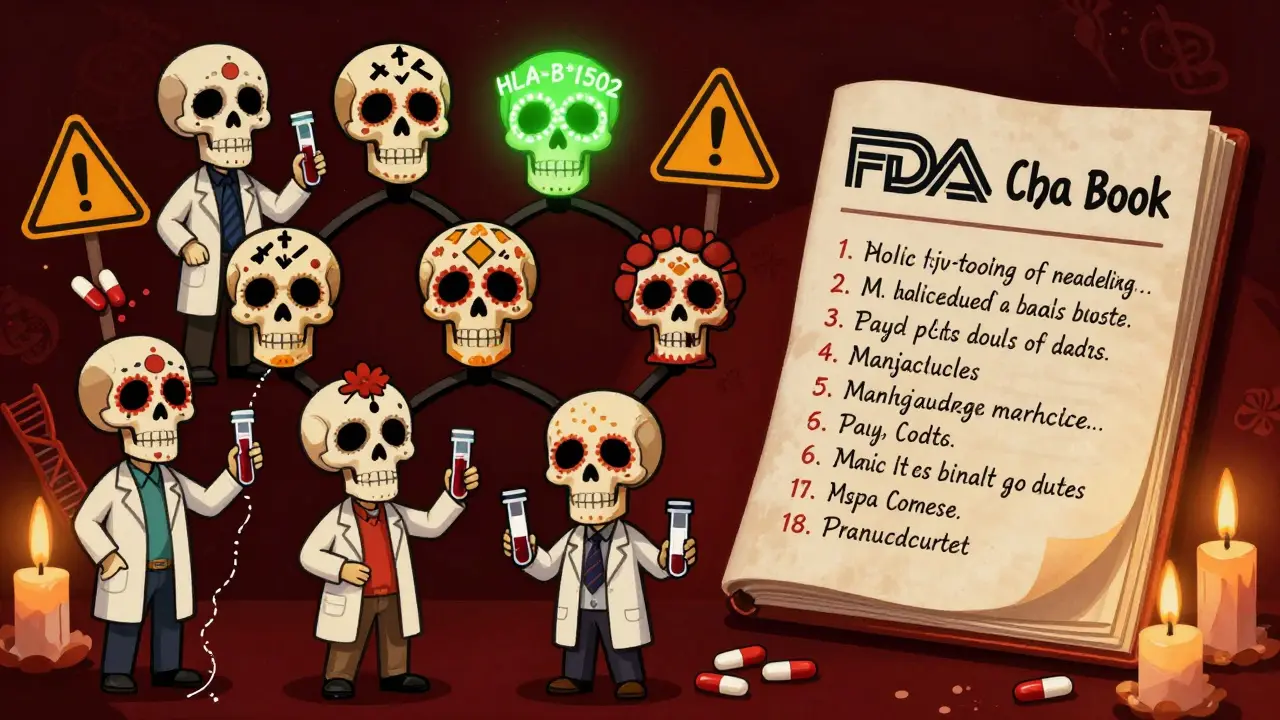
And then there’s the genetic risk. People of Asian descent who carry the HLA-B*1502 gene have a 10-fold higher chance of developing Stevens-Johnson Syndrome-a deadly skin reaction-when taking carbamazepine. The FDA requires screening for this gene before prescribing, especially in patients of Chinese, Thai, Malaysian, or Filipino ancestry. If you’re positive for this allele, carbamazepine shouldn’t be used at all. But many patients aren’t screened, especially if they’re prescribed by a non-neurologist or get the drug through a fast-fill pharmacy.
What doctors and pharmacists need to do
There’s a gap between what’s known and what’s practiced. Many prescribers still write “carbamazepine 200 mg” without specifying the brand or manufacturer. Pharmacists, following automatic substitution rules, may switch the product without telling the patient or the doctor. But for carbamazepine, that’s not safe. The American Epilepsy Society recommends that doctors write “dispense as written” (DAW 1) on prescriptions to block automatic substitution. A 2023 survey found only 68% of U.S. neurologists do this consistently.
Therapeutic Drug Monitoring (TDM) is non-negotiable. If you switch carbamazepine brands-even from one generic to another-your blood level should be checked before the switch, then again at 7-10 days and 4 weeks after. If your level drops or rises by more than 15%, your dose needs to be adjusted. The International League Against Epilepsy calls this standard practice. Yet many patients never get tested. They just assume the generic is the same.
Pharmacists should also check the manufacturer. The FDA’s Orange Book lists 12 different makers of 200 mg carbamazepine tablets alone. One generic (Nostrum Pharmaceuticals) uses larger beads that may not dissolve well in patients with gastroparesis. Another might use a different filler that changes absorption. These differences aren’t visible on the bottle. Only the manufacturer code tells you.
What patients should do
If you’re on carbamazepine, here’s what you need to do:
- Ask your doctor if you’re on a brand or generic-and if it’s a generic, ask which manufacturer.
- Request a blood test to check your carbamazepine level. Don’t wait for symptoms.
- If your pharmacy switches your medication, call your doctor immediately. Don’t assume it’s safe.
- Keep a seizure diary. Note any changes in frequency, intensity, or side effects after a switch.
- If you’re of Asian descent, ask if you’ve been tested for HLA-B*1502. If not, get tested.
- Always tell every new doctor or pharmacist you’re on carbamazepine. List all other meds you take.
Some patients report no issues switching. But for those who do, the consequences can be severe. A Reddit user named NeuroNurse2020 shared that a patient had a seizure after switching to a new generic because the capsule beads were too large for their slow-moving gut. Another patient on Epilepsy.com went from one seizure a month to five a week after a pharmacy switch. Her blood level dropped into the subtherapeutic range. She didn’t know why-until she checked the label and saw a different manufacturer.
The future: Precision dosing and better testing
Regulators are starting to catch up. The FDA now calls carbamazepine extended-release products a “high-priority” for better bioequivalence testing. New guidelines require dissolution testing across multiple pH levels and even in vitro-in vivo correlation (IVIVC) modeling to predict how the drug behaves in real patients-not just healthy volunteers. The European Medicines Agency already requires steady-state testing for NTI drugs like carbamazepine, not just single-dose studies.
Research is moving toward personalized dosing. Scientists have found 17 genetic variants that affect how people metabolize carbamazepine. People with the CYP3A4*22 variant need 25% less drug to reach safe levels. Future dosing may involve a simple genetic test before starting treatment. The American Epilepsy Society is developing a TDM toolkit for 2024 that will include algorithms accounting for age, sex, weight, and other meds.
For now, the safest approach is simple: stick with the same manufacturer. If your doctor and pharmacist know which version works for you, keep it. Don’t let cost or convenience override safety. Carbamazepine isn’t a drug you can treat like ibuprofen. It’s a powerful, unpredictable tool-and it demands respect.





There are 8 Comments
shivani acharya
Oh wow, so the FDA just says 'eh, 80-125% close enough' and calls it a day? 😂 Meanwhile, my cousin in Delhi had a seizure because her pharmacy swapped her generic from Nostrum to some cheap Indian brand with giant beads that wouldn't dissolve in her sluggish gut. They told her it's 'the same drug' - same drug my ass. It's like giving someone a Ferrari and then swapping the engine for a lawnmower and saying 'it still has four wheels'. And don't even get me started on HLA-B*1502 - they screen for it in Thailand but here? Nah, just hand out the pill like candy. They don't care if you turn into a human burn victim. 😈
Sarvesh CK
While the clinical evidence presented here is compelling and aligns with established pharmacokinetic principles, one must also consider the broader systemic context. Generic substitution policies are often driven by cost containment imperatives, which, while economically rational, may inadvertently compromise therapeutic stability in vulnerable populations. The bioequivalence thresholds, established for drugs with wide therapeutic indices, are demonstrably inadequate for narrow therapeutic index agents like carbamazepine. A more nuanced regulatory framework - perhaps tiered bioequivalence standards based on drug class - may be warranted. Furthermore, the role of pharmacogenomics in personalizing therapy remains underutilized, suggesting a gap between scientific knowledge and clinical implementation.
Hilary Miller
My neurologist in Austin made me switch and I had a seizure 3 weeks later. Called the pharmacy - they said 'it's the same thing'. I screamed. Now I always check the tiny letters on the pill. 😭
Margaret Khaemba
Wait, so if you're on carbamazepine and your pharmacy switches your generic, you're basically playing Russian roulette with your brain? That's wild. I had no idea. My sister's on it for trigeminal neuralgia and she never even knew her pills changed. She just thought she was getting 'weirdly tired'. I'm gonna send her this article ASAP. Also - why isn't this common knowledge?? 🤯
Malik Ronquillo
So the system is literally letting people have seizures because some pharmacist wants to save 50 cents? 🤡 And you're telling me the FDA doesn't care? I swear if I had a dollar for every time a bureaucrat said 'it's within guidelines' while someone's kid was having a stroke I'd buy my own island. This is criminal negligence wrapped in a white coat. Just say no to generics. Stick with Tegretol. Or die trying. 🤷♂️
Brenda King
My mom’s on carbamazepine and she’s Indian-American. We never got her tested for HLA-B*1502. I just looked it up - turns out she’s at 10x risk. We’re calling her doctor tomorrow. I’m so glad this post exists. Please, everyone, if you’re on this med and have Asian ancestry - get tested. It’s a simple blood test. Could save your life. 💙
Keith Helm
Therapeutic drug monitoring is mandatory for carbamazepine. Failure to implement it constitutes substandard care. Recommend immediate policy revision.
Chiraghuddin Qureshi
Bro, I’m from Mumbai and we get generics here that cost 1/10th. My uncle took one and his skin started peeling off. Hospital for 3 weeks. 😢 FDA standards? More like 'FDA standards for rich people'. We need global testing. Not just for Indians but for everyone. 🙏 #CarbamazepineCrisis
Write a comment
Your email address will not be published. Required fields are marked *