
One second. That’s all it takes for a chemical splash to turn a routine task into a life-changing emergency. Whether it’s cleaning fluid, battery acid, or even household ammonia, a single mist of the wrong substance hitting your eye can start a chain reaction that destroys vision-fast. And the worst part? Most people don’t know what to do next. They rub. They blink. They wait. By the time they reach a hospital, the damage is already done.
Why Speed Is Everything
Chemical splashes don’t wait. Alkali substances like drain cleaners or ammonia can penetrate the eye’s surface in under 10 seconds, eating through tissue like acid through metal. Acid burns, like those from toilet bowl cleaner, are painful but tend to stay on the surface. Alkali? It keeps going-deep into the cornea, the lens, even the optic nerve. According to a 2017 meta-analysis in the British Journal of Ophthalmology, starting irrigation within 10 seconds of exposure cuts the risk of permanent vision loss by 76%. That’s not a suggestion. That’s a survival rule.Yet, a 2022 study of 1,247 workplace eye injuries found that only 43.7% of people began flushing their eyes within 60 seconds. The average delay? Over two minutes. In that time, the chemical keeps working. The eye keeps burning. And the chances of saving sight drop by the second.
What You Must Do Right Now
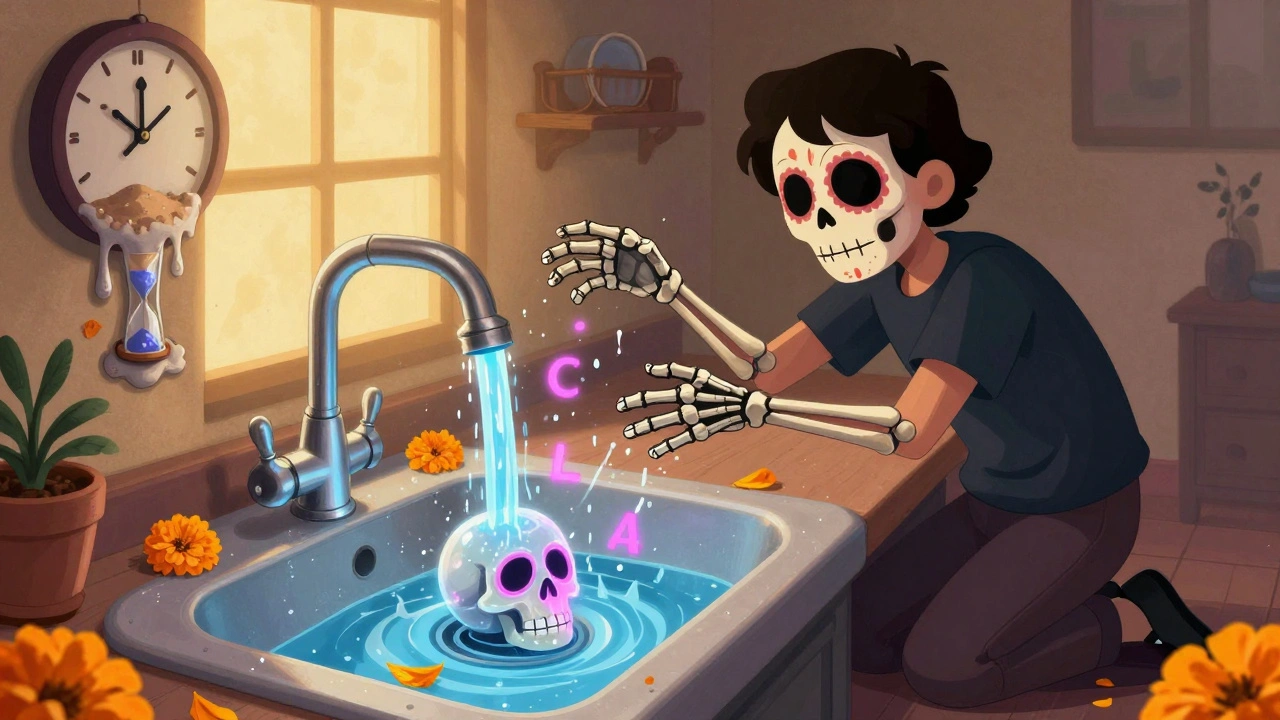
If your eye gets splashed, don’t panic. Don’t rub. Don’t wait for someone else to help. Do this:- Get to water immediately. Tap water is fine. You don’t need saline. Research from Dr. Reay Brown at Bascom Palmer Eye Institute shows tap water works just as well as sterile saline for initial flushing. The goal isn’t purity-it’s volume and speed.
- Hold your eye open. Use your fingers to pull your upper and lower eyelids apart. If you’re alone, use your thumb and index finger to keep the lids wide. You can’t flush what you can’t see.
- Let water flow across the eye. Tilt your head back and turn your face toward the injured side. This stops the chemical from washing into your other eye. Healthdirect Australia’s guideline is the only one that specifically mentions this. Don’t ignore it.
- Flush for at least 20 minutes. Yes, 20 minutes. Healthdirect Australia, the Better Health Channel, and the American Academy of Ophthalmology all agree: 15 to 20 minutes is the minimum. Some cases need longer. Don’t stop because it hurts. Don’t stop because you think it’s clean. Keep going.
- If you wear contacts, try to remove them-but only if you can do it without poking your eye. If the surface is too damaged or painful, leave them in. The water will flush them out eventually.
Stop after 20 minutes? Only if you’re certain the chemical is gone. The CDC recommends testing the eye’s pH with litmus paper until it reads between 7.0 and 7.4. If you don’t have paper, keep flushing. Better to overdo it than underdo it.
What Not to Do
Most people make the same mistakes. Here’s what not to do:- Don’t rub your eye. This grinds the chemical deeper into the tissue. In 68.2% of cases, people rubbed-making injuries worse.
- Don’t apply pressure. Squeezing your eye or pressing on it can rupture the cornea. Even a gentle press can cause permanent damage.
- Don’t use small amounts of water. A quick rinse from a bottle? Useless. You need a steady, strong flow-like from a shower, sink, or eyewash station. The American Red Cross says flush until EMS arrives. That’s because most people stop too soon.
- Don’t wait for help. If you’re at work, don’t wait for your supervisor. If you’re at home, don’t call someone first. Go to water. Now.
Workplace vs. Home: Different Rules, Same Goal
In a factory, lab, or warehouse, you should have an ANSI Z358.1-2021 compliant eyewash station nearby. These are required by OSHA if chemicals are used. They must deliver tepid water (60-100°F) at 0.4 gallons per minute, and activate in under one second. But here’s the problem: a 2023 OSHA audit found 22.8% of workplaces with chemical hazards didn’t have these stations within 10 seconds of travel. That’s not just negligence-it’s a waiting accident.At home, you don’t have a fancy station. But you do have a sink. Use it. Run cold water. Don’t wait for a special kit. The truth? Most households (78.4% according to a 2022 CDC survey) don’t even have an emergency eyewash solution on hand. And only 12.3% of people knew how long to flush. That’s terrifying.
Training helps. People who’ve had hands-on first aid training are 3.2 times more likely to do it right. If you work with chemicals-even if it’s just cleaning your garage-take a 20-minute course. The American Red Cross saw a 37.2% jump in workplace first aid certifications between 2019 and 2023. That’s progress. But it’s not enough.
New Tools, But Still No Substitute for Water
There are new options. In 2022, the FDA approved a product called Diphoterine-a special solution that binds to chemicals instead of just washing them away. It’s used in industrial settings and can cut irrigation time by 40%. But it’s expensive, not widely available, and still requires immediate use. It’s not a replacement for water. It’s a backup.Researchers are also testing citrate buffers that might neutralize alkali burns better than plain water. Smart goggles with built-in pH sensors are in beta testing by 3M. These could alert you the moment a chemical hits your eye. But none of these are in your home right now. And they won’t help if you don’t start flushing immediately.

The Real Cost of Delay
This isn’t just about pain. It’s about money, and life.In the U.S., chemical eye injuries cost employers $327.4 million every year. Each claim averages $14,286 in medical bills and lost work. And that’s just the start. Nearly 1 in 5 patients who survive a severe chemical burn need a corneal transplant within five years. Each transplant costs $27,700. That’s not insurance-covered pain. That’s a lifetime change.
And yet, the most effective treatment is free. Water. Time. Knowledge.
What Comes After the Flush
Even if you flush perfectly, you still need medical care. Don’t assume you’re fine because the burning stopped. Chemicals can keep damaging tissue for hours after exposure. Go to an ER or eye specialist. Tell them exactly what splashed you, how long you flushed, and what you did. Bring the container if you can.Doctors will check your vision, your eye pressure, and the pH of your eye. They may use special dyes to see corneal damage. They might prescribe antibiotics or steroid drops. But none of that matters if you didn’t flush for 20 minutes first.
Be Ready Before It Happens
You can’t prevent every accident. But you can prepare.- Know where your eyewash station is at work. Test it once a month.
- Keep a bottle of water near your cleaning supplies at home. Don’t wait until the moment you need it.
- Teach your kids. Show them how to open their eyes and turn their head under the faucet.
- Take a first aid course. Even a 30-minute online module from the American Red Cross can save your sight-or someone else’s.
Chemical eye injuries are preventable. Not because of fancy gear or expensive solutions. But because someone knew what to do-and did it fast.
What should I do if a chemical gets in my eye?
Immediately flush your eye with cool tap water for at least 20 minutes. Hold your eyelids open with your fingers, tilt your head back, and turn your face toward the injured side to prevent the chemical from spreading to your other eye. Don’t rub, don’t press, and don’t stop until the full time has passed-even if it hurts. After flushing, seek emergency medical care.
Is saline better than tap water for flushing the eye?
No. Research from the Bascom Palmer Eye Institute shows tap water is just as effective as sterile saline for initial irrigation. The key is volume and speed, not purity. Don’t waste time looking for saline-use whatever water is closest.
How long should I flush my eye after a chemical splash?
Flush for at least 20 minutes. Some guidelines say 15 minutes, but 20 is the safest minimum. Alkali burns (like from cleaners or ammonia) can keep damaging tissue for hours. If you don’t have pH paper to test neutrality, keep flushing. Better to over-flush than risk permanent damage.
Should I remove my contact lenses if I get a chemical splash?
Try to remove them only if you can do so safely without poking or pressing your eye. If your eye is too swollen, painful, or damaged, leave them in. The water will flush them out during irrigation. Forcing removal can cause more harm.
Do I need to go to the hospital after flushing my eye?
Yes. Even if your eye feels better after flushing, you still need medical evaluation. Chemicals can cause hidden damage that doesn’t show symptoms until hours later. An eye doctor will check for corneal burns, pressure changes, and deeper tissue injury. Don’t assume you’re okay just because the burning stopped.
Are eyewash stations required at work?
Yes. OSHA requires ANSI Z358.1-compliant eyewash stations within 10 seconds of travel for any workplace where hazardous chemicals are used. These stations must deliver tepid water (60-100°F) at 0.4 gallons per minute for at least 15 minutes. If your workplace doesn’t have one, report it. It’s a violation-and a risk to life.
Can I use bottled water to flush my eye?
Bottled water is better than nothing, but it’s not ideal. You need a continuous, strong flow to flush out chemicals effectively. A bottle won’t deliver enough volume or pressure. Use a sink, shower, or eyewash station instead. If those aren’t available, use the bottle-but keep pouring for the full 20 minutes.
What’s the difference between acid and alkali chemical burns to the eye?
Acid burns (like sulfuric acid) usually cause immediate pain and stay on the surface, forming a protective layer that limits deeper damage. Alkali burns (like sodium hydroxide) are more dangerous-they penetrate quickly, dissolve tissue, and keep spreading even after the splash. Alkali injuries are more common and more likely to cause permanent vision loss. But both require the same first step: immediate, prolonged irrigation.

There are 12 Comments
Bruno Janssen
I saw a guy at the hardware store get ammonia in his eye last year. He just stood there blinking like an idiot. Took him three minutes to get to the sink. His cornea got ruined. I still think about it. I keep a water bottle next to my cleaning supplies now. Just in case.
Don’t wait. Just go.
It’s not dramatic. It’s survival.
Karen Mccullouch
AMERICA NEEDS TO STOP BEING LAZY ABOUT THIS!!! 🇺🇸
Why are we letting people die from something that takes 20 seconds to fix?! We have the water, we have the knowledge, but NOPE - people still rub their eyes like it’s a spicy chip! 🤬
OSHA should fine every company that doesn’t have a working eyewash station. Like, $50K per violation. And make them post signs in Spanish, too. This isn’t rocket science. It’s basic human decency.
STOP THE NAPTIME FIRST AID. WAKE UP, AMERICA.
😭
Ronan Lansbury
Interesting how the CDC and OSHA are so adamant about water flushing - but silent on the fact that most industrial chemicals are deliberately formulated to evade standard decontamination protocols. The real agenda? Keep the chemical industry profitable by making you the liability.
Did you know Diphoterine was developed by a French conglomerate that also owns half the world’s sodium hydroxide patents? Coincidence? Or is this just another engineered dependency?
And why is tap water ‘just as good’? Because the FDA doesn’t fund saline R&D for home use. It’s all about control.
Read between the lines. The system wants you to flush - but not to prevent. To react - not to resist.
They’ll give you water. But they won’t give you truth.
Shelby Ume
Thank you for writing this with such clarity. I’m a nurse, and I’ve seen too many avoidable tragedies - especially with teenagers cleaning their rooms or DIYers mixing vinegar and bleach.
One thing I always emphasize: it’s not about being brave. It’s about being *prepared*. Keep a water bottle by your sink. Teach your kids how to open their eyes under the faucet. Practice it like a fire drill.
And if you’re a parent, teacher, or coworker - don’t wait for an emergency to teach this. Do it now. Because the next person who gets splashed? Could be your child. Your friend. You.
We don’t need fancy gear. We need awareness. And you just gave it to us.
Jade Hovet
OMG I JUST REALIZED I NEVER KNEW HOW LONG TO FLUSH 😭 I ALWAYS DID 5 SECONDS AND THOUGHT I WAS DOING GREAT 😅
Just went and put a water bottle next to my drain cleaner. And I’m telling my roommate. And my mom. And my dog. (He’s a good listener.)
20 MINUTES?! I can do that. I can watch a whole TikTok. I can text my ex. I can cry. But I will NOT stop flushing.
Thank you for saving my eyes. 🙏💧👁️
sharon soila
There is a profound truth here: prevention is not expensive. It is not complex. It is not even difficult. It is simply a matter of attention.
Human beings are wired to avoid thinking about disaster until it is upon them. We are creatures of habit, not of foresight.
Yet, the cost of inattention is not measured in dollars - it is measured in sight. In silence. In the absence of a child’s laugh because their world became blurry. In the quiet of a life forever changed.
So we must act. Not because we are told. Not because it is required. But because we are human. And to be human is to care - deeply, urgently, and without delay.
This is not first aid. This is love in action.
Hamza Laassili
WTF why is everyone talking about water?!?!?!?!?!?!!
Who the hell is letting you use tap water?!?!? That’s dirty! That’s full of chlorine and lead and who-knows-what from the pipes!!
My cousin got a chemical burn and they gave him bottled water - and he lost his eye! It’s because the water wasn’t sterile!!
They’re lying to you. They’re lying to everyone. Saline is the ONLY way. And nobody’s telling you that because Big Pharma wants you to buy their overpriced kits!!
STOP TRUSTING THE GOVERNMENT!!
…wait, did I just…? Oh no. I think I’m having a stroke. I need to flush my eye. NOW.
Tyrone Marshall
I’ve trained hundreds of warehouse workers. Most of them think ‘eyewash station’ means a little plastic cup you squirt in your eye.
Here’s what I tell them: You’re not fixing your eye. You’re buying time. For yourself. For your family. For the future version of you who still gets to see the sunrise.
It’s not about the water. It’s about the will.
Do you have the will to keep your eyes open for 20 minutes while it burns? To not rub? To not stop?
If yes - you’re already saved.
If no - you’re already lost.
Choose now. Before it happens.
Emily Haworth
Okay but… what if the water is poisoned? 🤔
I mean, think about it - what if the government is using the eyewash stations to track us? Like, the water has microchips? Or it’s laced with something to make us docile? I read a forum post once that said the CDC puts fluoride in the water to make people forget how to blink properly.
And what if the 20-minute rule is just a distraction? So we don’t notice the drones overhead?
…I’m not saying it’s true. But I’m not saying it’s not true either.
Maybe we should all just wear goggles. Always. Like, even at home. Even while brushing teeth.
👁️👁️👁️
Himmat Singh
While the general advice presented is superficially sound, it lacks critical epistemological grounding. The assertion that tap water is equivalent to sterile saline is based on empirical studies with insufficient sample stratification, particularly regarding regional water hardness and microbiological contamination profiles. Furthermore, the reliance on anecdotal evidence from the Bascom Palmer Eye Institute constitutes a logical fallacy of authority. The American Academy of Ophthalmology’s guidelines, while authoritative, are not universally validated across global populations, particularly in developing nations where waterborne pathogens are endemic. Therefore, one must question the universality of the prescribed protocol. A more rigorous approach would involve molecular neutralization agents, not merely mechanical dilution. This recommendation, while well-intentioned, is fundamentally incomplete.
Keasha Trawick
Imagine your eye as a cathedral. A single drop of alkali? That’s not a splash - that’s a wildfire in the stained glass. The light doesn’t just dim - it shatters. And the worst part? You don’t even feel it at first. It’s silent. Elegant. Deadly.
Water isn’t a bandage. It’s a prayer. A flood of mercy. A scream you make with your hands, not your voice.
And 20 minutes? That’s not a rule. That’s the time it takes to say goodbye to the person you were before - and beg the universe to let you become someone who can still see their mother’s face.
Flush like your soul depends on it.
Because it does.
Webster Bull
Just flush. 20 min. No excuses. No waiting. No ‘I’ll do it later.’
Water. Open eyes. Don’t stop.
That’s it.
Everything else is noise.
Do it. Now.
Save your sight.
That’s all.
Write a comment
Your email address will not be published. Required fields are marked *