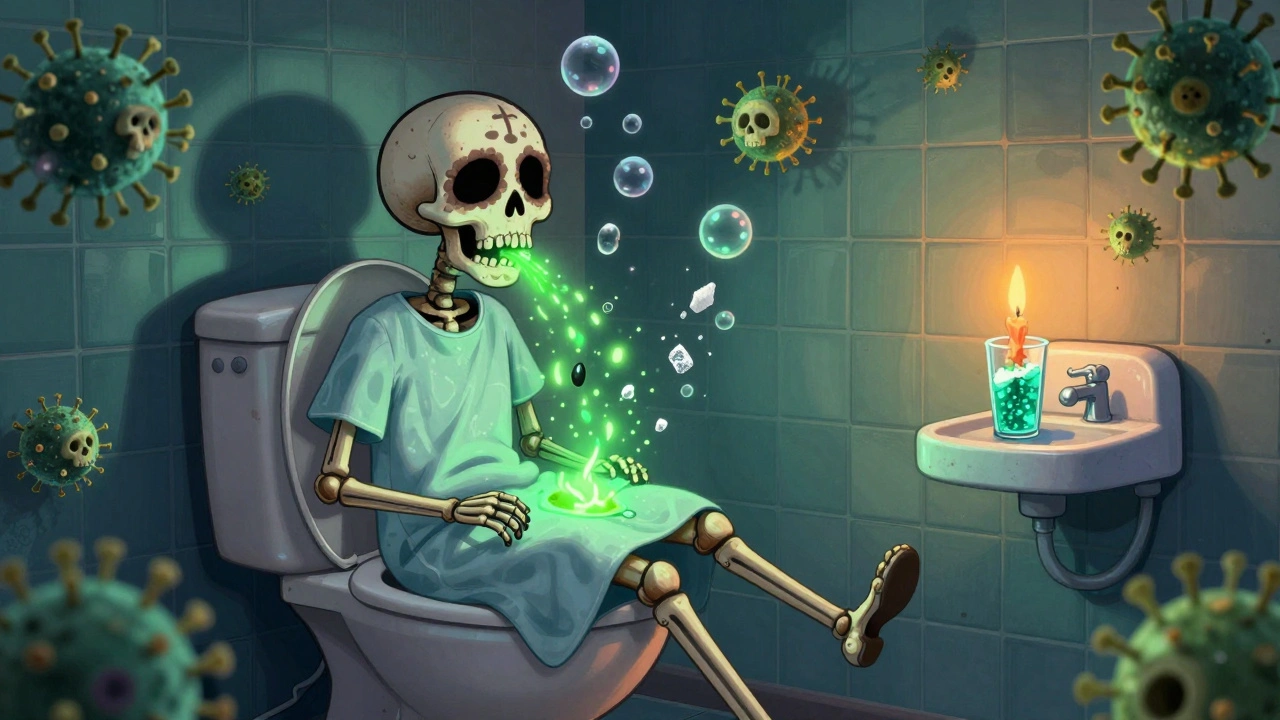
What Norovirus Really Does to Your Body
Norovirus doesn’t just give you a bad stomach ache. It hits fast and hard. One minute you’re fine, the next you’re vomiting, having watery diarrhea, and cramping so badly you can’t stand up. Symptoms usually start 24 to 48 hours after you’ve been exposed, and they last anywhere from 12 to 60 hours. But here’s the catch: you can spread the virus before you even feel sick, and you can keep shedding it for days after you think you’re better.
This virus is tiny-so small that as few as 18 particles can make you ill. A single person can release up to 10 billion viral particles in just one gram of stool. That’s why outbreaks spread like wildfire in places like nursing homes, hospitals, schools, and cruise ships. It doesn’t care about cleanliness or luck. It just needs a surface, a hand, or a piece of food to jump from one person to the next.
How Norovirus Spreads-And Why Soap Beats Hand Sanitizer
You might think alcohol-based hand sanitizers are enough. They’re not. Norovirus has a tough outer shell that alcohol can’t break down. The CDC says soap and water are the only reliable way to remove it from your hands. Wash for at least 20 seconds-long enough to sing "Happy Birthday" twice. Do it after using the bathroom, before eating, and after cleaning up vomit or diarrhea.
Most outbreaks (62%) happen through direct person-to-person contact. But 23% come from food, especially ready-to-eat items like salads, sandwiches, or cooked foods handled by someone who’s infected. Leafy greens and shellfish are common culprits. Waterborne outbreaks are rarer, but still happen when sewage contaminates drinking water.
And don’t forget surfaces. Norovirus can live on doorknobs, bed rails, toilets, and countertops for up to 12 days. It survives freezing, heat up to 140°F, and even common cleaners. That’s why disinfecting isn’t optional-it’s survival.
Stopping an Outbreak: What Hospitals and Care Homes Do
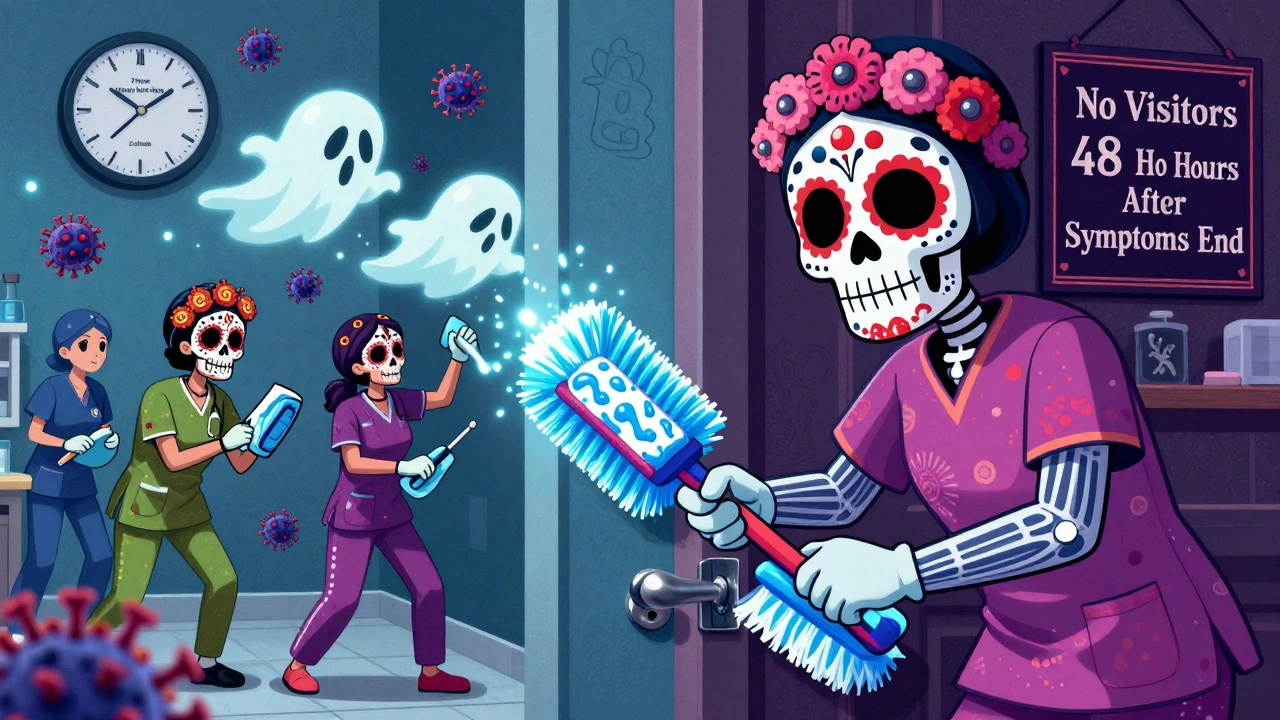
In a healthcare setting, the moment two or more people show symptoms within 48 hours, it’s considered an outbreak. The first move? Isolate. Put sick patients in single rooms if possible. If not, group them together and keep them away from healthy people. No group activities. No shared dining. No moving residents between units.
Staff must wear gloves and gowns when caring for infected patients-and change them between every person. Masks and eye protection are added if vomiting is likely. All equipment used for one patient gets cleaned before it’s used for another. And no one goes back to work until at least 48 hours after symptoms stop. For food handlers in care homes? That’s 72 hours.
Environmental cleaning is brutal but necessary. Bleach solutions with 1,000 to 5,000 ppm of chlorine are the gold standard. That’s about 5 to 25 tablespoons of household bleach per gallon of water. Spray it on surfaces, let it sit for 10 minutes, then wipe. Focus on high-touch areas: toilet handles, sink faucets, light switches, call buttons. And clean more often-every two hours during active outbreaks.
Hydration Isn’t Optional-It’s Life-Saving
When you’re vomiting and having diarrhea every 10 minutes, your body loses fluids faster than you can drink. Dehydration kills. Especially in older adults, infants, and people with chronic illnesses.
The best first step? Oral rehydration solution (ORS). It’s not just water. It’s water with the right mix of salt, sugar, and potassium. WHO guidelines recommend solutions with 50-90 mmol/L sodium and 75-100 mmol/L glucose. You can buy pre-made packets, or make your own: 1 liter of clean water, 6 teaspoons of sugar, and half a teaspoon of salt. Stir well. Sip small amounts every 5 to 10 minutes.
For kids, give 50-100 mL after each episode of vomiting or diarrhea. For elderly patients, check for dry mouth, confusion, or low urine output. Don’t wait until they’re dizzy or fainting. Check every 4 to 6 hours during an outbreak.
If someone can’t keep fluids down, or they’re showing signs of severe dehydration-sunken eyes, no urine for 12 hours, rapid heartbeat-they need IV fluids. Hospitals use normal saline or lactated Ringer’s, given in 20 mL/kg boluses over 15 to 30 minutes. Don’t try to power through this. Get help fast.
Why Visitors and Staff Training Matter More Than You Think
Outbreaks don’t end because the sick get better. They end because everyone else stops spreading it. That means visitors need rules too. Restrict non-essential visits during outbreaks. If someone must come in, make them wash their hands before entering and leaving. Show them how to recognize symptoms-vomiting, diarrhea, nausea-and tell them to stay home if they feel even slightly off.
Staff training is non-negotiable. In California, all staff must be trained within 24 hours of an outbreak being declared. They learn how to put on PPE, how to clean properly, and why handwashing isn’t just a formality. Without this, even the best bleach solution won’t help.
And here’s something most people don’t know: about 30% of people infected with norovirus never show symptoms-but they still shed the virus. That means someone who feels fine could be silently spreading it. That’s why you can’t rely on symptoms alone. You have to assume everyone could be carrying it.

What’s Next? Vaccines and Better Tools
There’s hope on the horizon. Takeda’s norovirus vaccine showed 46.7% effectiveness in phase 2 trials in 2022. If approved by the FDA in 2025, it could be a game-changer for nursing homes and hospitals. But vaccines won’t replace hygiene. They’ll just add another layer.
Some hospitals are now using hydrogen peroxide vapor systems to disinfect entire rooms after an outbreak. These machines kill 99.9% of the virus on surfaces-far better than manual cleaning. Wisconsin’s real-time outbreak reporting system cut investigation time from 72 hours to 24. That means faster action, fewer infections.
But here’s the truth: no single tool stops norovirus. It takes soap, bleach, isolation, hydration, training, and discipline-all working together. One missed handwash. One delayed cleanup. One visitor who ignores the rules. That’s all it takes.
What You Can Do Today
- Wash hands with soap and water for 20 seconds-every time, no exceptions.
- If someone in your home is sick, clean the bathroom and kitchen surfaces with bleach solution daily.
- Keep sick people away from food prep areas until 48 hours after symptoms stop.
- Keep kids and elderly people hydrated with oral rehydration solution, not just water.
- If you work in healthcare or care for vulnerable people, know your facility’s outbreak protocol. Ask if you don’t.
Norovirus doesn’t care if you’re busy, tired, or in a hurry. It only cares if you’re careless. The best defense isn’t a magic pill or a fancy machine. It’s simple, boring, and repeatable: clean hands, clean surfaces, clean water. Do that, and you’re already ahead of most outbreaks.



There are 9 Comments
John Biesecker
Genesis Rubi
Doug Hawk
Michael Campbell
Saravanan Sathyanandha
alaa ismail
ruiqing Jane
Fern Marder
Carolyn Woodard
Write a comment
Your email address will not be published. Required fields are marked *