
The U.S. healthcare system saves billions every year because of a law passed in 1984 - the Hatch-Waxman Act. You probably don’t hear about it often, but if you’ve ever picked up a generic pill at the pharmacy that cost a fraction of the brand-name version, this law is why. It didn’t just tweak a rule. It rebuilt how generic drugs get approved, balancing innovation with access. And it still shapes your medicine bills today.
Before Hatch-Waxman: A Broken System
Before 1984, making a generic drug was nearly impossible. If you wanted to copy a brand-name medicine, you had to prove it was safe and effective from scratch. That meant running full clinical trials - the same expensive, years-long process the original company went through. The FDA already knew the brand drug worked. But the law didn’t let generic makers use that data. So companies didn’t even try. In 1984, only 19% of prescriptions were filled with generics. Many patients couldn’t afford their meds. Others waited months, sometimes years, for a copy to become available.
What the Hatch-Waxman Act Actually Did
The Drug Price Competition and Patent Term Restoration Act of 1984 - nicknamed after its sponsors, Senator Orrin Hatch and Rep. Henry Waxman - changed everything. It created a new path called the Abbreviated New Drug Application (ANDA) a streamlined regulatory pathway for generic drug approval that allows manufacturers to rely on the safety and efficacy data of the original brand-name drug. No more redoing clinical trials. Instead, generic makers only had to prove one thing: their drug behaves the same way in the body as the brand. This is called bioequivalence a scientific standard requiring generic drugs to deliver the same amount of active ingredient at the same rate as the brand-name drug, with 90% confidence intervals between 80% and 125% for key pharmacokinetic measures.
Here’s how it works: A generic drug must match the brand in active ingredient, strength, dosage form, and how it’s taken (pill, injection, etc.). Then, it must show that its absorption into the bloodstream is within 80-125% of the brand’s. That’s it. No animal studies. No human trials. Just blood tests and chemistry. This cut the cost of developing a generic drug from over $2.6 million (in 1984 dollars) down to about $5-10 million today - still a lot, but far more doable.
The Orange Book: The Patent Map
One of the smartest parts of the law was the Orange Book the FDA’s official list of approved drug products with therapeutic equivalence evaluations, including patent and exclusivity information for brand-name drugs. The FDA started publishing this list, officially called Approved Drug Products with Therapeutic Equivalence Evaluations. Every brand-name company must list patents covering their drug - not just the main one, but secondary patents too, like for the pill coating or how it’s released over time. As of 2024, the Orange Book listed over 18,000 drug products.
This transparency lets generic companies know exactly when they can legally enter the market. But here’s the twist: if a generic maker believes a patent is invalid or won’t be infringed, they can challenge it. This is where things get intense.
The Paragraph IV Gamble
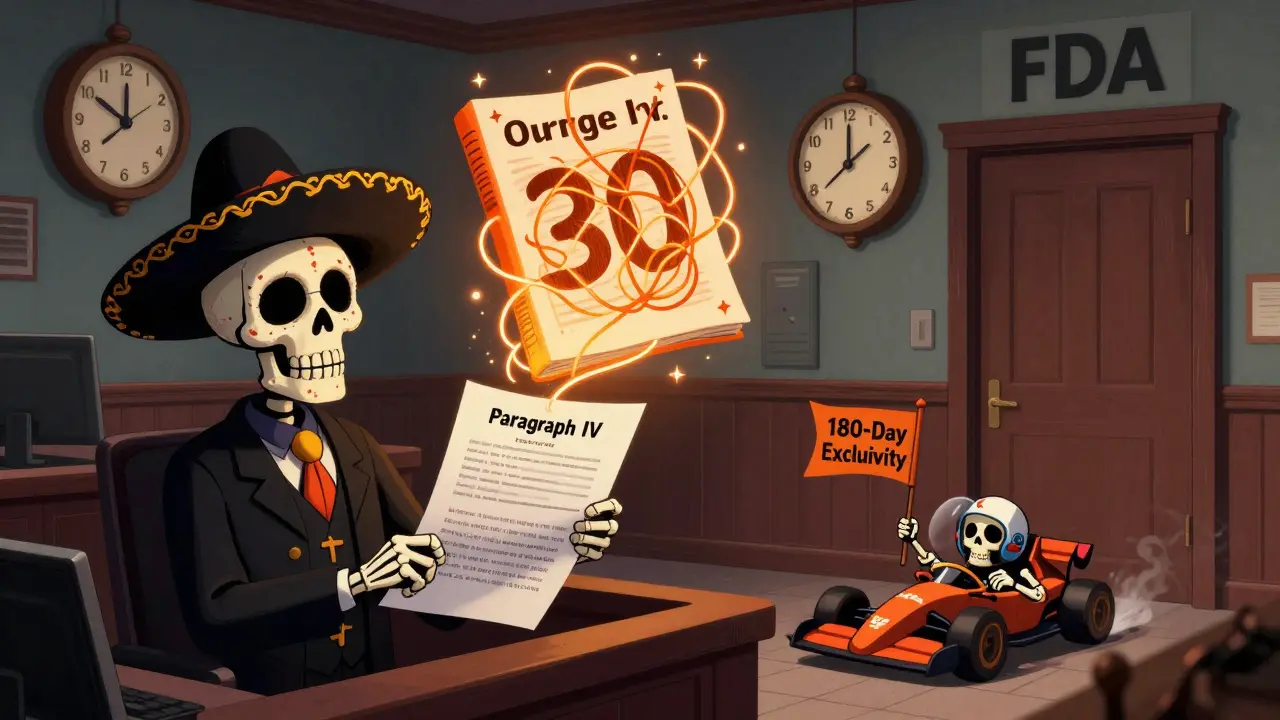
When a generic company files an ANDA, they must check one of four boxes - called Paragraph I through IV - about the drug’s patents. Paragraph IV is the bomb. It means: “I think this patent is fake or I’m not breaking it.”
By filing a Paragraph IV certification, the generic company triggers a legal countdown. The brand-name company has 45 days to sue for patent infringement. If they do, the FDA can’t approve the generic for 30 months - unless the court rules faster. This is called the 30-month stay. It’s supposed to protect innovation. But it’s also been used to delay competition.
And here’s the carrot: the first company to file a Paragraph IV ANDA gets 180 days of market exclusivity a legal incentive granting the first generic applicant to successfully challenge a brand patent a period of exclusive right to sell their version before other generics can enter. During those six months, no other generic can get approved. That’s why companies race to file. In the early 2000s, some firms even camped outside FDA offices to be first. Today, if two companies file on the same day, they split the exclusivity.
Why This Works - And Why It’s Controversial
The results speak for themselves. Today, over 90% of prescriptions in the U.S. are filled with generics. But they make up only 23% of total drug spending. That’s because generics cost 80-90% less than brand-name drugs. Over the last decade, the Hatch-Waxman system saved the U.S. healthcare system roughly $1.7 trillion. Medicare Part D beneficiaries save an average of $3,200 per year thanks to generics.
But the system isn’t perfect. Critics say brand-name companies abuse it. They pile on dozens of minor patents - what’s called “patent thickets” - just to stretch protection. They also strike secret deals with generic makers called “pay-for-delay” agreements. The brand pays the generic to stay out of the market. Courts have cracked down on these, but they still happen.
Another issue: some drugs are too complex to copy easily. The Hatch-Waxman Act was built for small-molecule pills. It doesn’t work well for biologics - complex drugs made from living cells. That’s why Congress passed the Biologics Price Competition and Innovation Act (BPCIA) a 2010 law creating a separate approval pathway for biosimilar drugs, modeled after Hatch-Waxman but with different requirements for complex biologics in 2010.

What’s Changed Since 2020?
The FDA has been working hard to fix bottlenecks. Under the Generic Drug User Fee Amendments (GDUFA) a funding and performance agreement between the FDA and generic drug manufacturers that sets review timelines and improves communication to accelerate generic approvals, the average time to approve an ANDA dropped from 36 months in 2012 to just 18 months in 2023. The FDA also now enforces the CREATES Act a 2019 law requiring brand-name manufacturers to provide generic companies with necessary drug samples for bioequivalence testing, preventing delays caused by sample withholding, which stopped some brands from blocking generics by refusing to sell them samples.
Still, in 2023, 283 generic drugs faced shortages. Some manufacturing plants have quality issues. And with more complex drugs coming off patent - like injectables and inhalers - the old system is being pushed to its limits.
What’s Next?
Lawmakers are debating whether to tighten rules around patent challenges and ban pay-for-delay deals completely. Some want to shorten the 30-month stay. Others want to make it harder to list secondary patents in the Orange Book. The FDA has issued 15 new guidance documents since 2023 to help generic makers navigate these gray areas.
One thing’s clear: the Hatch-Waxman Act didn’t just change how drugs are approved. It changed how we think about medicine. It proved that competition doesn’t have to mean lower quality. It showed that a system can reward innovation and still put affordable drugs in people’s hands.
What is the main purpose of the Hatch-Waxman Act?
The main purpose of the Hatch-Waxman Act is to balance two goals: protecting innovation by giving brand-name drug companies patent protections and market exclusivity, while also speeding up access to affordable generic drugs by creating a streamlined approval process that doesn’t require repeating clinical trials.
How do generic drugs prove they work the same as brand-name drugs?
Generic drugs prove they work the same through bioequivalence studies. These tests measure how quickly and completely the drug is absorbed into the bloodstream. The generic must show that its peak concentration (Cmax) and total exposure (AUC) fall within 80-125% of the brand-name drug’s values, using a 90% confidence interval. This ensures the body processes the drug identically.
What is the Orange Book and why does it matter?
The Orange Book is the FDA’s official list of approved drug products and their associated patents and exclusivity periods. It matters because it tells generic manufacturers exactly which patents they must address before they can legally sell a copy. Without it, companies wouldn’t know when or how to challenge patents.
Why is the 180-day exclusivity period so important?
The 180-day exclusivity period rewards the first generic company to successfully challenge a brand patent by giving it a head start on the market. During those six months, no other generic can enter, so the first filer can capture most of the sales before prices drop. This incentive drives companies to take the legal risk of challenging patents.
Can brand-name companies block generic entry indefinitely?
They can delay it, but not indefinitely. The 30-month stay stops FDA approval during patent litigation, but if the court rules in favor of the generic before then, approval happens. Also, if the first generic doesn’t launch within 75 days of the patent expiring or if they don’t market the drug within 180 days, they lose their exclusivity. The FDA can also forfeit exclusivity if the applicant fails to meet deadlines.
Does the Hatch-Waxman Act apply to biologics?
No. The Hatch-Waxman Act was designed for small-molecule drugs, like pills and injections with simple chemical structures. Biologics - complex drugs made from living cells - require a different pathway created by the Biologics Price Competition and Innovation Act (BPCIA) in 2010. Biosimilars, the equivalent of generics for biologics, have a longer approval process and more stringent requirements.
How much money has the Hatch-Waxman Act saved the U.S. healthcare system?
The Congressional Budget Office estimates that the Hatch-Waxman Act has saved the U.S. healthcare system approximately $1.7 trillion over the past decade. Generic drugs now account for over 90% of prescriptions filled but only 23% of total drug spending, with prices typically dropping 80-90% after generic entry.
There are 12 Comments
tamilan Nadar
India's generic drug industry owes a lot to Hatch-Waxman. We don't just make them-we export them globally. The ANDA system gave us a blueprint to scale without reinventing the wheel. Millions in Africa and Latin America rely on Indian generics because this law made it possible.
Dylan Patrick
Let’s be real-Hatch-Waxman is the reason I can afford my insulin. My dad died because he couldn’t pay for brand-name meds in the ‘90s. This law didn’t just tweak regulations. It saved lives. And yeah, the system’s flawed-but it’s still the best thing we’ve got.
Adam M
Patent thickets are a scam. Companies aren’t innovating-they’re gaming the system.
Elsa Rodriguez
I HATE how brand companies use the 30-month stay like a shield. It’s not protection-it’s extortion. And don’t even get me started on pay-for-delay deals. These are corporate criminals hiding behind lawyers.
Emma Deasy
The Hatch-Waxman Act, as enacted under the Drug Price Competition and Patent Term Restoration Act of 1984, represents a landmark legislative achievement in balancing intellectual property rights with public health imperatives. The creation of the Abbreviated New Drug Application pathway, coupled with the establishment of the Orange Book as a transparent regulatory instrument, has fundamentally altered the pharmacoeconomic landscape of the United States. Bioequivalence standards-anchored in 80-125% confidence intervals for AUC and Cmax-are not merely technical benchmarks; they are scientific guarantees of therapeutic equivalence. Moreover, the 180-day exclusivity incentive, while controversial, has demonstrably accelerated market entry for generics, reducing drug expenditures by over 80% per prescription. The FDA’s subsequent implementation of GDUFA and the CREATES Act further underscores the adaptive, evidence-based evolution of this framework. To dismiss its impact is to ignore empirical data that shows over $1.7 trillion in savings and 90% generic utilization. This is not policy-it is public health infrastructure.
Noluthando Devour Mamabolo
Orange Book? More like Orange Book of Power. 📚💸 The Paragraph IV filings? That’s the only way to break monopolies. I’ve seen how Big Pharma hoards samples-CREATES Act was a godsend. Biosimilars? Still a mess. We need a Hatch-Waxman 2.0 for biologics. #PharmaTransparency
Buddy Nataatmadja
My cousin works at a generic manufacturer in Indiana. She says the real bottleneck isn’t the FDA-it’s the supply chain. One bad batch of API and everything stalls. Hatch-Waxman made the approval process faster, but we still can’t make pills fast enough.
Aaron Leib
Just wanted to say thanks to Hatch and Waxman. My mom’s on a generic for hypertension and it’s the only reason she can stay on meds. This law isn’t perfect, but it’s the reason I don’t have to choose between rent and refills.
Amisha Patel
So if two companies file Paragraph IV on the same day, they split the 180 days? That’s wild. I wonder how often that happens. I’ve read about companies racing to the FDA-but never knew it was that close.
Kathy Leslie
I just refill my asthma inhaler every month. Never thought about how it got here. Now I know. Thanks for explaining this.
Serena Petrie
Generic drugs are fine. I just wish they worked as well as the brand.
Rosemary Chude-Sokei
Thank you for sharing this nuanced breakdown. I’ve always wondered why generics are so much cheaper, and now I understand the delicate balance between patent protection and market access. The Orange Book’s transparency is particularly brilliant-it turns legal uncertainty into a predictable timeline. And while the 30-month stay can be abused, the system still delivers on its core promise: affordable medicine for millions. I hope policymakers continue to refine, not dismantle, this framework.
Write a comment
Your email address will not be published. Required fields are marked *