
Birth Control Compatibility Checker
Check Birth Control Compatibility
Recommendations
Recommended Methods
Methods to Avoid
Important Information
Even if your birth control is compatible, always use it consistently and correctly. Some methods like the pill require daily use, which can lead to missed doses. IUDs and implants provide continuous protection without user error.
Special Considerations
It’s not just about taking your pill every day. If you’re on medication for seizures, your birth control might not be working like you think. This isn’t a myth, a rumor, or a warning from a friend. It’s backed by decades of medical research and confirmed by major health organizations. Thousands of women in the U.S. and around the world are at risk of unintended pregnancy because their seizure meds are breaking down their birth control hormones before they can do their job.
How Anticonvulsants Break Down Birth Control
Some anticonvulsants don’t just control seizures-they also turn your liver into a hormone-processing factory on overdrive. These are called enzyme-inducing antiepileptic drugs (EIAEDs). They crank up activity in your liver’s CYP450 enzymes, which are supposed to help break down toxins. But when they get too active, they start breaking down the hormones in your birth control too fast.
Think of it like this: your body needs estrogen and progestin to stop ovulation and thicken cervical mucus. But if your liver turns those hormones into inactive waste within hours instead of days, your body never gets the signal to stay protected. Studies show these drugs can slash ethinyl estradiol (the estrogen in most pills) by up to 60%. Progestin levels? Down by half. That’s not a small drop. That’s enough to let ovulation slip through.
Which Medications Are the Problem?
Not all seizure drugs do this. Some are safe. Others are risky. Here’s the clear breakdown:
- High Risk: Carbamazepine (Tegretol), oxcarbazepine (Trileptal), phenytoin (Dilantin), phenobarbital, primidone (Mysoline), felbamate (Felbatol), and topiramate (Topamax) at doses over 200 mg/day. Topiramate at 400 mg/day can cut estrogen levels by 43%.
- Unique Risk: Lamotrigine (Lamictal) doesn’t speed up hormone breakdown-but hormonal birth control slashes lamotrigine levels by 50%. That means more seizures, not less. It’s a two-way trap.
- Safe Options: Valproate (Depakote), gabapentin (Neurontin), pregabalin (Lyrica), and levetiracetam (Keppra) don’t interfere with birth control hormones.
One study of 327 women with epilepsy found that 42% had breakthrough bleeding-often the first sign their birth control was failing. And 18% had an unintended pregnancy despite taking their pill every day. That’s not user error. That’s pharmacology.
What Birth Control Methods Still Work?
If you’re on a high-risk anticonvulsant, not all birth control options are equal. Here’s what actually holds up:
- Levonorgestrel IUDs (Mirena, Kyleena): These work great. Pregnancy rates stay under 0.1% per year-even with enzyme inducers. The hormone is released slowly right where it’s needed, bypassing liver metabolism.
- Copper IUD (ParaGard): Zero hormones. Zero interaction. Just copper ions that make the uterus hostile to sperm. It’s the most reliable option if you want zero drug interference.
- Depo-Provera (DMPA): The shot delivers 150 mg of progestin every 12 weeks. That’s so much hormone that even a fast-metabolizing liver can’t break it all down before it works.
- Implant (Nexplanon): Like the IUD, it releases progestin locally. No liver overload. No drop in effectiveness.
On the flip side, avoid these if you’re on carbamazepine or topiramate:
- Combined oral contraceptives (the pill)
- The patch (Ortho Evra)
- The ring (NuvaRing)
These all rely on hormones absorbed through the skin or gut and processed by the liver. They’re too vulnerable to enzyme induction. Even if you take them perfectly, your body just isn’t getting enough of the active ingredients.
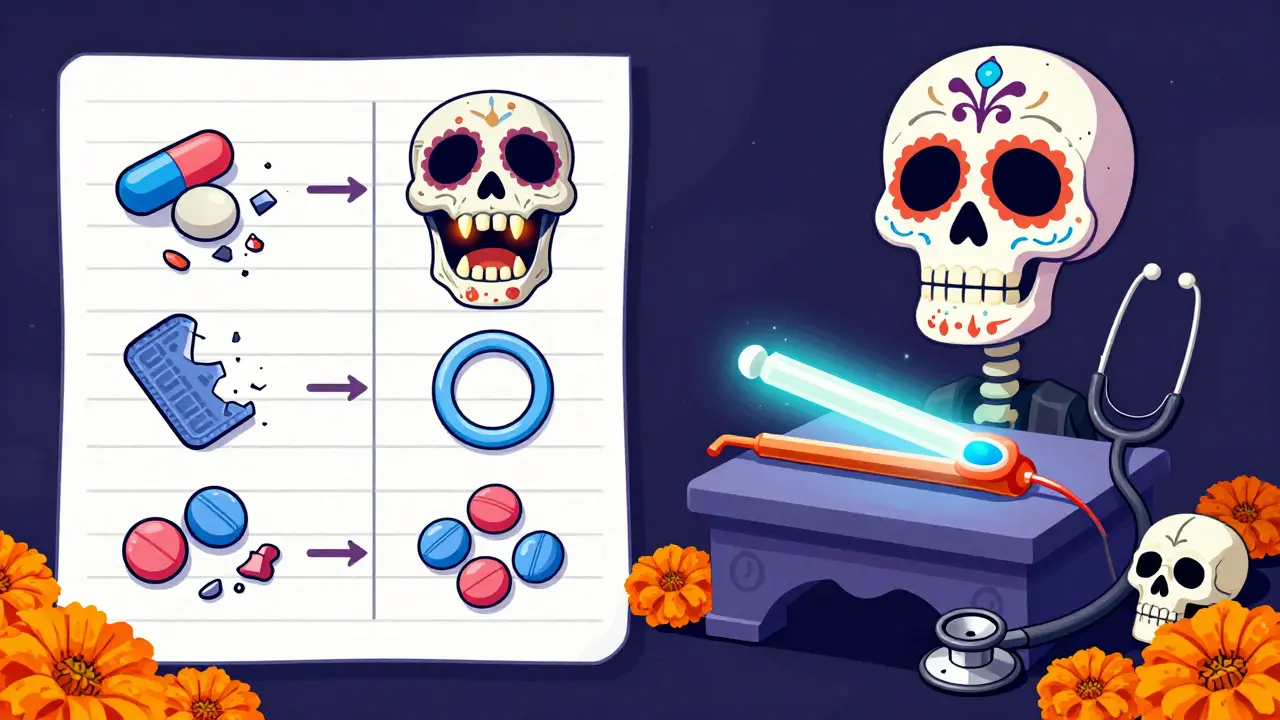
Emergency Contraception Isn’t Always Reliable
What if you have unprotected sex? Emergency contraception sounds like a backup-but it’s not foolproof either.
Levonorgestrel pills (Plan B, Next Choice) lose about half their effectiveness when taken with enzyme-inducing drugs. Ulipristal acetate (Ella) might not work at all. The CDC and ACOG both say: if you’re on carbamazepine, topiramate, or phenytoin, don’t rely on emergency pills. Go straight for a copper IUD. It’s the only emergency method proven to work without fail in this situation.
What About Lamotrigine?
Lamotrigine is a special case. It doesn’t break down birth control hormones-but birth control breaks it down. Estrogen in the pill or ring cuts lamotrigine levels by 50%. That means your seizure control could crumble. Then, when you take your pill-free week, lamotrigine spikes back up by 30-40%. That can cause dizziness, rashes, even seizures.
Women on lamotrigine need to avoid estrogen-containing methods. If you must use hormonal birth control, your doctor might need to double your lamotrigine dose. But even then, the interaction isn’t perfectly predictable. Many experts recommend skipping estrogen entirely and going with a progestin-only IUD or implant.

Why This Isn’t Just a Medical Issue-It’s a System Failure
Here’s the heartbreaking part: most women don’t know this is happening.
A 2022 survey by the Epilepsy Foundation found only 35% of women with epilepsy got counseling about contraceptive risks from their neurologist. Only 22% heard it from their gynecologist. That’s not negligence-it’s a gap in how care is divided. Neurologists focus on seizures. Gynecologists focus on contraception. No one connects the dots.
One Reddit user wrote: “I got pregnant on Ortho Tri-Cyclen while taking Tegretol despite perfect use-my neurologist never warned me.” That story isn’t rare. It’s systemic.
The FDA already requires drug labels to warn about these interactions. Tegretol’s packaging says: “Contraceptives containing estrogen or progestin may be ineffective when used concurrently with Tegretol.” But if patients don’t read labels-or if their doctors don’t talk about them-warnings mean nothing.
What Should You Do?
If you’re on anticonvulsants and need birth control:
- Know your drug. Is it carbamazepine, topiramate, phenytoin? Then your birth control is likely compromised.
- Don’t assume your pill works. Even if you’ve been on it for years, enzyme inducers can start affecting you at any time.
- Ask for an IUD. The levonorgestrel IUD or copper IUD are the gold standards. They’re long-lasting, highly effective, and immune to drug interactions.
- Get both specialists involved. Your neurologist and OB/GYN should talk. If they don’t, ask for a referral or bring your medication list to both appointments.
- Use backup. If you’re stuck with a pill, patch, or ring, use condoms every time. It’s not ideal-but it’s safer than nothing.
For women on lamotrigine: avoid estrogen. Talk to your doctor about adjusting your dose if you use progestin-only methods. And never stop your seizure meds without medical advice.
The Bigger Picture
This isn’t just about pregnancy. Women on enzyme-inducing anticonvulsants have a 30-40% higher risk of having a baby with major birth defects. That’s why preventing unintended pregnancy isn’t just about choice-it’s about safety. Every pregnancy in this group needs preconception planning, not last-minute decisions.
Newer anticonvulsants like perampanel (Fycompa) and brivaracetam (Briviact) don’t induce liver enzymes. That’s promising. But they’re not yet widely used. For now, the safest path is clear: skip the pill, get the IUD, and make sure your care team is talking.
There’s no shame in switching methods. No shame in asking for help. Your body deserves better than guesswork.
Can I still use the birth control pill if I take topiramate?
No, not reliably. Topiramate at doses over 200 mg/day cuts estrogen levels by up to 43%, making the pill ineffective. Even if you take it perfectly, your body isn’t getting enough hormone to prevent ovulation. The American College of Obstetricians and Gynecologists (ACOG) recommends avoiding combined hormonal contraceptives entirely if you’re on topiramate. Switch to a levonorgestrel IUD or copper IUD instead.
Does the birth control patch work better than the pill?
No. The patch (Ortho Evra) delivers hormones through the skin, but they still go through the liver for metabolism. If you’re on an enzyme-inducing anticonvulsant like carbamazepine or phenytoin, the patch is just as likely to fail as the pill. Studies show similar drops in hormone levels. Experts recommend avoiding it entirely. IUDs and implants are far safer.
Why doesn’t the Depo-Provera shot fail like the pill?
Because it delivers a very high dose of progestin-150 mg-directly into muscle every 12-13 weeks. Even if your liver breaks down half of it, there’s still enough left to stop ovulation. The pill gives you about 30 mcg of estrogen daily. That tiny amount gets wiped out by enzyme inducers. Depo-Provera’s high dose overwhelms the liver’s ability to break it down.
Is it safe to use emergency contraception like Plan B if I’m on carbamazepine?
Plan B (levonorgestrel) loses about half its effectiveness when taken with carbamazepine or other enzyme-inducing drugs. Studies show it’s not reliable. The CDC recommends using a copper IUD as emergency contraception instead. It’s the only method proven to work regardless of drug interactions. If you can’t get an IUD right away, take Plan B-but don’t assume it worked. Follow up with a pregnancy test in two weeks.
I’m on lamotrigine and want birth control. What should I do?
Avoid any birth control that contains estrogen-pills, patches, rings. Estrogen cuts lamotrigine levels by 50%, which can trigger seizures. The safest options are the levonorgestrel IUD, the implant, or Depo-Provera. If you must use a hormonal method, your doctor may need to increase your lamotrigine dose by 50-100%. Never adjust your dose on your own. Always coordinate with your neurologist.





There are 12 Comments
Mike Dubes
Zacharia Reda
Tobias Mösl
Ethan Zeeb
Darren Torpey
Lebogang kekana
Raman Kapri
Megan Nayak
Tildi Fletes
Betsy Silverman
Pankaj Gupta
Ivan Viktor
Write a comment
Your email address will not be published. Required fields are marked *