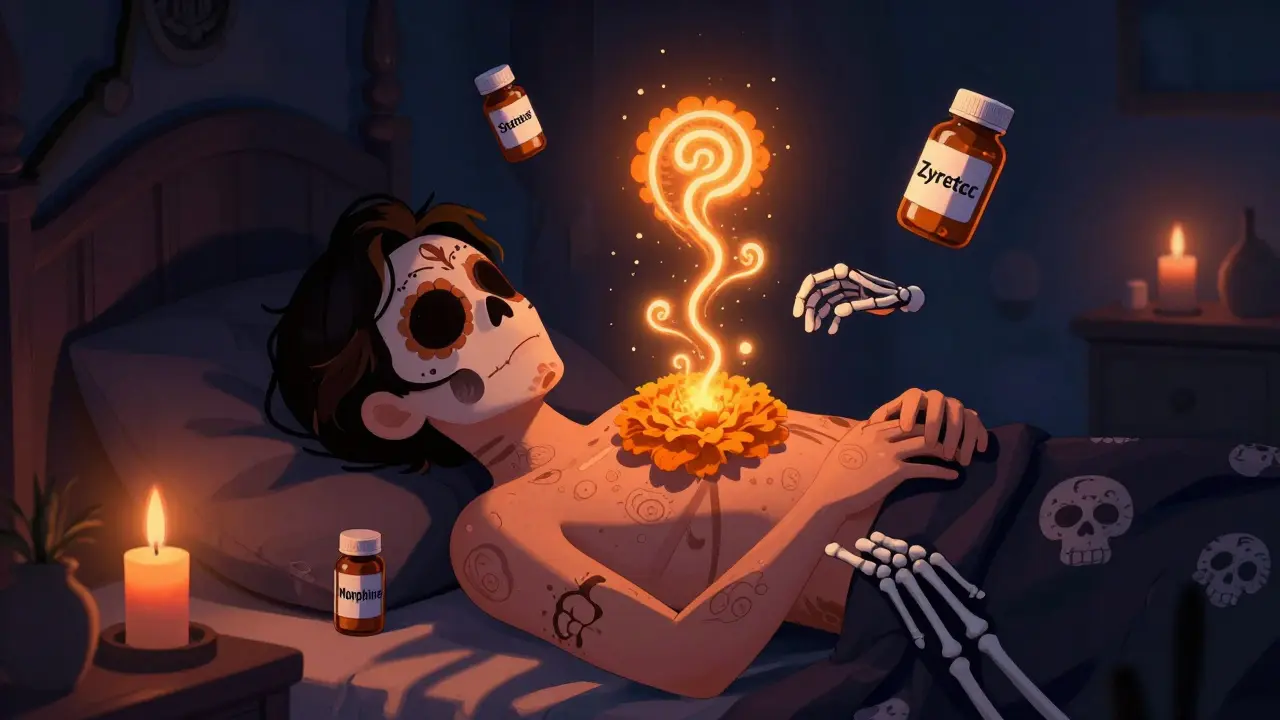
Itching from medication isn’t just a nuisance-it can be disabling. You take your pills as directed, but then your skin starts burning, tingling, or crawling. No rash. No bumps. Just relentless itch. If you’ve been there, you know how hard it is to sleep, focus, or even leave the house. And the worst part? Doctors often dismiss it as "dry skin" or "stress." But this isn’t normal. It’s drug-induced pruritus, and it’s more common than you think.
Why Do Medications Make You Itch?
Itching from drugs isn’t one thing. It’s a chain reaction. Some medications trigger histamine release, the same chemical your body uses in allergic reactions. Others mess with nerve signals in your skin, confuse your liver’s bile flow, or even irritate your nervous system directly. The result? Your brain gets a false signal: itch. Take opioids like morphine. Up to 90% of people get itchy after spinal injections-not because they’re allergic, but because the drug activates receptors in the spinal cord that trigger itch signals. Statins? About 1 in 100 people on these cholesterol drugs report severe itching, especially women and Black patients. And then there’s the weird one: stopping antihistamines like cetirizine or levocetirizine. After months or years of daily use, quitting cold turkey can cause itching so bad it leads to hospital visits or suicidal thoughts. The FDA confirmed 209 such cases between 2017 and 2023.Which Medications Are Most Likely to Cause Itching?
Some drugs are notorious for this side effect. Here’s what the data shows:- Antibiotics: Tetracyclines, penicillin, and sulfamethoxazole (Bactrim) are top offenders.
- High blood pressure meds: ACE inhibitors (like lisinopril) and calcium channel blockers (like amlodipine) can cause itching without swelling or rash.
- Statins and fibrates: Atorvastatin, simvastatin, fenofibrate-itching is one of the most common reasons people stop taking them.
- Antidepressants: Tricyclics like amitriptyline can trigger itch, especially in older adults.
- Antimalarials: Chloroquine causes intense itching in 55-90% of Black patients, often within hours of taking it.
- Antihistamines: Cetirizine (Zyrtec) and levocetirizine (Xyzal) are the most common culprits for withdrawal itching. The longer you’ve taken them, the worse the rebound.
- IV fluids: Hydroxyethyl starch, used in hospitals for low blood pressure, can cause itching that lasts over a year.
It’s not just the drug-it’s who’s taking it. Women are 70% more likely to develop drug-induced itching than men. Black patients are nearly twice as likely to react to certain drugs like chloroquine or statins. Age matters too: older adults on multiple medications have a higher risk of overlapping reactions.
How Do You Know It’s the Medicine?
Itching from drugs doesn’t always look like an allergy. No hives. No swelling. Just pure, unexplained itch. Here’s how to tell:- Did the itching start after you began a new drug? (Usually within days to weeks)
- Did it get worse after increasing the dose?
- Did it improve after stopping the drug-even if you didn’t think it was the cause?
- Does it come back if you restart the same drug?
For antihistamine withdrawal, the pattern is very specific: itching starts 1-5 days after the last pill. In 90% of cases, taking the same antihistamine again stops the itch within hours. That’s not an allergy-it’s dependence. Your body got used to the drug blocking itch signals, and when you stopped, the system went into overdrive.
Don’t wait for a rash. If you’re itchy and on any of the drugs listed above, suspect the medication-even if your doctor says it’s "unlikely." Patient reports to the FDA show that 87% of these cases came from people themselves, not doctors. You’re the first line of detection.
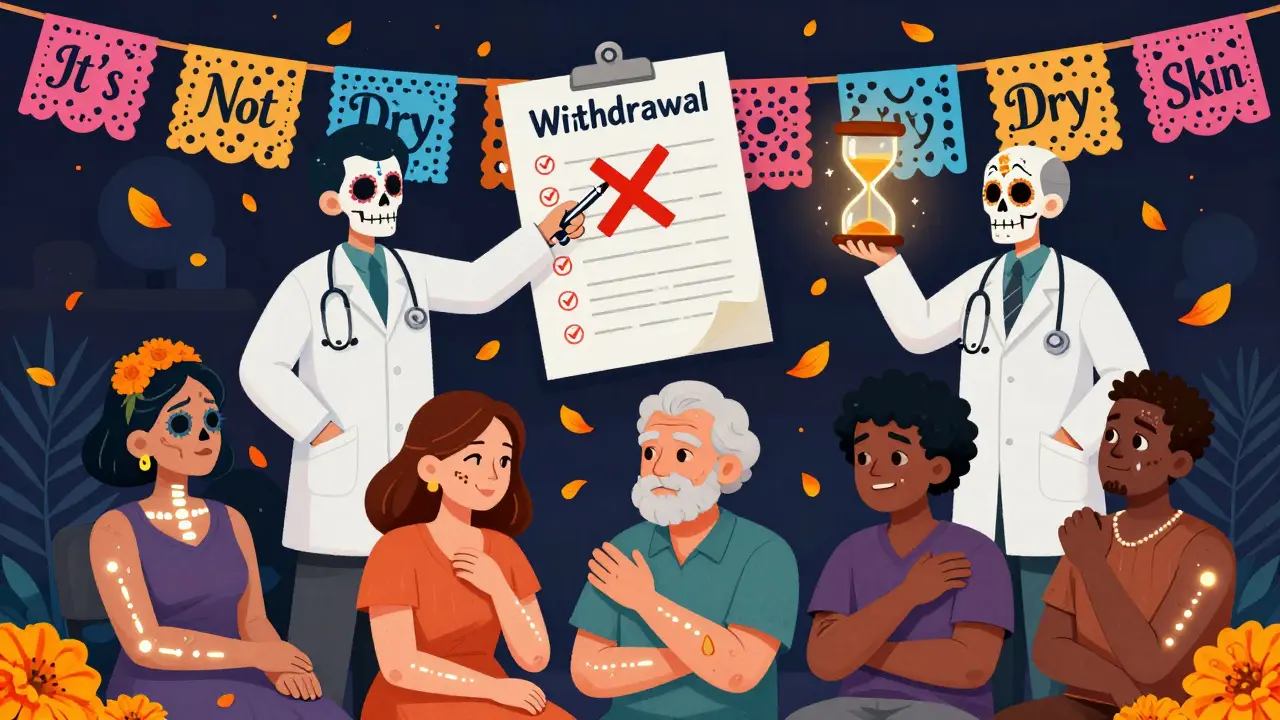
What Should You Do If You’re Itching from a Drug?
Step one: Don’t panic. Step two: Don’t quit cold turkey unless your doctor says so. Some meds, like blood pressure or seizure drugs, can be dangerous to stop suddenly.Here’s what works:
- Stop the drug (if safe): For non-essential meds like statins or antihistamines, stopping often clears the itch in days to weeks. Keep a symptom diary-note when it started, how bad it is, and what you were taking.
- Restart and taper: For antihistamine withdrawal, restarting the same drug (like Zyrtec) resolves itching in 9 out of 10 people. Then, slowly reduce the dose over weeks. About 38% of people who taper after restarting avoid the itch coming back.
- Try non-histamine treatments: If antihistamines don’t help (and they often don’t), your doctor might suggest gabapentin, naltrexone, or low-dose doxepin. These target nerve pathways, not histamine.
- Moisturize daily: Dry skin makes itching worse. Use fragrance-free creams like CeraVe or Vanicream right after showering. Cool compresses help too.
- Avoid triggers: Hot showers, wool clothing, and alcohol can make itch worse. Stick to lukewarm water and cotton clothes.
Topical steroids might help if your skin is inflamed from scratching, but they won’t fix the root cause. Capsaicin cream (from chili peppers) can retrain nerve endings, but it burns at first-only use it if you can tolerate the initial sting.
When to See a Doctor
Call your doctor if:- The itch lasts more than two weeks after stopping the drug
- You’re having trouble sleeping or functioning
- You feel anxious, depressed, or have thoughts of self-harm
- You’re on a drug you can’t stop (like blood pressure or heart meds)
Bring your full medication list-prescription, OTC, supplements, even herbal teas. Many cases are missed because no one thinks to check for interactions. Pharmacists are especially good at spotting these patterns. Ask for a med review.
What’s New in Treatment?
For years, doctors treated all itching like an allergy. That’s why antihistamines were the go-to-even though 70% of drug-induced itch doesn’t respond to them. New research shows that many cases involve non-histamine pathways: opioid receptors, serotonin, bile acids, or even immune cells in the skin.The FDA’s 2023 warning about antihistamine withdrawal was a turning point. For the first time, drug labels now include this risk. That means more doctors will recognize it. Clinical trials are now testing drugs like nemolizumab and dupilumab-originally for eczema-for severe drug-induced itch. Early results are promising.
Electronic health records are also helping. Johns Hopkins analyzed over a million patient records and found that itching from statins was 3x more common than previously thought. That kind of data is changing prescribing habits.
What You Can Do Right Now
If you’re itchy and on medication:- Write down every pill, supplement, and cream you use-name, dose, how long you’ve taken it.
- Rate your itch on a scale of 1 to 10, twice a day.
- Check if the itch started after a new drug or dose change.
- Don’t stop any meds without talking to your doctor.
- Ask: "Could this itching be from one of my drugs?"
- If you’re on Zyrtec or Xyzal and stopped recently, consider restarting for a few days to see if it helps.
Itching from meds isn’t in your head. It’s real, measurable, and treatable. You don’t have to suffer through it. With the right info and a little persistence, you can find relief-and get back to living without scratching.

There are 11 Comments
Jarrod Flesch
Man, I thought I was the only one who got this itch from Zyrtec. Stopped it cold turkey after 5 years and felt like my skin was crawling with ants for three weeks. No rash, no swelling-just pure, soul-crushing itch. I even called my doctor thinking I had scabies. Turns out, it’s a known thing now? Glad I’m not crazy. 😅
Barbara Mahone
Thank you for writing this. As someone who’s been dismissed by three different doctors as having "anxiety-related dermatitis," it’s validating to see the science laid out so clearly. The FDA data on antihistamine withdrawal is particularly compelling-and alarming.
Kelly McRainey Moore
My grandma was on lisinopril for 12 years and never said a word about the itching until she finally stopped it. Then she was like, "Oh, that’s why I couldn’t sleep." We all thought she was just getting older. This post should be mandatory reading for every geriatric patient.
Amber Lane
Statins made me itch like crazy. Stopped them. Itch vanished in 48 hours. My cardiologist said it was "probably coincidence." Nope.
Ashok Sakra
Bro this is why Big Pharma is hiding this!! They don't want you to know you can just stop taking pills and feel better!! They make billions off itching cream!! I heard they even inject itch into people in hospitals to sell more drugs!!
michelle Brownsea
Let me be perfectly clear: this is not a medical issue-it’s a systemic failure of pharmaceutical oversight, compounded by the medical establishment’s refusal to acknowledge patient-reported outcomes as legitimate data. The fact that the FDA had to wait for 209 documented cases before issuing a warning is unconscionable. And yet, here we are-still blaming patients for "not managing stress."
Malvina Tomja
Ugh. Another one of these "my meds made me itch" posts. Look, if you’re itchy, maybe you’re allergic to the *pill*-or maybe you’re just a hypochondriac who Googles symptoms at 3 a.m. I’ve been on 17 different meds in the last decade and never had a single itch. Coincidence? I think not.
Samuel Mendoza
Antihistamine withdrawal? More like your body got lazy. Stop taking drugs and your body should adapt-not throw a tantrum.
Steve Hesketh
Brother, I feel you. In Nigeria, we call this "spirit itch"-but now I know it’s science. My sister stopped her statin and cried for a week from the itch. She thought she was cursed. Now she’s back on a lower dose, tapering slow. You’re not alone. We got you.
shubham rathee
you know what causes itching more than meds? 5g of sugar a day and no sun. meds are just a distraction. the real problem is modern life. also why are you all so obsessed with pills? just go outside. eat real food. stop being so weak
Sangeeta Isaac
So let me get this straight… I’ve been taking Zyrtec for 8 years because my allergies were "bad," and now I’m supposed to believe the *drug itself* made me dependent on it to not feel like I’m being tickled by a thousand spiders? 😂 I’m not mad, I’m just… impressed. Like, who designed this trap? And why did no one warn me? Also, can we get a Zyrtec withdrawal support group? I need merch.
Write a comment
Your email address will not be published. Required fields are marked *